



 Chat with AI
Exam 20: Income Inequality and Poverty

Exam 1: Ten Principles of Economics455 Questions
Exam 2: Thinking Like an Economist643 Questions
Exam 3: Interdependence and the Gains From Trade547 Questions
Exam 4: The Market Forces of Supply and Demand693 Questions
Exam 5: Elasticity and Its Application626 Questions
Exam 6: Supply, Demand, and Government Policies668 Questions
Exam 7: Consumers, Producers, and the Efficiency of Markets547 Questions
Exam 8: Applications: the Costs of Taxation509 Questions
Exam 9: Application: International Trade521 Questions
Exam 10: Externalities543 Questions
Exam 11: Public Goods and Common Resources452 Questions
Exam 12: The Design of the Tax System664 Questions
Exam 13: The Costs of Production649 Questions
Exam 14: Firms in Competitive Markets604 Questions
Exam 15: Monopoly662 Questions
Exam 16: Monopolistic Competition649 Questions
Exam 17: Oligopoly522 Questions
Exam 18: The Markets for the Factors of Production592 Questions
Exam 19: Earnings and Discrimination511 Questions
Exam 20: Income Inequality and Poverty478 Questions
Exam 21: The Theory of Consumer Choice570 Questions
Exam 22: Frontiers in Microeconomics461 Questions
Exam 23: Measuring a Nation S Income547 Questions
Exam 24: Measuring the Cost of Living565 Questions
Exam 25: Production and Growth527 Questions
Exam 26: Saving, Investment, and the Financial System637 Questions
Exam 27: Tools of Finance534 Questions
Exam 28: Unemployment and Its Natural Rate701 Questions
Exam 29: The Monetary System540 Questions
Exam 30: Money Growth and Inflation504 Questions
Exam 31: Open-Economy Macroeconomics: Basic Concepts540 Questions
Exam 32: A Macroeconomic Theory of the Open Economy511 Questions
Exam 33: Aggregate Demand and Aggregate Supply572 Questions
Exam 34: The Influence of Monetary and Fiscal Policy on Aggregate Demand523 Questions
Exam 35: The Short-Run Tradeoff Between Inflation and Unemployment536 Questions
Exam 36: Six Debates Over Macroeconomic Policy354 Questions
Select questions type


Scenario 20-3
Suppose that a society is made up of five families whose incomes are as follows:
$120,000; $90,000; $30,000; $30,000; and $18,000.
The federal government is considering two potential income tax plans:
Plan A is a negative income tax plan where the taxes owed equal 1/3 of income minus $20,000.
Plan B is a two-tiered plan where families earning less than $35,000 pay no income tax and families earning more than $35,000 pay 10% of their income in taxes. The income tax revenue collected from those families earning over $35,000 is then redistributed equally to those families earning less than $35,000.
-Refer to Scenario 20-3. Assuming that utility is directly proportional to the cash value of after-tax income, which government policy would an advocate of utilitarianism prefer?
(Multiple Choice)
4.9/5  (88)
(88) Table 20-5
Distribution of Income in Umakastan 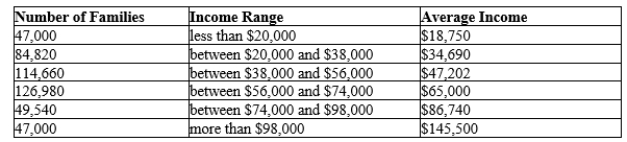 -Refer to Table 20-5. If the poverty rate in Umakastan is 10%, what is the poverty line?
 (Multiple Choice)
4.8/5 (77)
(77) An income distribution may not give an accurate picture of the standard of living for the poor because it does not include in-kind transfers.
(True/False)
4.8/5 (84)
(84) When incentives to earn income are distorted by income redistribution programs,
(Multiple Choice)
4.9/5 (89)
(89) The invisible hand of the marketplace acts to allocate resources
(Multiple Choice)
4.7/5 (91)
(91) The poverty rate is an absolute level of income set by the federal government for each family size. A family with income below this rate is deemed to be in poverty.
(True/False)
4.8/5 (83)
(83) If the government decided that each family needs a minimum income of $25,000 and promised to make up the difference between whatever a family earned and $25,000, which of the following is correct?
(Multiple Choice)
4.8/5 (76)
(76) The US government sets the poverty line equal to approximately
(Multiple Choice)
4.9/5 (79)
(79) Which of the following statements illustrates diminishing marginal utility?
(Multiple Choice)
4.7/5 (85)
(85) Temporary Assistance for Needy Families (TANF) is an example of a negative income tax program.
(True/False)
4.8/5 (78)
(78) When John F. Kennedy said, "A rising tide lifts all boats," to what was he referring?
(Multiple Choice)
4.9/5 (79)
(79) Table 20-13
Distribution of Income in Imagination  -Refer to Table 20-13. If the poverty rate in Imagination is 25%, in what income range on the table is the poverty line?
 (Short Answer)
4.9/5 (84)
(84) Liberalism aims to raise the welfare of the worst-off person in society. This rule is called the
(Multiple Choice)
4.9/5 (79)
(79) Table 20-1
The following table shows the distribution of income in Marysville. 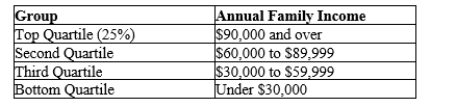 -Refer to Table 20-1. If the poverty line was $31,852, what would be the poverty rate?
 (Multiple Choice)
5.0/5 (84)
(84) Which political philosophy argues that the government should choose policies to maximize the total utility of everyone in society?
(Short Answer)
4.7/5 (72)
(72) According to the maximin criterion, income should be transferred from the rich to the poor as long as it
(Multiple Choice)
4.8/5 (72)
(72) Comparing the United States household income distribution to other countries is
(Multiple Choice)
4.9/5 (83)
(83) Figure 20-3 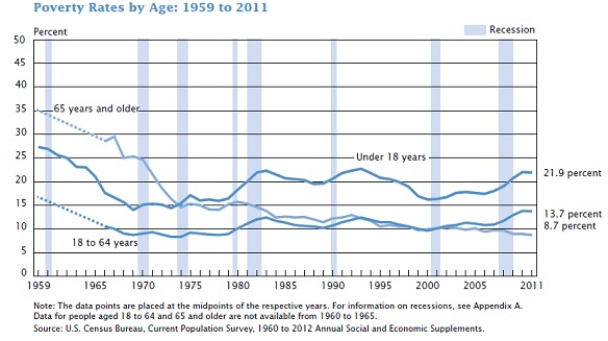 -Refer to Figure 20-3. In 2011, the percent of children under age 18 in poverty is
 (Multiple Choice)
4.9/5 (73)
(73) Table 20-8 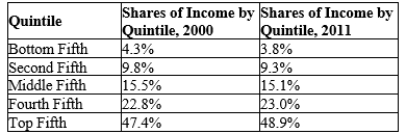 Source: U.S. Bureau of Census
-Refer to Table 20-8. In 2011, the bottom 40% of families has
Source: U.S. Bureau of Census
-Refer to Table 20-8. In 2011, the bottom 40% of families has (Multiple Choice)
4.7/5 (84)
(84) 
Filters
- Essay(0)
- Multiple Choice(0)
- Short Answer(0)
- True False(0)
- Matching(0)