



 Chat with AI
Exam 36: The Urinary System

Exam 1: An Introduction to Life on Earth91 Questions
Exam 2: Atoms, Molecules, and Life90 Questions
Exam 3: Biological Molecules98 Questions
Exam 4: Cell Structure and Function90 Questions
Exam 5: Cell Membrane Structure and Function96 Questions
Exam 6: Energy Flow in the Life of a Cell90 Questions
Exam 7: Capturing Solar Energy: Photosynthesis102 Questions
Exam 8: Harvesting Energy: Glycolysis and Cellular Respiration97 Questions
Exam 9: Cellular Reproduction133 Questions
Exam 10: Meiosis: the Basis of Sexual Reproduction104 Questions
Exam 11: Patterns of Inheritance98 Questions
Exam 12: DNA: The Molecule of Heredity97 Questions
Exam 13: Gene Expression and Regulation93 Questions
Exam 14: Biotechnology91 Questions
Exam 15: Principles of Evolution97 Questions
Exam 16: How Populations Evolve109 Questions
Exam 17: The Origin of Species89 Questions
Exam 18: The History of Life125 Questions
Exam 19: Systematics: Seeking Order Amid Diversity90 Questions
Exam 20: The Diversity of Prokaryotes and Viruses97 Questions
Exam 21: The Diversity of Protists102 Questions
Exam 22: The Diversity of Plants115 Questions
Exam 23: The Diversity of Fungi107 Questions
Exam 24: Animal Diversity I: Invertebrates101 Questions
Exam 25: Animal Diversity Ii: Vertebrates118 Questions
Exam 26: Animal Behavior116 Questions
Exam 27: Population Growth and Regulation114 Questions
Exam 28: Community Interactions125 Questions
Exam 29: Energy Flow and Nutrient Cycling in Ecosystems122 Questions
Exam 30: Earths Diverse Ecosystems126 Questions
Exam 31: Conserving Earths Biodiversity109 Questions
Exam 32: Homeostasis and the Organization of the Animal Body95 Questions
Exam 33: Circulation89 Questions
Exam 34: Respiration92 Questions
Exam 35: Nutrition and Digestion91 Questions
Exam 36: The Urinary System99 Questions
Exam 37: Defenses Against Disease104 Questions
Exam 38: Chemical Control of the Animal Body: the Endocrine System133 Questions
Exam 39: The Nervous System118 Questions
Exam 40: The Senses94 Questions
Exam 41: Action and Support: the Muscles and Skeleton90 Questions
Exam 42: Animal Reproduction120 Questions
Exam 43: Animal Development122 Questions
Exam 44: Plant Anatomy and Nutrient Transport95 Questions
Exam 45: Plant Reproduction and Development90 Questions
Exam 46: Plant Responses to the Environment87 Questions
Select questions type


How does drinking a lot of water affect ADH production and urine output?
(Essay)
5.0/5  (70)
(70) Nitrogenous waste products, such as urea and uric acid, are primarily formed because of the digestion of
(Multiple Choice)
4.9/5 (89)
(89) Most reabsorption takes place in what part of the tubule system in the kidney?
(Multiple Choice)
4.9/5 (83)
(83) Kidney failure or end-stage renal disease is most commonly associated with
(Multiple Choice)
4.9/5 (83)
(83) During reabsorption, organic nutrients and ions are moved by diffusion or active transport from the renal tubule into the
(Multiple Choice)
4.9/5 (85)
(85) Because there is a high concentration of salt in the interstitial fluid around the nephron loop, what happens to the filtrate as it flows through the descending limb?
(Essay)
4.9/5 (98)
(98) Explain why the process in the kidneys is called ʺfiltration.ʺ (What is acting as a ʺfilterʺ?))
(Essay)
4.8/5 (85)
(85) An average hemodialysis session usually lasts 4 hours and occurs about
(Multiple Choice)
5.0/5 (99)
(99) Which of the following is (are) produced by the kidney and is (are) important in the regulation of blood pressure?
(Multiple Choice)
4.9/5 (65)
(65) Based on your knowledge of the differences between the male and female urinary systems, why are females at greater risk of bladder infections?
(Essay)
4.9/5 (78)
(78) How much urine does the average adult human excrete per day?
(Multiple Choice)
4.8/5 (70)
(70) The composition of urine varies to help maintain homeostasis within the body. With this in mind, which of the following would you NOT expect to find in the urine of a healthy individual?
(Multiple Choice)
4.7/5 (78)
(78) Filtration of the blood occurs when fluid is forced by blood pressure out of the
(Multiple Choice)
4.8/5 (74)
(74) Which of the following explains why a sample of the filtrate taken from the proximal tubule is NOT ideal for conducting a drug test or toxicology screen?
(Multiple Choice)
4.8/5 (82)
(82) According to the illustration, blood entering which structure will undergo no further modification by the nephron? 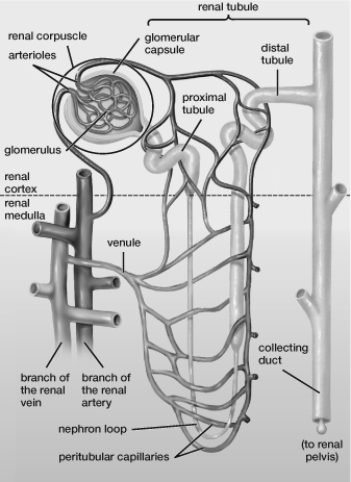
(Multiple Choice)
4.9/5 (91)
(91) Which of the following describes the role of urinary systems in maintaining cellular homeostasis?
(Multiple Choice)
4.8/5 (83)
(83) Which of the following nitrogenous waste products is the least toxic, but requires the most energy to produce?
(Multiple Choice)
4.7/5 (83)
(83) 
Filters
- Essay(0)
- Multiple Choice(0)
- Short Answer(0)
- True False(0)
- Matching(0)