



 Chat with AI
Exam 37: Defenses Against Disease

Exam 1: An Introduction to Life on Earth91 Questions
Exam 2: Atoms, Molecules, and Life90 Questions
Exam 3: Biological Molecules98 Questions
Exam 4: Cell Structure and Function90 Questions
Exam 5: Cell Membrane Structure and Function96 Questions
Exam 6: Energy Flow in the Life of a Cell90 Questions
Exam 7: Capturing Solar Energy: Photosynthesis102 Questions
Exam 8: Harvesting Energy: Glycolysis and Cellular Respiration97 Questions
Exam 9: Cellular Reproduction133 Questions
Exam 10: Meiosis: the Basis of Sexual Reproduction104 Questions
Exam 11: Patterns of Inheritance98 Questions
Exam 12: DNA: The Molecule of Heredity97 Questions
Exam 13: Gene Expression and Regulation93 Questions
Exam 14: Biotechnology91 Questions
Exam 15: Principles of Evolution97 Questions
Exam 16: How Populations Evolve109 Questions
Exam 17: The Origin of Species89 Questions
Exam 18: The History of Life125 Questions
Exam 19: Systematics: Seeking Order Amid Diversity90 Questions
Exam 20: The Diversity of Prokaryotes and Viruses97 Questions
Exam 21: The Diversity of Protists102 Questions
Exam 22: The Diversity of Plants115 Questions
Exam 23: The Diversity of Fungi107 Questions
Exam 24: Animal Diversity I: Invertebrates101 Questions
Exam 25: Animal Diversity Ii: Vertebrates118 Questions
Exam 26: Animal Behavior116 Questions
Exam 27: Population Growth and Regulation114 Questions
Exam 28: Community Interactions125 Questions
Exam 29: Energy Flow and Nutrient Cycling in Ecosystems122 Questions
Exam 30: Earths Diverse Ecosystems126 Questions
Exam 31: Conserving Earths Biodiversity109 Questions
Exam 32: Homeostasis and the Organization of the Animal Body95 Questions
Exam 33: Circulation89 Questions
Exam 34: Respiration92 Questions
Exam 35: Nutrition and Digestion91 Questions
Exam 36: The Urinary System99 Questions
Exam 37: Defenses Against Disease104 Questions
Exam 38: Chemical Control of the Animal Body: the Endocrine System133 Questions
Exam 39: The Nervous System118 Questions
Exam 40: The Senses94 Questions
Exam 41: Action and Support: the Muscles and Skeleton90 Questions
Exam 42: Animal Reproduction120 Questions
Exam 43: Animal Development122 Questions
Exam 44: Plant Anatomy and Nutrient Transport95 Questions
Exam 45: Plant Reproduction and Development90 Questions
Exam 46: Plant Responses to the Environment87 Questions
Select questions type


Would you expect someone with AIDS to have inflammation and/or a fever in response to an infection?

Free
(Multiple Choice)
4.9/5  (68)
(68) Correct Answer: Verified
D
Based on this figure, when does the maximum immune response occur? 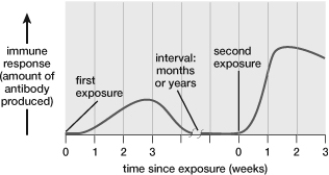
Free
(Multiple Choice)
4.8/5 (93)
(93) Correct Answer:Verified
VerifiedA
Which of these are immune cells produced by the bone marrow?
Free
(Multiple Choice)
4.8/5 (91)
(91) Correct Answer:Verified
VerifiedD
Triclosan is a common antibiotic used in antiperspirants, toothpastes, and antibacterial soaps. You are a doctor studying the evolution of bacterial resistance to triclosan. You need to find a population of nonresistant bacteria. Where should you look?
(Multiple Choice)
4.7/5 (64)
(64) A student athlete suffered an injury while playing softball and subsequently has pain in her shoulder. Her doctor prescribes cortisone, a strong anti-inflammatory steroid. When filling the prescription, the pharmacist warns her that an increased risk of contracting a bacterial infection, such as pneumonia, is associated with the use of steroids. Based on your knowledge of the immune system and on the information in this scenario, what do you conclude about anti-inflammatory steroids?
(Multiple Choice)
4.8/5 (83)
(83) These white blood cells kill virus-infected cells exhibiting ʺnon-selfʺ major histocompatibility complex (MHC) proteins.
(Multiple Choice)
4.8/5 (85)
(85) Which of the following antibody types is the most common in the blood, lymph, and interstitial fluid?
(Multiple Choice)
4.8/5 (73)
(73) As a doctor, you discover a new virus that prevents the body from creating memory cells. Based on what you know about human defenses against disease, you predict that this virus is infecting and destroying which type of white blood cell?
(Multiple Choice)
5.0/5 (87)
(87) Vertebrate and invertebrate immune systems are similar in that their first line of defense is a nonspecific external barrier; however, they differ in that invertebrates do not produce white blood cells.
(True/False)
4.8/5 (80)
(80) Cells that produce antibodies and provide future immunity against similar pathogens are
(Multiple Choice)
4.8/5 (69)
(69) When Europeans first came to North America, one of the most disastrous impacts on native populations was the introduction of ʺOld World diseases.ʺ These diseases, such as smallpox, influenza, and plague, devastated the Native American population as the number of settlers grew steadily. One author has called this ʺthe greatest human catastrophe in history, far exceeding . . . the Black Death of Medieval Europe.ʺ Based on this scenario and what you know about the immune system, what can you conclude about the Native American and European populations?
(Multiple Choice)
4.9/5 (84)
(84) 
Filters
- Essay(0)
- Multiple Choice(0)
- Short Answer(0)
- True False(0)
- Matching(0)