



 Chat with AI
Exam 39: The Nervous System

Exam 1: An Introduction to Life on Earth91 Questions
Exam 2: Atoms, Molecules, and Life90 Questions
Exam 3: Biological Molecules98 Questions
Exam 4: Cell Structure and Function90 Questions
Exam 5: Cell Membrane Structure and Function96 Questions
Exam 6: Energy Flow in the Life of a Cell90 Questions
Exam 7: Capturing Solar Energy: Photosynthesis102 Questions
Exam 8: Harvesting Energy: Glycolysis and Cellular Respiration97 Questions
Exam 9: Cellular Reproduction133 Questions
Exam 10: Meiosis: the Basis of Sexual Reproduction104 Questions
Exam 11: Patterns of Inheritance98 Questions
Exam 12: DNA: The Molecule of Heredity97 Questions
Exam 13: Gene Expression and Regulation93 Questions
Exam 14: Biotechnology91 Questions
Exam 15: Principles of Evolution97 Questions
Exam 16: How Populations Evolve109 Questions
Exam 17: The Origin of Species89 Questions
Exam 18: The History of Life125 Questions
Exam 19: Systematics: Seeking Order Amid Diversity90 Questions
Exam 20: The Diversity of Prokaryotes and Viruses97 Questions
Exam 21: The Diversity of Protists102 Questions
Exam 22: The Diversity of Plants115 Questions
Exam 23: The Diversity of Fungi107 Questions
Exam 24: Animal Diversity I: Invertebrates101 Questions
Exam 25: Animal Diversity Ii: Vertebrates118 Questions
Exam 26: Animal Behavior116 Questions
Exam 27: Population Growth and Regulation114 Questions
Exam 28: Community Interactions125 Questions
Exam 29: Energy Flow and Nutrient Cycling in Ecosystems122 Questions
Exam 30: Earths Diverse Ecosystems126 Questions
Exam 31: Conserving Earths Biodiversity109 Questions
Exam 32: Homeostasis and the Organization of the Animal Body95 Questions
Exam 33: Circulation89 Questions
Exam 34: Respiration92 Questions
Exam 35: Nutrition and Digestion91 Questions
Exam 36: The Urinary System99 Questions
Exam 37: Defenses Against Disease104 Questions
Exam 38: Chemical Control of the Animal Body: the Endocrine System133 Questions
Exam 39: The Nervous System118 Questions
Exam 40: The Senses94 Questions
Exam 41: Action and Support: the Muscles and Skeleton90 Questions
Exam 42: Animal Reproduction120 Questions
Exam 43: Animal Development122 Questions
Exam 44: Plant Anatomy and Nutrient Transport95 Questions
Exam 45: Plant Reproduction and Development90 Questions
Exam 46: Plant Responses to the Environment87 Questions
Select questions type


At a chemical synapse, the presynaptic and postsynaptic neurons touch and chemicals are exchanged through gap junctions.

Free
(True/False)
4.9/5  (72)
(72) Correct Answer: Verified
False
Sensory information processing as well as the direction of voluntary movements are carried out by the
Free
(Multiple Choice)
4.7/5 (74)
(74) Correct Answer:Verified
VerifiedB
If a bone fragment resulting from a broken nose pushed against the olfactory (smell) nerve, triggering an action potential, the person would
Free
(Multiple Choice)
4.9/5 (92)
(92) Correct Answer:Verified
VerifiedA
While walking barefoot along the beach, you step on a shard of glass and reflexively lift your injured foot. Which path did the reflex to lift your foot take?
(Multiple Choice)
4.8/5 (83)
(83) Individuals diagnosed with Huntington?s disease exhibit abnormal involuntary movements due to deterioration of the__________ .
(Short Answer)
4.8/5 (69)
(69) Neurons release chemicals known as__________ into a synapse to convey signals to adjacent cells.
(Short Answer)
4.8/5 (87)
(87) A diffuse nerve net would be found in which of the following animals?
(Multiple Choice)
4.8/5 (77)
(77) A(n) __________postsynaptic potential is initiated when neurotransmitter binding to receptor proteins causes the postsynaptic neuron to become less negative.
(Short Answer)
4.9/5 (90)
(90) Activity of the neurotransmitter acetylcholine is brief because it
(Multiple Choice)
4.9/5 (71)
(71) The __________is a cluster of neurons that plays a role in wake-sleep cycles, muscle tone, emotions, and some reflexes.
(Short Answer)
4.9/5 (80)
(80) Which portion of the neuron typically receives information?
(Multiple Choice)
4.9/5 (85)
(85) When you hear a loud noise, you immediately turn your head and direct your eyes toward the sound. Which region of the brain directs this reflexive movement of your eyes?
(Multiple Choice)
4.9/5 (73)
(73) Marta has been having terrible headaches. Now her hand feels like it is being gripped even though it is not actually being touched. Sheʹs also having a hard time interpreting sensations. For example, she blistered her hand on a hot pan because she interpreted the heat sensation as cold. Which portion of Martaʹs brain is most likely damaged?
(Multiple Choice)
5.0/5 (85)
(85) Nicotine affects neurotransmission by causing more action potentials in the presynaptic neuron and by causing more neurotransmitter to be released per vesicle. This means your postsynaptic neurons
(Multiple Choice)
4.9/5 (89)
(89) 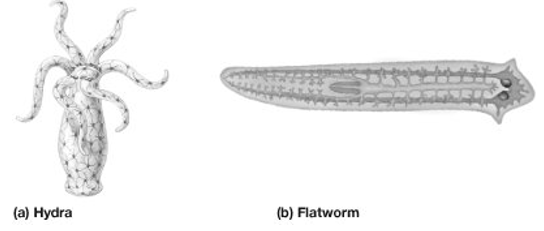 -What type of nervous system does the flatworm exhibit?
Sensations of fear, pleasure, and sexual arousal are produced by the
(Multiple Choice)
4.8/5 (91)
(91) Sympathetic and parasympathetic nervous system responses usually oppose each other.
(True/False)
4.9/5 (87)
(87) The integration of excitatory postsynaptic potentials (EPSPs) and inhibitory postsynaptic potentials (IPSPs) received by a postsynaptic neuron determines its activity.
(True/False)
4.8/5 (80)
(80) Damage to the right frontal cortex may produce paralysis on the__________side of the body.
(Multiple Choice)
4.9/5 (69)
(69) 
Filters
- Essay(0)
- Multiple Choice(0)
- Short Answer(0)
- True False(0)
- Matching(0)