



 Chat with AI
Exam 39: The Nervous System

Exam 1: An Introduction to Life on Earth91 Questions
Exam 2: Atoms, Molecules, and Life90 Questions
Exam 3: Biological Molecules98 Questions
Exam 4: Cell Structure and Function90 Questions
Exam 5: Cell Membrane Structure and Function96 Questions
Exam 6: Energy Flow in the Life of a Cell90 Questions
Exam 7: Capturing Solar Energy: Photosynthesis102 Questions
Exam 8: Harvesting Energy: Glycolysis and Cellular Respiration97 Questions
Exam 9: Cellular Reproduction133 Questions
Exam 10: Meiosis: the Basis of Sexual Reproduction104 Questions
Exam 11: Patterns of Inheritance98 Questions
Exam 12: DNA: The Molecule of Heredity97 Questions
Exam 13: Gene Expression and Regulation93 Questions
Exam 14: Biotechnology91 Questions
Exam 15: Principles of Evolution97 Questions
Exam 16: How Populations Evolve109 Questions
Exam 17: The Origin of Species89 Questions
Exam 18: The History of Life125 Questions
Exam 19: Systematics: Seeking Order Amid Diversity90 Questions
Exam 20: The Diversity of Prokaryotes and Viruses97 Questions
Exam 21: The Diversity of Protists102 Questions
Exam 22: The Diversity of Plants115 Questions
Exam 23: The Diversity of Fungi107 Questions
Exam 24: Animal Diversity I: Invertebrates101 Questions
Exam 25: Animal Diversity Ii: Vertebrates118 Questions
Exam 26: Animal Behavior116 Questions
Exam 27: Population Growth and Regulation114 Questions
Exam 28: Community Interactions125 Questions
Exam 29: Energy Flow and Nutrient Cycling in Ecosystems122 Questions
Exam 30: Earths Diverse Ecosystems126 Questions
Exam 31: Conserving Earths Biodiversity109 Questions
Exam 32: Homeostasis and the Organization of the Animal Body95 Questions
Exam 33: Circulation89 Questions
Exam 34: Respiration92 Questions
Exam 35: Nutrition and Digestion91 Questions
Exam 36: The Urinary System99 Questions
Exam 37: Defenses Against Disease104 Questions
Exam 38: Chemical Control of the Animal Body: the Endocrine System133 Questions
Exam 39: The Nervous System118 Questions
Exam 40: The Senses94 Questions
Exam 41: Action and Support: the Muscles and Skeleton90 Questions
Exam 42: Animal Reproduction120 Questions
Exam 43: Animal Development122 Questions
Exam 44: Plant Anatomy and Nutrient Transport95 Questions
Exam 45: Plant Reproduction and Development90 Questions
Exam 46: Plant Responses to the Environment87 Questions
Select questions type


The more frequently an action potential is triggered by a stimulus, the greater the intensity of the sensation.
(True/False)
4.8/5  (80)
(80) Aliceʹs PET (positron emission tomography) scan shows a large red area in the occipital lobe when taken while Alice is looking at color images. Which of the following is TRUE about Aliceʹs PET scan?
(Multiple Choice)
4.9/5 (73)
(73) The dorsal root ganglia of the spinal cord contain cell bodies of __________neurons.
(Short Answer)
4.7/5 (76)
(76) A person you know has been in an automobile accident. The accident caused a dramatic personality change. Before the accident, he was industrious and well liked; after the accident, he is profane, impetuous, and incapable of working toward a goal. Which portion of the brain was most likely damaged?
(Multiple Choice)
4.8/5 (79)
(79) To survive the winter, some birds, such as the black-capped chickadee, must locate caches of seeds it buries each fall. Which region of the brain allows the birds to remember the exact locations of these stashes?
(Multiple Choice)
4.9/5 (96)
(96) Dolphins use echolocation to maneuver around objects quickly and precisely to capture prey. Thus, you would expect them to have a larger -than-normal
(Multiple Choice)
4.9/5 (76)
(76) The __________is a cluster of neurons that plays a role in wake-sleep cycles, muscle tone, emotions, and some reflexes.
(Multiple Choice)
4.8/5 (74)
(74) The part of a neuron that contains a nucleus and other organelles typical of cells is the__________.
(Short Answer)
5.0/5 (78)
(78) People with multiple sclerosis develop areas in which the myelin sheath on their neurons has disintegrated. This disease often results in paralysis and extreme weakness. Using what you know about the myelin sheath, explain why these symptoms might occur.
(Essay)
4.7/5 (90)
(90) In an unstimulated neuron, the plasma membrane is most permeable to ions.
(Multiple Choice)
4.9/5 (75)
(75) 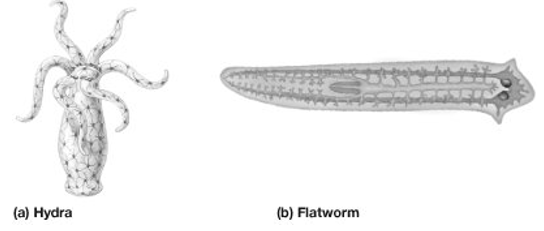 -What type of nervous system is exhibited by the hydra?
Which of the following does NOT describe the autonomic nervous system?
(Multiple Choice)
4.8/5 (87)
(87) The stronger the stimulus, the more powerful the action potential.
(True/False)
4.8/5 (87)
(87) Which of the following is part of the peripheral nervous system?
(Multiple Choice)
4.7/5 (90)
(90) At the synapse, some neurotransmitters open ion channels that make the interior of the postsynaptic neuron more negative. Thus, these neurotransmitters produce a(n) __________postsynaptic potential (IPSP).
(Multiple Choice)
5.0/5 (62)
(62) Glutamate is the major excitatory neurotransmitter in the brain. Which drug produces a relaxing effect by blocking the receptors for glutamate?
(Multiple Choice)
4.8/5 (87)
(87) 
Filters
- Essay(0)
- Multiple Choice(0)
- Short Answer(0)
- True False(0)
- Matching(0)