



 Chat with AI
Exam 2: Atoms, Molecules, and Life

Exam 1: An Introduction to Life on Earth91 Questions
Exam 2: Atoms, Molecules, and Life90 Questions
Exam 3: Biological Molecules98 Questions
Exam 4: Cell Structure and Function90 Questions
Exam 5: Cell Membrane Structure and Function96 Questions
Exam 6: Energy Flow in the Life of a Cell90 Questions
Exam 7: Capturing Solar Energy: Photosynthesis102 Questions
Exam 8: Harvesting Energy: Glycolysis and Cellular Respiration97 Questions
Exam 9: Cellular Reproduction133 Questions
Exam 10: Meiosis: the Basis of Sexual Reproduction104 Questions
Exam 11: Patterns of Inheritance98 Questions
Exam 12: DNA: The Molecule of Heredity97 Questions
Exam 13: Gene Expression and Regulation93 Questions
Exam 14: Biotechnology91 Questions
Exam 15: Principles of Evolution97 Questions
Exam 16: How Populations Evolve109 Questions
Exam 17: The Origin of Species89 Questions
Exam 18: The History of Life125 Questions
Exam 19: Systematics: Seeking Order Amid Diversity90 Questions
Exam 20: The Diversity of Prokaryotes and Viruses97 Questions
Exam 21: The Diversity of Protists102 Questions
Exam 22: The Diversity of Plants115 Questions
Exam 23: The Diversity of Fungi107 Questions
Exam 24: Animal Diversity I: Invertebrates101 Questions
Exam 25: Animal Diversity Ii: Vertebrates118 Questions
Exam 26: Animal Behavior116 Questions
Exam 27: Population Growth and Regulation114 Questions
Exam 28: Community Interactions125 Questions
Exam 29: Energy Flow and Nutrient Cycling in Ecosystems122 Questions
Exam 30: Earths Diverse Ecosystems126 Questions
Exam 31: Conserving Earths Biodiversity109 Questions
Exam 32: Homeostasis and the Organization of the Animal Body95 Questions
Exam 33: Circulation89 Questions
Exam 34: Respiration92 Questions
Exam 35: Nutrition and Digestion91 Questions
Exam 36: The Urinary System99 Questions
Exam 37: Defenses Against Disease104 Questions
Exam 38: Chemical Control of the Animal Body: the Endocrine System133 Questions
Exam 39: The Nervous System118 Questions
Exam 40: The Senses94 Questions
Exam 41: Action and Support: the Muscles and Skeleton90 Questions
Exam 42: Animal Reproduction120 Questions
Exam 43: Animal Development122 Questions
Exam 44: Plant Anatomy and Nutrient Transport95 Questions
Exam 45: Plant Reproduction and Development90 Questions
Exam 46: Plant Responses to the Environment87 Questions
Select questions type


The chemical properties of an element are determined by the number of _________in its outermost energy shell.

Free
(Short Answer)
4.9/5  (71)
(71) Correct Answer: Verified
electrons
What determines the cohesiveness of water molecules?
Free
(Multiple Choice)
4.8/5 (77)
(77) Correct Answer:Verified
VerifiedA
A substance with specific properties that cannot be broken down or converted into another substance is called a(n)
Free
(Multiple Choice)
4.8/5 (75)
(75) Correct Answer:Verified
VerifiedC
Which of the following best explains why a particular atom may not form compounds easily?
(Multiple Choice)
4.9/5 (84)
(84) Which of the following results from a transfer of electron(s) between atoms (e.g., NaCl)?
(Multiple Choice)
4.8/5 (61)
(61) Iron is an important element in human body cells. If iron has an atomic number of 26, what does this tell you about this element?
(Multiple Choice)
4.7/5 (76)
(76) If a certain atom has a tendency to lose two electrons, that atom can then become a(n)
(Multiple Choice)
4.8/5 (83)
(83) Unlike a rock, a reptile can sit in the hot sunshine without its body temperature soaring quickly. This is because the water in its body
(Multiple Choice)
5.0/5 (88)
(88) Which of these atoms would become inert if it accepted three electrons? 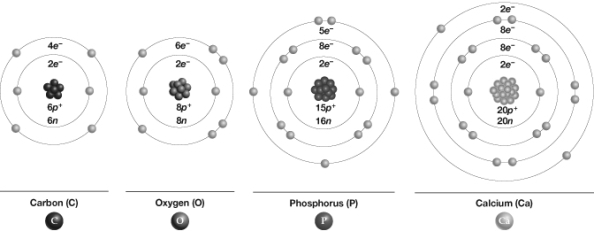
(Multiple Choice)
4.7/5 (78)
(78) When the acidic level of human blood increases, how is the proper balance of hydrogen ions (H +) restored?
(Multiple Choice)
4.8/5 (91)
(91) The fact that salt dissolves in water is best explained by the
(Multiple Choice)
4.9/5 (69)
(69) Your friend does a belly flop into a swimming pool. The stinging pain he feels is most likely due to the
(Multiple Choice)
4.9/5 (89)
(89) Imagine that you have been hired as a chemist and your first task is to examine a newly discovered atom. The paperwork you are given states that its atomic number is 110. What does this mean?
(Multiple Choice)
4.7/5 (93)
(93) Ions and polar molecules that are electrically attracted to water molecules are_________ .
(Short Answer)
4.8/5 (72)
(72) 
Filters
- Essay(0)
- Multiple Choice(0)
- Short Answer(0)
- True False(0)
- Matching(0)