



 Chat with AI
Exam 27: Population Growth and Regulation

Exam 1: An Introduction to Life on Earth91 Questions
Exam 2: Atoms, Molecules, and Life90 Questions
Exam 3: Biological Molecules98 Questions
Exam 4: Cell Structure and Function90 Questions
Exam 5: Cell Membrane Structure and Function96 Questions
Exam 6: Energy Flow in the Life of a Cell90 Questions
Exam 7: Capturing Solar Energy: Photosynthesis102 Questions
Exam 8: Harvesting Energy: Glycolysis and Cellular Respiration97 Questions
Exam 9: Cellular Reproduction133 Questions
Exam 10: Meiosis: the Basis of Sexual Reproduction104 Questions
Exam 11: Patterns of Inheritance98 Questions
Exam 12: DNA: The Molecule of Heredity97 Questions
Exam 13: Gene Expression and Regulation93 Questions
Exam 14: Biotechnology91 Questions
Exam 15: Principles of Evolution97 Questions
Exam 16: How Populations Evolve109 Questions
Exam 17: The Origin of Species89 Questions
Exam 18: The History of Life125 Questions
Exam 19: Systematics: Seeking Order Amid Diversity90 Questions
Exam 20: The Diversity of Prokaryotes and Viruses97 Questions
Exam 21: The Diversity of Protists102 Questions
Exam 22: The Diversity of Plants115 Questions
Exam 23: The Diversity of Fungi107 Questions
Exam 24: Animal Diversity I: Invertebrates101 Questions
Exam 25: Animal Diversity Ii: Vertebrates118 Questions
Exam 26: Animal Behavior116 Questions
Exam 27: Population Growth and Regulation114 Questions
Exam 28: Community Interactions125 Questions
Exam 29: Energy Flow and Nutrient Cycling in Ecosystems122 Questions
Exam 30: Earths Diverse Ecosystems126 Questions
Exam 31: Conserving Earths Biodiversity109 Questions
Exam 32: Homeostasis and the Organization of the Animal Body95 Questions
Exam 33: Circulation89 Questions
Exam 34: Respiration92 Questions
Exam 35: Nutrition and Digestion91 Questions
Exam 36: The Urinary System99 Questions
Exam 37: Defenses Against Disease104 Questions
Exam 38: Chemical Control of the Animal Body: the Endocrine System133 Questions
Exam 39: The Nervous System118 Questions
Exam 40: The Senses94 Questions
Exam 41: Action and Support: the Muscles and Skeleton90 Questions
Exam 42: Animal Reproduction120 Questions
Exam 43: Animal Development122 Questions
Exam 44: Plant Anatomy and Nutrient Transport95 Questions
Exam 45: Plant Reproduction and Development90 Questions
Exam 46: Plant Responses to the Environment87 Questions
Select questions type


When mosquitoes are abundant, purple martins flock to the area and feed exclusively on them. When mosquito populations are not large, purple martins are similarly scarce and feed on other insects. This is an example of

Free
(Multiple Choice)
5.0/5  (86)
(86) Correct Answer: Verified
E
Which species has the highest biotic potential?
Free
(Multiple Choice)
4.8/5 (77)
(77) Correct Answer:Verified
VerifiedB
What is the term for regular population cycles of rapid growth followed by massive die-off?
Free
(Short Answer)
4.9/5 (89)
(89) Correct Answer:Verified
Verifiedboom-and-bust cycles
All members of a species that reside within an ecosystem make up a(n)
(Multiple Choice)
4.9/5 (66)
(66) Why do many non-native species, such as a prickly pear cactus brought to Australia from South America, rapidly become abundant when first introduced?
(Multiple Choice)
4.9/5 (68)
(68) Predation is considered a density-dependent factor that controls the population size of prey species. Give two examples of predators acting in density-dependent ways in response to fluctuations in the size of prey populations.
(Essay)
4.7/5 (84)
(84) Write an equation that describes a situation in which a population remains stable.
(Essay)
4.9/5 (64)
(64) An insect population grows exponentially until an early winter freeze kills almost all of the insects. The next spring, the population grows exponentially again. This type of population growth is called
(Multiple Choice)
4.8/5 (75)
(75) In countries that have large numbers of children under age 15, the population is
(Multiple Choice)
4.8/5 (77)
(77) According to the equation for population growth rate, if two populations have the same death rates, then the population with r = 2 will increase more rapidly than a population with r = 4.
(True/False)
4.9/5 (79)
(79) Increased population densities and increased competition lead to increased emigration.
(True/False)
4.9/5 (74)
(74) 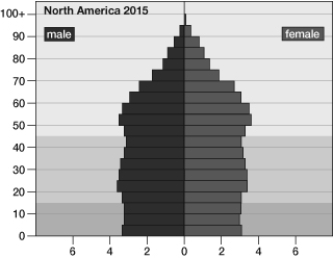
A small country begins to experience stable economic prosperity after centuries of extreme poverty. The government uses the taxes generated for educating all members of the population and creating a comprehensive health care system for all of its citizens. A social security system is established to support elderly members of the population. What demographic changes would you expect to see?
(Multiple Choice)
5.0/5 (62)
(62) 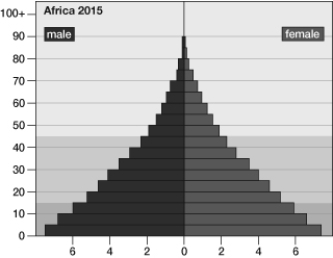
Based on the data in the table, this population has a_________ growth pattern. 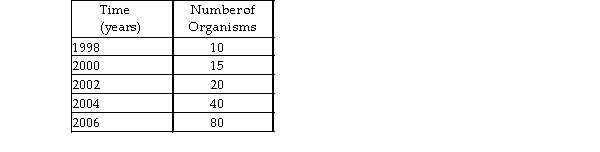
(Multiple Choice)
4.8/5 (81)
(81) Invasive species can rapidly disrupt an ecosystem because they have a high biotic potential and face little environmental resistance.
(True/False)
4.9/5 (77)
(77) 
Filters
- Essay(0)
- Multiple Choice(0)
- Short Answer(0)
- True False(0)
- Matching(0)