



 Chat with AI
Exam 27: Population Growth and Regulation

Exam 1: An Introduction to Life on Earth91 Questions
Exam 2: Atoms, Molecules, and Life90 Questions
Exam 3: Biological Molecules98 Questions
Exam 4: Cell Structure and Function90 Questions
Exam 5: Cell Membrane Structure and Function96 Questions
Exam 6: Energy Flow in the Life of a Cell90 Questions
Exam 7: Capturing Solar Energy: Photosynthesis102 Questions
Exam 8: Harvesting Energy: Glycolysis and Cellular Respiration97 Questions
Exam 9: Cellular Reproduction133 Questions
Exam 10: Meiosis: the Basis of Sexual Reproduction104 Questions
Exam 11: Patterns of Inheritance98 Questions
Exam 12: DNA: The Molecule of Heredity97 Questions
Exam 13: Gene Expression and Regulation93 Questions
Exam 14: Biotechnology91 Questions
Exam 15: Principles of Evolution97 Questions
Exam 16: How Populations Evolve109 Questions
Exam 17: The Origin of Species89 Questions
Exam 18: The History of Life125 Questions
Exam 19: Systematics: Seeking Order Amid Diversity90 Questions
Exam 20: The Diversity of Prokaryotes and Viruses97 Questions
Exam 21: The Diversity of Protists102 Questions
Exam 22: The Diversity of Plants115 Questions
Exam 23: The Diversity of Fungi107 Questions
Exam 24: Animal Diversity I: Invertebrates101 Questions
Exam 25: Animal Diversity Ii: Vertebrates118 Questions
Exam 26: Animal Behavior116 Questions
Exam 27: Population Growth and Regulation114 Questions
Exam 28: Community Interactions125 Questions
Exam 29: Energy Flow and Nutrient Cycling in Ecosystems122 Questions
Exam 30: Earths Diverse Ecosystems126 Questions
Exam 31: Conserving Earths Biodiversity109 Questions
Exam 32: Homeostasis and the Organization of the Animal Body95 Questions
Exam 33: Circulation89 Questions
Exam 34: Respiration92 Questions
Exam 35: Nutrition and Digestion91 Questions
Exam 36: The Urinary System99 Questions
Exam 37: Defenses Against Disease104 Questions
Exam 38: Chemical Control of the Animal Body: the Endocrine System133 Questions
Exam 39: The Nervous System118 Questions
Exam 40: The Senses94 Questions
Exam 41: Action and Support: the Muscles and Skeleton90 Questions
Exam 42: Animal Reproduction120 Questions
Exam 43: Animal Development122 Questions
Exam 44: Plant Anatomy and Nutrient Transport95 Questions
Exam 45: Plant Reproduction and Development90 Questions
Exam 46: Plant Responses to the Environment87 Questions
Select questions type


Parasites often kill their hosts, although they do not directly benefit from their hostsʹ death. Yet many ecologists believe that parasites may have beneficial effects on their host populations. Why?
(Essay)
4.7/5  (68)
(68) During the winter of 1999, minimum temperatures did not get much below freezing in an Oregon pond, and the following summer, large mosquito populations were observed. In the winter of 2000, frost came early and most ponds were frozen for 3 months. The following summer, very small mosquito populations were observed. This is an example of
(Multiple Choice)
4.8/5 (72)
(72) If a population of 100 birds increases to 120 birds in a year, what is the value of r?
(Multiple Choice)
4.8/5 (76)
(76) Predation is considered to be a density-_________ factor that controls the size of the prey population.
(Short Answer)
5.0/5 (83)
(83) In a stable population with neither immigration nor emigration, the RLF is 1.0 (one child per woman).
(True/False)
4.7/5 (86)
(86) In the United States today, there is a trend toward women having their first child in their late 30s or early 40s. In contrast, a few decades ago, most women started having children in their early 20s. What effect would you expect this change to have on population growth in the United States? Would it have any effect if the number of children per woman remains the same? Explain.
(Essay)
5.0/5 (81)
(81) 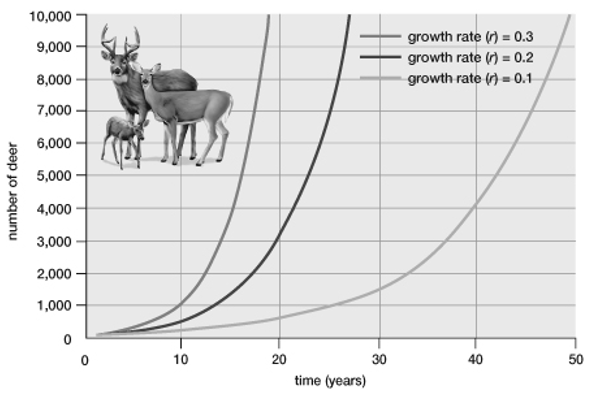 -Which population represented on the graph has the highest biotic potential?
 (Multiple Choice)
4.7/5 (82)
(82) An ecologist is studying the painted turtle population in a small pond. At the beginning of the year, there are 100 individuals. Over the course of a year, 40 turtles are born and 60 die. There is no migration. What is the growth rate (r) of the painted turtle population?
(Multiple Choice)
4.8/5 (81)
(81) Which tends to be more intense: intraspecific or interspecific competition? Why?
(Essay)
4.9/5 (76)
(76) The_________ is made up of the entire Earth and all of the living organisms that inhabit it.
(Short Answer)
5.0/5 (82)
(82) All the members of a species that live within an ecosystem form a(n) _________.
(Short Answer)
5.0/5 (81)
(81) The sum of all factors (living and nonliving) that limit the ability of a population to grow is known as_________ .
(Short Answer)
4.8/5 (76)
(76) In a constant-loss population, an organism has an equal risk of dying at any time during its life span.
(True/False)
4.9/5 (92)
(92) 
Filters
- Essay(0)
- Multiple Choice(0)
- Short Answer(0)
- True False(0)
- Matching(0)