



 Chat with AI
Exam 36: The Urinary System

Exam 1: An Introduction to Life on Earth91 Questions
Exam 2: Atoms, Molecules, and Life90 Questions
Exam 3: Biological Molecules98 Questions
Exam 4: Cell Structure and Function90 Questions
Exam 5: Cell Membrane Structure and Function96 Questions
Exam 6: Energy Flow in the Life of a Cell90 Questions
Exam 7: Capturing Solar Energy: Photosynthesis102 Questions
Exam 8: Harvesting Energy: Glycolysis and Cellular Respiration97 Questions
Exam 9: Cellular Reproduction133 Questions
Exam 10: Meiosis: the Basis of Sexual Reproduction104 Questions
Exam 11: Patterns of Inheritance98 Questions
Exam 12: DNA: The Molecule of Heredity97 Questions
Exam 13: Gene Expression and Regulation93 Questions
Exam 14: Biotechnology91 Questions
Exam 15: Principles of Evolution97 Questions
Exam 16: How Populations Evolve109 Questions
Exam 17: The Origin of Species89 Questions
Exam 18: The History of Life125 Questions
Exam 19: Systematics: Seeking Order Amid Diversity90 Questions
Exam 20: The Diversity of Prokaryotes and Viruses97 Questions
Exam 21: The Diversity of Protists102 Questions
Exam 22: The Diversity of Plants115 Questions
Exam 23: The Diversity of Fungi107 Questions
Exam 24: Animal Diversity I: Invertebrates101 Questions
Exam 25: Animal Diversity Ii: Vertebrates118 Questions
Exam 26: Animal Behavior116 Questions
Exam 27: Population Growth and Regulation114 Questions
Exam 28: Community Interactions125 Questions
Exam 29: Energy Flow and Nutrient Cycling in Ecosystems122 Questions
Exam 30: Earths Diverse Ecosystems126 Questions
Exam 31: Conserving Earths Biodiversity109 Questions
Exam 32: Homeostasis and the Organization of the Animal Body95 Questions
Exam 33: Circulation89 Questions
Exam 34: Respiration92 Questions
Exam 35: Nutrition and Digestion91 Questions
Exam 36: The Urinary System99 Questions
Exam 37: Defenses Against Disease104 Questions
Exam 38: Chemical Control of the Animal Body: the Endocrine System133 Questions
Exam 39: The Nervous System118 Questions
Exam 40: The Senses94 Questions
Exam 41: Action and Support: the Muscles and Skeleton90 Questions
Exam 42: Animal Reproduction120 Questions
Exam 43: Animal Development122 Questions
Exam 44: Plant Anatomy and Nutrient Transport95 Questions
Exam 45: Plant Reproduction and Development90 Questions
Exam 46: Plant Responses to the Environment87 Questions
Select questions type


Which of the following is closest to the external surface of the kidney?

Free
(Multiple Choice)
4.9/5  (85)
(85) Correct Answer: Verified
D
The funnel-like chamber of the kidney that collects urine is called the
Free
(Multiple Choice)
4.8/5 (89)
(89) Correct Answer:Verified
VerifiedB
Explain the relationship between protein consumption and the nitrogenous waste products found in mammalian urine.
Free
(Essay)
5.0/5 (88)
(88) Correct Answer:Verified
VerifiedProteins are made up of amino acids, which contain an amino group. When more protein is consumed than can be used for making more protein, the amino group has to be removed in the liver from the amino acids. These amino groups are made into ammonia, which is extremely toxic. The liver immediately changes the ammonia into urea, which is less toxic. The kidneys filter the urea from the blood and excrete it in urine.
Which of the following increases the reabsorption of water by inserting aquaporins into the membranes of the distal tubule and collecting duct cells?
(Multiple Choice)
5.0/5 (73)
(73) Why do mammals adapted to dry climates tend to have considerably more long -looped nephrons than those adapted to wet climates?
(Multiple Choice)
4.9/5 (86)
(86) Which of the following has a urinary system that makes use of flame cells?
(Multiple Choice)
4.8/5 (74)
(74) The primary nitrogenous waste product excreted in the urine of all mammals is__________ .
(Short Answer)
4.8/5 (92)
(92) Which of these structures most closely resembles a vertebrate nephron?
(Multiple Choice)
4.7/5 (69)
(69) The composition of glomerular filtrate is almost identical to that of urine.
(True/False)
4.9/5 (75)
(75) Refer to the following diagram. Which of the following could result from localized brain damage to the pituitary gland? 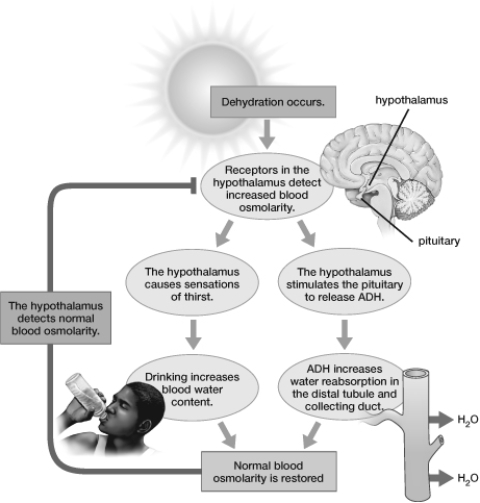
(Multiple Choice)
4.9/5 (86)
(86) Which portion of the nephron receives filtrate from the glomerular capsule?
(Multiple Choice)
4.8/5 (93)
(93) In a healthy kidney, glucose and amino acids are reabsorbed into the blood at which location in the nephron?
(Multiple Choice)
4.8/5 (84)
(84) It is estimated that more than 90% of Americans get a daily dose of caffeine from coffee, sodas, tea, or ʺenergyʺ drinks. Excessive caffeine intake can result in difficulty sleeping, jitteriness, and anxiety. It can also cause increased urination, which can lead to dehydration. Based on your knowledge of urinary systems and on the information provided in this scenario, which of the following explains the effects of caffeine?
(Multiple Choice)
4.9/5 (77)
(77) Which of these is normally found in the glomerular filtrate?
(Multiple Choice)
4.8/5 (85)
(85) In a healthy kidney, which of the following would you NOT expect to find in the filtrate?
(Multiple Choice)
4.7/5 (74)
(74) Briefly explain why animals that live in very dry climates have the longest nephron loops.
(Essay)
5.0/5 (69)
(69) 
Filters
- Essay(0)
- Multiple Choice(0)
- Short Answer(0)
- True False(0)
- Matching(0)