



 Chat with AI
Exam 22: The Diversity of Plants

Exam 1: An Introduction to Life on Earth91 Questions
Exam 2: Atoms, Molecules, and Life90 Questions
Exam 3: Biological Molecules98 Questions
Exam 4: Cell Structure and Function90 Questions
Exam 5: Cell Membrane Structure and Function96 Questions
Exam 6: Energy Flow in the Life of a Cell90 Questions
Exam 7: Capturing Solar Energy: Photosynthesis102 Questions
Exam 8: Harvesting Energy: Glycolysis and Cellular Respiration97 Questions
Exam 9: Cellular Reproduction133 Questions
Exam 10: Meiosis: the Basis of Sexual Reproduction104 Questions
Exam 11: Patterns of Inheritance98 Questions
Exam 12: DNA: The Molecule of Heredity97 Questions
Exam 13: Gene Expression and Regulation93 Questions
Exam 14: Biotechnology91 Questions
Exam 15: Principles of Evolution97 Questions
Exam 16: How Populations Evolve109 Questions
Exam 17: The Origin of Species89 Questions
Exam 18: The History of Life125 Questions
Exam 19: Systematics: Seeking Order Amid Diversity90 Questions
Exam 20: The Diversity of Prokaryotes and Viruses97 Questions
Exam 21: The Diversity of Protists102 Questions
Exam 22: The Diversity of Plants115 Questions
Exam 23: The Diversity of Fungi107 Questions
Exam 24: Animal Diversity I: Invertebrates101 Questions
Exam 25: Animal Diversity Ii: Vertebrates118 Questions
Exam 26: Animal Behavior116 Questions
Exam 27: Population Growth and Regulation114 Questions
Exam 28: Community Interactions125 Questions
Exam 29: Energy Flow and Nutrient Cycling in Ecosystems122 Questions
Exam 30: Earths Diverse Ecosystems126 Questions
Exam 31: Conserving Earths Biodiversity109 Questions
Exam 32: Homeostasis and the Organization of the Animal Body95 Questions
Exam 33: Circulation89 Questions
Exam 34: Respiration92 Questions
Exam 35: Nutrition and Digestion91 Questions
Exam 36: The Urinary System99 Questions
Exam 37: Defenses Against Disease104 Questions
Exam 38: Chemical Control of the Animal Body: the Endocrine System133 Questions
Exam 39: The Nervous System118 Questions
Exam 40: The Senses94 Questions
Exam 41: Action and Support: the Muscles and Skeleton90 Questions
Exam 42: Animal Reproduction120 Questions
Exam 43: Animal Development122 Questions
Exam 44: Plant Anatomy and Nutrient Transport95 Questions
Exam 45: Plant Reproduction and Development90 Questions
Exam 46: Plant Responses to the Environment87 Questions
Select questions type


Explain how bryophytes are an intermediate between green algae and terrestrial plants.

Free
(Essay)
4.9/5  (83)
(83) Correct Answer: Verified
Bryophytes are land-dwelling plants but must be close to water because they are nonvascular and lack the ability to transport water over long distances. Like green algae, they also produce swimming sperm, which means water must be available for fertilization to occur.
The characteristic that sets plants apart from photosynthetic protists is the multicellular, dependent embryo.
Free
(True/False)
4.7/5 (71)
(71) Correct Answer:Verified
VerifiedTrue
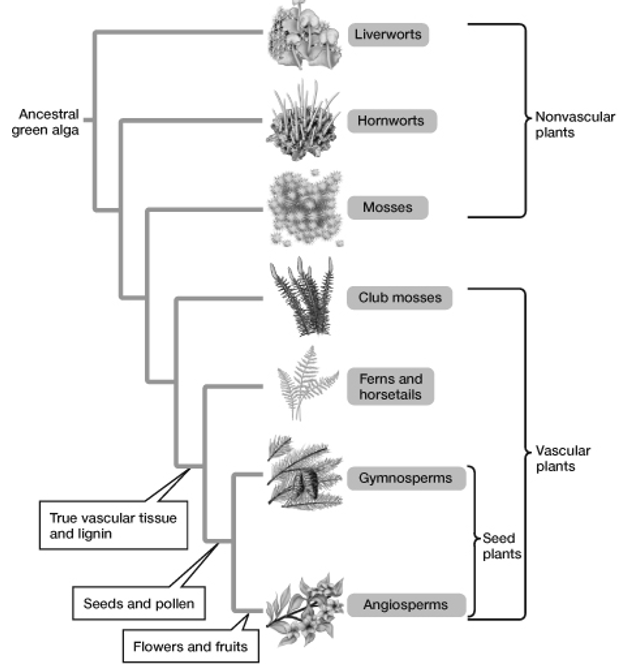 -Based on the evolutionary tree, the closest relatives of seed plants are the
Free
(Multiple Choice)
4.9/5 (68)
(68) Correct Answer:Verified
VerifiedB
-Based on the evolutionary tree, angiosperms are most closely related to
-Based on the evolutionary tree, angiosperms are most closely related to (Multiple Choice)
4.9/5 (80)
(80) Which of these is an advantage shared by early plants that invaded land?
(Multiple Choice)
4.8/5 (80)
(80) One function of the plant cuticle is to increase water uptake by roots.
(True/False)
4.8/5 (80)
(80) To reduce water loss, stems and leaves are covered with a(n)__________ .
(Short Answer)
5.0/5 (65)
(65) Which of the following weather conditions would you expect to have the greatest negative impact on the sexual reproduction of ferns and mosses?
(Multiple Choice)
4.8/5 (90)
(90) Fruit production requires precious resources. What important benefit does fruit provide?
(Multiple Choice)
4.7/5 (77)
(77) What evidence supports the idea that members of the plant kingdom evolved from ancestral green algae?
(Essay)
5.0/5 (79)
(79) Specific cells of diploid sporophytes undergo meiosis to produce
(Multiple Choice)
4.9/5 (91)
(91) While walking in a tropical forest, you come upon a 6 -meter-tall plant that shows no evidence of seed production. The plant is most likely a(n)
(Multiple Choice)
4.9/5 (73)
(73) With respect to plant reproduction, there has been an evolutionary trend toward
(Multiple Choice)
4.8/5 (85)
(85) What group dominated the Carboniferous period and is now burned as coal?
(Multiple Choice)
4.9/5 (82)
(82) 
Filters
- Essay(0)
- Multiple Choice(0)
- Short Answer(0)
- True False(0)
- Matching(0)