



 Chat with AI
Exam 27: Population Growth and Regulation

Exam 1: An Introduction to Life on Earth91 Questions
Exam 2: Atoms, Molecules, and Life90 Questions
Exam 3: Biological Molecules98 Questions
Exam 4: Cell Structure and Function90 Questions
Exam 5: Cell Membrane Structure and Function96 Questions
Exam 6: Energy Flow in the Life of a Cell90 Questions
Exam 7: Capturing Solar Energy: Photosynthesis102 Questions
Exam 8: Harvesting Energy: Glycolysis and Cellular Respiration97 Questions
Exam 9: Cellular Reproduction133 Questions
Exam 10: Meiosis: the Basis of Sexual Reproduction104 Questions
Exam 11: Patterns of Inheritance98 Questions
Exam 12: DNA: The Molecule of Heredity97 Questions
Exam 13: Gene Expression and Regulation93 Questions
Exam 14: Biotechnology91 Questions
Exam 15: Principles of Evolution97 Questions
Exam 16: How Populations Evolve109 Questions
Exam 17: The Origin of Species89 Questions
Exam 18: The History of Life125 Questions
Exam 19: Systematics: Seeking Order Amid Diversity90 Questions
Exam 20: The Diversity of Prokaryotes and Viruses97 Questions
Exam 21: The Diversity of Protists102 Questions
Exam 22: The Diversity of Plants115 Questions
Exam 23: The Diversity of Fungi107 Questions
Exam 24: Animal Diversity I: Invertebrates101 Questions
Exam 25: Animal Diversity Ii: Vertebrates118 Questions
Exam 26: Animal Behavior116 Questions
Exam 27: Population Growth and Regulation114 Questions
Exam 28: Community Interactions125 Questions
Exam 29: Energy Flow and Nutrient Cycling in Ecosystems122 Questions
Exam 30: Earths Diverse Ecosystems126 Questions
Exam 31: Conserving Earths Biodiversity109 Questions
Exam 32: Homeostasis and the Organization of the Animal Body95 Questions
Exam 33: Circulation89 Questions
Exam 34: Respiration92 Questions
Exam 35: Nutrition and Digestion91 Questions
Exam 36: The Urinary System99 Questions
Exam 37: Defenses Against Disease104 Questions
Exam 38: Chemical Control of the Animal Body: the Endocrine System133 Questions
Exam 39: The Nervous System118 Questions
Exam 40: The Senses94 Questions
Exam 41: Action and Support: the Muscles and Skeleton90 Questions
Exam 42: Animal Reproduction120 Questions
Exam 43: Animal Development122 Questions
Exam 44: Plant Anatomy and Nutrient Transport95 Questions
Exam 45: Plant Reproduction and Development90 Questions
Exam 46: Plant Responses to the Environment87 Questions
Select questions type


The United Nations estimates that by 2050, the world?s population may reach over _________billion and still be growing.
(Multiple Choice)
4.8/5  (73)
(73) The maximum rate at which a population could increase is known as its_________ .
(Short Answer)
4.9/5 (73)
(73) Although social changes and increased access to contraceptives have caused a decrease in fertility rates in some less-developed countries, their rates are still above RLF.
(True/False)
4.8/5 (73)
(73) If all the people in the world were to live at the American level in terms of technology, wealth, education, and other factors, the population of the world would have to _________to support them.
(Multiple Choice)
4.9/5 (74)
(74) A population of rabbits introduced into an island grew rapidly for a few years and then the growth slowed down and stabilized. Why did the population become stable?
(Multiple Choice)
4.9/5 (88)
(88) To support the world population at the same standard of living as we have in the United States would require_________ times the resources that are available on Earth today.
(Multiple Choice)
4.7/5 (81)
(81) A population of birds migrating to winter nesting grounds is blown off course by a late -season hurricane and ends up on an island that is uninhabited by any animal species. Which of the following represents a density-independent factor that will limit the population size?
(Multiple Choice)
4.8/5 (84)
(84) Environmental resistance may limit the size of populations by
(Multiple Choice)
4.8/5 (85)
(85) Purple loosestrife, a European plant, was introduced into the American Great Lakes region where it has no natural predators. Each plant produces thousands of seeds annually, and it now clogs acres of wetlands, crowding out native plants. Purple loosestrife is considered a(n)
(Multiple Choice)
4.9/5 (82)
(82) If a caterpillar eats all of the seedlings in your garden, killing all of them, the caterpillar is acting as a
(Multiple Choice)
4.9/5 (72)
(72) 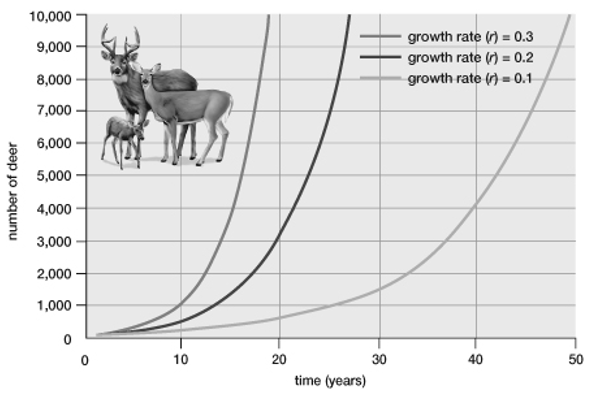 -According to the graph, how long does it take the population of deer that is experiencing moderate growth (r = 0.2) to reach 3,000 deer?
 (Multiple Choice)
4.9/5 (85)
(85) The study of how organisms interact with one another and with their nonliving environment is
(Multiple Choice)
4.9/5 (73)
(73) Some predators feed primarily on the most abundant prey. This is an example of _________predation.
(Multiple Choice)
4.9/5 (85)
(85) In a population of lemmings, a sudden freeze that caused many of the lemmings to die is an example of a
(Multiple Choice)
4.9/5 (83)
(83) 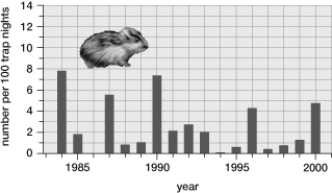
Which factor does NOT influence the size a population reaches through natural increase?
(Multiple Choice)
4.8/5 (73)
(73) 
Filters
- Essay(0)
- Multiple Choice(0)
- Short Answer(0)
- True False(0)
- Matching(0)