



 Chat with AI
Exam 27: Population Growth and Regulation

Exam 1: An Introduction to Life on Earth91 Questions
Exam 2: Atoms, Molecules, and Life90 Questions
Exam 3: Biological Molecules98 Questions
Exam 4: Cell Structure and Function90 Questions
Exam 5: Cell Membrane Structure and Function96 Questions
Exam 6: Energy Flow in the Life of a Cell90 Questions
Exam 7: Capturing Solar Energy: Photosynthesis102 Questions
Exam 8: Harvesting Energy: Glycolysis and Cellular Respiration97 Questions
Exam 9: Cellular Reproduction133 Questions
Exam 10: Meiosis: the Basis of Sexual Reproduction104 Questions
Exam 11: Patterns of Inheritance98 Questions
Exam 12: DNA: The Molecule of Heredity97 Questions
Exam 13: Gene Expression and Regulation93 Questions
Exam 14: Biotechnology91 Questions
Exam 15: Principles of Evolution97 Questions
Exam 16: How Populations Evolve109 Questions
Exam 17: The Origin of Species89 Questions
Exam 18: The History of Life125 Questions
Exam 19: Systematics: Seeking Order Amid Diversity90 Questions
Exam 20: The Diversity of Prokaryotes and Viruses97 Questions
Exam 21: The Diversity of Protists102 Questions
Exam 22: The Diversity of Plants115 Questions
Exam 23: The Diversity of Fungi107 Questions
Exam 24: Animal Diversity I: Invertebrates101 Questions
Exam 25: Animal Diversity Ii: Vertebrates118 Questions
Exam 26: Animal Behavior116 Questions
Exam 27: Population Growth and Regulation114 Questions
Exam 28: Community Interactions125 Questions
Exam 29: Energy Flow and Nutrient Cycling in Ecosystems122 Questions
Exam 30: Earths Diverse Ecosystems126 Questions
Exam 31: Conserving Earths Biodiversity109 Questions
Exam 32: Homeostasis and the Organization of the Animal Body95 Questions
Exam 33: Circulation89 Questions
Exam 34: Respiration92 Questions
Exam 35: Nutrition and Digestion91 Questions
Exam 36: The Urinary System99 Questions
Exam 37: Defenses Against Disease104 Questions
Exam 38: Chemical Control of the Animal Body: the Endocrine System133 Questions
Exam 39: The Nervous System118 Questions
Exam 40: The Senses94 Questions
Exam 41: Action and Support: the Muscles and Skeleton90 Questions
Exam 42: Animal Reproduction120 Questions
Exam 43: Animal Development122 Questions
Exam 44: Plant Anatomy and Nutrient Transport95 Questions
Exam 45: Plant Reproduction and Development90 Questions
Exam 46: Plant Responses to the Environment87 Questions
Select questions type


A species that is transferred to a new environment where it has little environmental resistance and experiences an explosive population growth is called a(n)_________species.
(Short Answer)
4.8/5  (77)
(77) The growth rate of a population is the difference between the population size and the death rate.
(True/False)
4.8/5 (77)
(77) A measure of the ability of a population to grow under ideal circumstances (maximum birth rate and minimum death rate) is its _________.
(Short Answer)
4.9/5 (80)
(80) Logistic population growth is characteristic of a population that moves into a new habitat, experiences a rapid increase in number, and then stabilizes.
(True/False)
5.0/5 (74)
(74) Density-dependent factors become less effective as the population size increases.
(True/False)
5.0/5 (64)
(64) Based on the data in the table, this population has a(n) _________growth pattern. 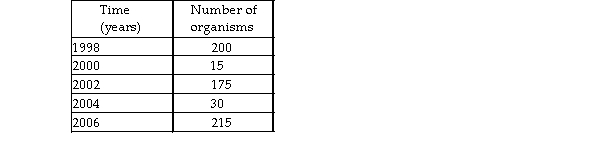
(Multiple Choice)
4.7/5 (79)
(79) What percentage of Earthʹs productive land is currently used by the human population for crops and livestock?
(Multiple Choice)
4.9/5 (97)
(97) In a maple forest in the spring, the ground is often covered with young maple seedlings, which compete for light and nutrients. By fall, most of the seedlings have died, leaving only a few survivors. This is an example of_________ life history pattern.
(Short Answer)
4.8/5 (81)
(81) As a developing country passes through the demographic transition, which of the following will occur?
(Multiple Choice)
4.8/5 (78)
(78) When parents, on average, have just the number of children required to replace themselves, the natural increase of their population is at replacement level fertility (RLF).
(True/False)
4.9/5 (84)
(84) If adults of reproductive age are having just enough children to replace themselves, then the population is said to have_________ fertility.
(Short Answer)
4.8/5 (89)
(89) The prediction, during the early 1800s, that our human population would eventually reach a point where we cannot sustain ourselves has not occurred. Why?
(Multiple Choice)
5.0/5 (75)
(75) Which of the following correctly describes the effect parasites have on their hostʹs population size and on the host itself?
(Multiple Choice)
4.8/5 (71)
(71) An ecologist is studying the painted turtle population in a small pond. At the beginning of the year, there are 100 individuals. Over the course of a year, 40 turtles are born and 60 die. There is no migration. What is the birth rate per year for this population?
(Multiple Choice)
4.7/5 (86)
(86) A forest fire is a density-independent population control factor.
(True/False)
4.8/5 (78)
(78) In areas that have a stable population, the number of children born in a period of time is
(Multiple Choice)
4.8/5 (79)
(79) If most of the individuals of a species die when they are young, that species exhibits a(n) _________survivorship curve.
(Multiple Choice)
4.9/5 (70)
(70) 
Filters
- Essay(0)
- Multiple Choice(0)
- Short Answer(0)
- True False(0)
- Matching(0)