



 Chat with AI
Exam 39: The Nervous System

Exam 1: An Introduction to Life on Earth91 Questions
Exam 2: Atoms, Molecules, and Life90 Questions
Exam 3: Biological Molecules98 Questions
Exam 4: Cell Structure and Function90 Questions
Exam 5: Cell Membrane Structure and Function96 Questions
Exam 6: Energy Flow in the Life of a Cell90 Questions
Exam 7: Capturing Solar Energy: Photosynthesis102 Questions
Exam 8: Harvesting Energy: Glycolysis and Cellular Respiration97 Questions
Exam 9: Cellular Reproduction133 Questions
Exam 10: Meiosis: the Basis of Sexual Reproduction104 Questions
Exam 11: Patterns of Inheritance98 Questions
Exam 12: DNA: The Molecule of Heredity97 Questions
Exam 13: Gene Expression and Regulation93 Questions
Exam 14: Biotechnology91 Questions
Exam 15: Principles of Evolution97 Questions
Exam 16: How Populations Evolve109 Questions
Exam 17: The Origin of Species89 Questions
Exam 18: The History of Life125 Questions
Exam 19: Systematics: Seeking Order Amid Diversity90 Questions
Exam 20: The Diversity of Prokaryotes and Viruses97 Questions
Exam 21: The Diversity of Protists102 Questions
Exam 22: The Diversity of Plants115 Questions
Exam 23: The Diversity of Fungi107 Questions
Exam 24: Animal Diversity I: Invertebrates101 Questions
Exam 25: Animal Diversity Ii: Vertebrates118 Questions
Exam 26: Animal Behavior116 Questions
Exam 27: Population Growth and Regulation114 Questions
Exam 28: Community Interactions125 Questions
Exam 29: Energy Flow and Nutrient Cycling in Ecosystems122 Questions
Exam 30: Earths Diverse Ecosystems126 Questions
Exam 31: Conserving Earths Biodiversity109 Questions
Exam 32: Homeostasis and the Organization of the Animal Body95 Questions
Exam 33: Circulation89 Questions
Exam 34: Respiration92 Questions
Exam 35: Nutrition and Digestion91 Questions
Exam 36: The Urinary System99 Questions
Exam 37: Defenses Against Disease104 Questions
Exam 38: Chemical Control of the Animal Body: the Endocrine System133 Questions
Exam 39: The Nervous System118 Questions
Exam 40: The Senses94 Questions
Exam 41: Action and Support: the Muscles and Skeleton90 Questions
Exam 42: Animal Reproduction120 Questions
Exam 43: Animal Development122 Questions
Exam 44: Plant Anatomy and Nutrient Transport95 Questions
Exam 45: Plant Reproduction and Development90 Questions
Exam 46: Plant Responses to the Environment87 Questions
Select questions type


Which of these neurotransmitters, released by neurons of the sympathetic nervous system, helps prepare the body for energetic activity?
(Multiple Choice)
4.8/5  (97)
(97) Sensations of fear, pleasure, and sexual arousal are produced by the__________ .
(Short Answer)
4.7/5 (76)
(76) A good meal and a pleasant evening relaxing in front of the fire trigger the parasympathetic nervous system.
(True/False)
4.7/5 (98)
(98) In an unstimulated neuron, the___________ concentration is higher inside the cell than outside.
(Multiple Choice)
4.7/5 (87)
(87) All sensory information, with the exception of olfaction, must pass though the__________as it travels to the cerebral cortex.
(Multiple Choice)
4.8/5 (70)
(70) Individuals with viral hemorrhagic fever lose the ability to regulate their K+ levels. Why does this condition create neurological problems?
(Essay)
4.9/5 (72)
(72) The intensity of a stimulus is indicated by the __________of action potentials.
(Multiple Choice)
5.0/5 (79)
(79) The junction across which electrical signals are passed from a neuron to a muscle fiber, a gland, or another neuron is called the
(Multiple Choice)
4.8/5 (92)
(92) Neurons receive, process, and transmit information; however, they cannot function without glia. What are glia, and how do they affect neuronal functioning?
(Essay)
4.8/5 (85)
(85) Electrical signals are transmitted to the synaptic terminals along the
(Multiple Choice)
4.8/5 (86)
(86) Individuals using drugs such as cocaine over extended periods of time find that they need increasing amounts just to feel okay. Why?
(Essay)
4.8/5 (72)
(72) A neuronʹs resting potential is due in large part to the diffusion of K+ ions out of the cell, leaving the negatively charged DNA and proteins inside the cell.
(True/False)
4.8/5 (87)
(87) What happens when the resting potential reaches threshold voltage?
(Multiple Choice)
4.9/5 (66)
(66) 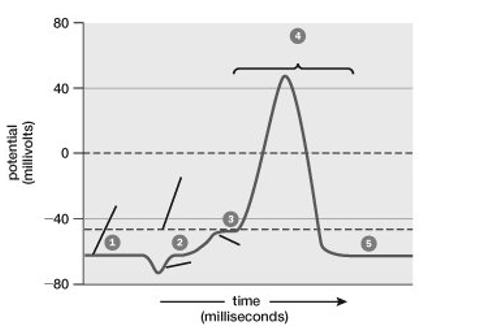 -Identify the numbered region in the above graph that indicates the action potential.
 (Multiple Choice)
4.8/5 (69)
(69) The brain is able to take sensory inputs from many neurons, integrate them, and determine an appropriate response.
(True/False)
4.9/5 (67)
(67) Why do negatively charged molecules tend to remain inside both an unstimulated and stimulated neuron?
(Essay)
4.9/5 (86)
(86) Explain why most adults do not have to think about how to walk even though they did when they were toddlers.
(Essay)
4.7/5 (80)
(80) 
Filters
- Essay(0)
- Multiple Choice(0)
- Short Answer(0)
- True False(0)
- Matching(0)