



 Chat with AI
Exam 19: Galaxies

Exam 1: Thinking Like an Astronomer 97 Questions
Exam 2: Patterns in the Skymotions of Earth and the Moon101 Questions
Exam 3: Motion of Astronomical Bodies99 Questions
Exam 4: Gravity and Orbits100 Questions
Exam 5: Light100 Questions
Exam 6: The Tools of the Astronomer100 Questions
Exam 7: The Formation of Planetary Systems100 Questions
Exam 8: The Terrestrial Planets and Earths Moon100 Questions
Exam 9: Atmospheres of the Terrestrial Planets100 Questions
Exam 10: Worlds of Gas and Liquidthe Giant Planets100 Questions
Exam 11: Planetary Moons and Rings100 Questions
Exam 12: Dwarf Planets and Small Solar System Bodies100 Questions
Exam 13: Taking the Measure of Stars101 Questions
Exam 14: Our Starthe Sun100 Questions
Exam 15: The Interstellar Medium and Star Formation100 Questions
Exam 16: Evolution of Low-Mass Stars100 Questions
Exam 17: Evolution of High-Mass Stars100 Questions
Exam 18: Relativity and Black Holes97 Questions
Exam 19: Galaxies100 Questions
Exam 20: The Milky Waya Normal Spiral Galaxy100 Questions
Exam 21: The Expanding Universe98 Questions
Exam 22: Cosmology100 Questions
Exam 23: Large-Scale Structure in the Universe103 Questions
Exam 24: Life100 Questions
Select questions type


If you found a galaxy with an H emission line that had a wavelength of 756.3 nm, what would be the galaxy's redshift? (Note that the rest wavelength of the H emission line is 656.3 nm.)
(Multiple Choice)
4.7/5  (86)
(86) Microquasars are scaled-down versions of quasars, the former being powered by accretion onto stellar-sized black holes, the material being provided by a companion star.The underlying mechanism seems to be very similar in both microquasars and their supermassive AGNs.Typical microquasars have luminosities that are ten orders of magnitude lower than ordinary quasars.What is the typical level of accretion rate in the two cases?
(Essay)
4.8/5 (68)
(68) Type Ia supernovae have a peak luminosity of 3.7 x1036 W.If you discover a Type Ia supernovae in a distant galaxy that has a measured brightness of 9.5 x10⁻¹⁷ W/m2, then how far away is this galaxy? Note that 1 Mpc = 3.1 x10²² m.
(Multiple Choice)
4.8/5 (67)
(67) Quasars were first discovered in which region of the electromagnetic spectrum?
(Multiple Choice)
4.7/5 (80)
(80) In spiral galaxies, the size of the central bulge is correlated with the
(Multiple Choice)
4.9/5 (92)
(92) The nearest known quasar shows a redshift of z = 0.0516, which means it is at a distance of
(Multiple Choice)
4.8/5 (74)
(74) For the more distant quasars, the emission lines that would normally occur in the visible domain would be shifted into
(Multiple Choice)
4.8/5 (66)
(66) How do the current star-formation rates of spiral and elliptical galaxies compare?
(Essay)
4.7/5 (99)
(99) What were the positions taken by Heber Curtis and Harlow Shapley in their "Great Debate," and how were both of them partially correct?
(Essay)
4.9/5 (92)
(92) 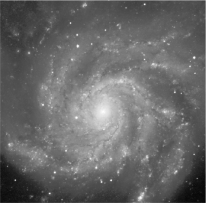
If there is a 4 million MSUN black hole at the center of our galaxy, why is our own galaxy not an AGN?
(Essay)
4.9/5 (90)
(90) If a galaxy has a recessional velocity of 50,000 km/s, at what wavelength will you observe the H emission line? (Note that the rest wavelength of the H emission line is 656.3 nm.)
(Multiple Choice)
4.8/5 (80)
(80) You see a galaxy in which the H line (rest wavelength = 656.3 nm) is observed at a wavelength of 756.3 nm.What would be the observed wavelength of a particular helium line that has a rest wavelength of 1,083 nm?
(Multiple Choice)
5.0/5 (79)
(79) The Tully-Fisher method of determination of distances to galaxies is based on the correlation between
(Multiple Choice)
5.0/5 (88)
(88) Describe the known properties of dark matter, and contrast it with "normal" matter.
(Essay)
4.9/5 (90)
(90) How did astronomers determine that elliptical galaxies are composed mostly of dark matter?
(Multiple Choice)
4.8/5 (91)
(91) We interpret the presence of more AGNs in the past than today to indicate that
(Multiple Choice)
4.8/5 (74)
(74) 
Filters
- Essay(0)
- Multiple Choice(0)
- Short Answer(0)
- True False(0)
- Matching(0)