



 Chat with AI
Exam 11: Planetary Moons and Rings

Exam 1: Thinking Like an Astronomer 97 Questions
Exam 2: Patterns in the Skymotions of Earth and the Moon101 Questions
Exam 3: Motion of Astronomical Bodies99 Questions
Exam 4: Gravity and Orbits100 Questions
Exam 5: Light100 Questions
Exam 6: The Tools of the Astronomer100 Questions
Exam 7: The Formation of Planetary Systems100 Questions
Exam 8: The Terrestrial Planets and Earths Moon100 Questions
Exam 9: Atmospheres of the Terrestrial Planets100 Questions
Exam 10: Worlds of Gas and Liquidthe Giant Planets100 Questions
Exam 11: Planetary Moons and Rings100 Questions
Exam 12: Dwarf Planets and Small Solar System Bodies100 Questions
Exam 13: Taking the Measure of Stars101 Questions
Exam 14: Our Starthe Sun100 Questions
Exam 15: The Interstellar Medium and Star Formation100 Questions
Exam 16: Evolution of Low-Mass Stars100 Questions
Exam 17: Evolution of High-Mass Stars100 Questions
Exam 18: Relativity and Black Holes97 Questions
Exam 19: Galaxies100 Questions
Exam 20: The Milky Waya Normal Spiral Galaxy100 Questions
Exam 21: The Expanding Universe98 Questions
Exam 22: Cosmology100 Questions
Exam 23: Large-Scale Structure in the Universe103 Questions
Exam 24: Life100 Questions
Select questions type


How does the thickness of Saturn's bright ring system compare to its diameter?

Free
(Multiple Choice)
4.9/5  (83)
(83) Correct Answer: Verified
E
From where does Titan's thick, nitrogen-rich atmosphere likely arise?
Free
(Multiple Choice)
4.9/5 (82)
(82) Correct Answer:Verified
VerifiedA
How many moons are known in the Solar System?
Free
(Multiple Choice)
4.8/5 (85)
(85) Correct Answer:Verified
VerifiedB
Why does the Adams Ring around Neptune clump into arcs rather than uniform rings?
(Essay)
4.8/5 (77)
(77) Titan is a high-priority candidate for the search for life outside Earth primarily because it has
(Multiple Choice)
4.9/5 (87)
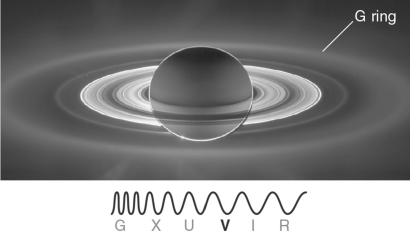
(87) Astronomers originally planned to have the Pioneer 11 space probe pass through the Cassini Gap in Saturn's rings.Would this have been completely safe?
(Multiple Choice)
4.9/5 (69)
(69) 
What material has been seen erupting from the surface of the icy moon Enceladus, and why?
(Essay)
4.8/5 (70)
(70) Rings of giant planets are very thin compared to their diameters mainly because
(Multiple Choice)
4.7/5 (68)
(68) Why are some moons such as Io and Enceladus geologically active even though they are small in size compared to the planets?
(Multiple Choice)
4.7/5 (74)
(74) The mass of all of Saturn's bright rings is comparable to the mass of
(Multiple Choice)
4.8/5 (92)
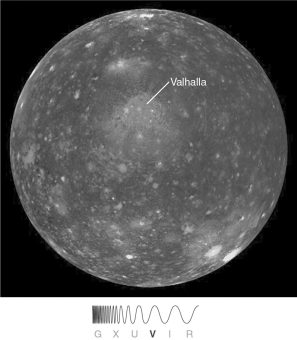
(92) 
By studying the orbit of a moon around its parent planet, astronomers can use ________ to find the parent planet's ________.
(Multiple Choice)
4.7/5 (73)
(73) What is the most likely reason that a planet's rings would reflect more than 50 percent of the sunlight they receive?
(Multiple Choice)
4.9/5 (80)
(80) On which of Saturn's moons did the Cassini-Huygens Probe land in 2004, providing our first view of the varied and active surface?
(Multiple Choice)
4.8/5 (88)
(88) Why is Io, a moon that is smaller and farther from the Sun than our own Moon, still geologically active?
(Essay)
4.9/5 (76)
(76) The semimajor axis of Iapetus's orbit around Saturn is approximately 3.56 * 106 km, and its orbital period is approximately 79 days.Use these data and Newton's version of Kepler's third law to calculate the mass of Saturn.
(Essay)
4.7/5 (76)
(76) 
Filters
- Essay(0)
- Multiple Choice(0)
- Short Answer(0)
- True False(0)
- Matching(0)