



 Chat with AI
Exam 24: Life

Exam 1: Thinking Like an Astronomer 97 Questions
Exam 2: Patterns in the Skymotions of Earth and the Moon101 Questions
Exam 3: Motion of Astronomical Bodies99 Questions
Exam 4: Gravity and Orbits100 Questions
Exam 5: Light100 Questions
Exam 6: The Tools of the Astronomer100 Questions
Exam 7: The Formation of Planetary Systems100 Questions
Exam 8: The Terrestrial Planets and Earths Moon100 Questions
Exam 9: Atmospheres of the Terrestrial Planets100 Questions
Exam 10: Worlds of Gas and Liquidthe Giant Planets100 Questions
Exam 11: Planetary Moons and Rings100 Questions
Exam 12: Dwarf Planets and Small Solar System Bodies100 Questions
Exam 13: Taking the Measure of Stars101 Questions
Exam 14: Our Starthe Sun100 Questions
Exam 15: The Interstellar Medium and Star Formation100 Questions
Exam 16: Evolution of Low-Mass Stars100 Questions
Exam 17: Evolution of High-Mass Stars100 Questions
Exam 18: Relativity and Black Holes97 Questions
Exam 19: Galaxies100 Questions
Exam 20: The Milky Waya Normal Spiral Galaxy100 Questions
Exam 21: The Expanding Universe98 Questions
Exam 22: Cosmology100 Questions
Exam 23: Large-Scale Structure in the Universe103 Questions
Exam 24: Life100 Questions
Select questions type


If astronomers focused only on studying planets in the habitable zones of single stars, what potentially life-harboring objects would be overlooked?

Free
(Essay)
4.9/5  (84)
(84) Correct Answer: Verified
Based on what we know from our own Solar System,there are moons orbiting Jupiter (e.g.,Europa)and Saturn (e.g.,Titan,Enceladus)whose environments could harbor primitive life-forms.There are also planets that orbit binary stellar systems in a complex "choreography" and the corresponding habitable zone would be much more difficult to define.
You find a planet orbiting an F-type star (surface temperature 6500 K).Where is this planet with respect to the habitable zone, if this planet has a circular orbit with a radius of 2.6 AU? The figure below may be helpful. 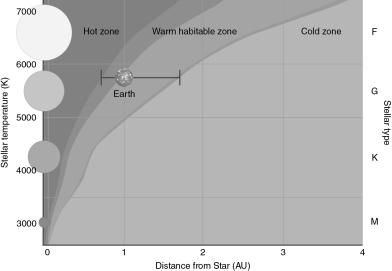
Free
(Multiple Choice)
4.9/5 (79)
(79) Correct Answer:Verified
VerifiedD
The "waste" product in the process of photosynthesis is
Free
(Multiple Choice)
4.9/5 (84)
(84) Correct Answer:Verified
VerifiedC
If the most pessimistic assumptions in the Drake equation were true, we would
(Multiple Choice)
4.9/5 (93)
(93) The habitable zone for a 2MSUN star is ________ and covers a ________ distance range compared with the habitable zone for a 1MSUN star.
(Multiple Choice)
4.8/5 (72)
(72) Why was the comet or asteroid impact 65 million years ago an event that benefited the evolution of humans?
(Multiple Choice)
4.8/5 (65)
(65) The current oxygen level in the Earth's atmosphere was reached about
(Multiple Choice)
4.8/5 (73)
(73) Which of the following sequences correctly ranks the number of atoms in the human body from highest to lowest?
(Multiple Choice)
4.7/5 (84)
(84) The field of astrobiology uses our knowledge of ________ to study life in the universe.
(Multiple Choice)
4.9/5 (93)
(93) Out of the chemical elements, the second-best candidate for enabling biological life-forms is
(Multiple Choice)
4.9/5 (78)
(78) Which of the following properties would be a unique marker of life, as compared to other natural processes?
(Multiple Choice)
4.8/5 (86)
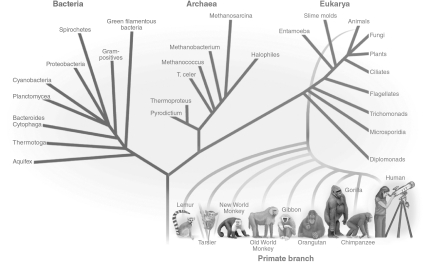
(86) 
What stars, in terms of mass, are preferred by scientists in the search for highly evolved
life-forms and why?
(Essay)
4.9/5 (62)
(62) At approximately what fraction of the Earth's current age were the dinosaurs wiped out by a large asteroid or comet?
(Multiple Choice)
4.8/5 (89)
(89) What is a biosignature, and why is the presence of oxygen considered to be a weak one?
(Essay)
4.8/5 (69)
(69) 
Filters
- Essay(0)
- Multiple Choice(0)
- Short Answer(0)
- True False(0)
- Matching(0)