



 Chat with AI
Exam 15: The Interstellar Medium and Star Formation

Exam 1: Thinking Like an Astronomer 97 Questions
Exam 2: Patterns in the Skymotions of Earth and the Moon101 Questions
Exam 3: Motion of Astronomical Bodies99 Questions
Exam 4: Gravity and Orbits100 Questions
Exam 5: Light100 Questions
Exam 6: The Tools of the Astronomer100 Questions
Exam 7: The Formation of Planetary Systems100 Questions
Exam 8: The Terrestrial Planets and Earths Moon100 Questions
Exam 9: Atmospheres of the Terrestrial Planets100 Questions
Exam 10: Worlds of Gas and Liquidthe Giant Planets100 Questions
Exam 11: Planetary Moons and Rings100 Questions
Exam 12: Dwarf Planets and Small Solar System Bodies100 Questions
Exam 13: Taking the Measure of Stars101 Questions
Exam 14: Our Starthe Sun100 Questions
Exam 15: The Interstellar Medium and Star Formation100 Questions
Exam 16: Evolution of Low-Mass Stars100 Questions
Exam 17: Evolution of High-Mass Stars100 Questions
Exam 18: Relativity and Black Holes97 Questions
Exam 19: Galaxies100 Questions
Exam 20: The Milky Waya Normal Spiral Galaxy100 Questions
Exam 21: The Expanding Universe98 Questions
Exam 22: Cosmology100 Questions
Exam 23: Large-Scale Structure in the Universe103 Questions
Exam 24: Life100 Questions
Select questions type


Dust that glows with a peak emission wavelength of 40 m has a temperature of

Free
(Multiple Choice)
4.9/5  (72)
(72) Correct Answer: Verified
B
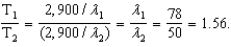
Suppose we observe two molecular clouds containing dust.The dust in Cloud 1 peaks in emission at 50 mm, while the dust in Cloud 2 peaks in emission at 78 mm.How much warmer is the dust in Cloud 1 compared to Cloud 2?
Free
(Essay)
4.9/5 (80)
(80) Correct Answer:Verified
VerifiedThe peak of the emission is related to the dust temperature via Wien's law,so that T1 = 2,900 µm  and T2 = 2,900 µm
 .The ratio of the two clouds' temperatures is then
Stars forming in molecular clouds tend to form first in
Free
(Multiple Choice)
4.8/5 (79)
(79) Correct Answer:Verified
VerifiedB
Dust that is heated to 30 K will emit a blackbody spectrum that peaks near
(Multiple Choice)
4.9/5 (80)
(80) Star formation is an inefficient process, with only a few percent of the initial cloud fragment ending up as stars.This means the initial mass of a molecular cloud fragment that formed a 2 MSUN star was probably close to
(Multiple Choice)
4.8/5 (92)
(92) How long does it typically take for a protostar to form a 1 MSUN star?
(Multiple Choice)
4.7/5 (86)
(86) Molecular clouds, which have temperatures of around 10 K, are best observed at ________ wavelengths.
(Multiple Choice)
5.0/5 (68)
(68) What is the interstellar medium made of? Give rough percentages of each.
(Essay)
4.8/5 (87)
(87) If you wanted to observe heavy elements in the interstellar medium, where would be the best place to look?
(Multiple Choice)
4.8/5 (81)
(81) A protostar's evolutionary "track" in the H-R diagram traces
(Multiple Choice)
4.8/5 (64)
(64) Compare the volume of the Sun with the volume of interstellar space it dominates.Is the occupied percentage large or small? Consider the volume around the Sun to be a sphere whose radius is equal to the distance to the nearest star, which is equal to 5 light-years.(Note: the radius of the Sun is 7 *105 km, and 1 light-year = 9.5 * 1012 km.)
(Essay)
4.9/5 (87)
(87) A young protostar is ________ than the Sun even though its surface temperature is ________.
(Multiple Choice)
4.8/5 (91)
(91) Dust in the ISM appears dark in ________ wavelengths and bright in ________ wavelengths.
(Multiple Choice)
4.9/5 (78)
(78) Electronic transitions from the H2 molecule are easily seen at
(Multiple Choice)
4.7/5 (93)
(93) 
Filters
- Essay(0)
- Multiple Choice(0)
- Short Answer(0)
- True False(0)
- Matching(0)