



 Chat with AI
Exam 19: Galaxies

Exam 1: Thinking Like an Astronomer 97 Questions
Exam 2: Patterns in the Skymotions of Earth and the Moon101 Questions
Exam 3: Motion of Astronomical Bodies99 Questions
Exam 4: Gravity and Orbits100 Questions
Exam 5: Light100 Questions
Exam 6: The Tools of the Astronomer100 Questions
Exam 7: The Formation of Planetary Systems100 Questions
Exam 8: The Terrestrial Planets and Earths Moon100 Questions
Exam 9: Atmospheres of the Terrestrial Planets100 Questions
Exam 10: Worlds of Gas and Liquidthe Giant Planets100 Questions
Exam 11: Planetary Moons and Rings100 Questions
Exam 12: Dwarf Planets and Small Solar System Bodies100 Questions
Exam 13: Taking the Measure of Stars101 Questions
Exam 14: Our Starthe Sun100 Questions
Exam 15: The Interstellar Medium and Star Formation100 Questions
Exam 16: Evolution of Low-Mass Stars100 Questions
Exam 17: Evolution of High-Mass Stars100 Questions
Exam 18: Relativity and Black Holes97 Questions
Exam 19: Galaxies100 Questions
Exam 20: The Milky Waya Normal Spiral Galaxy100 Questions
Exam 21: The Expanding Universe98 Questions
Exam 22: Cosmology100 Questions
Exam 23: Large-Scale Structure in the Universe103 Questions
Exam 24: Life100 Questions
Select questions type


If the distance of a galaxy is 50 Mpc, what is its recessional velocity if the Hubble constant is assumed to be 70 km/s/Mpc?

Free
(Multiple Choice)
4.9/5  (84)
(84) Correct Answer: Verified
C
More luminous giant galaxies tend to have ________ supermassive black holes at their centers.
Free
(Multiple Choice)
4.8/5 (76)
(76) Correct Answer:Verified
VerifiedA
The light curve of a Cepheid variable star allows astronomers to infer its mean brightness of 1.9 x10⁻¹⁴ W/m2 and the period of pulsation about 4.8 days.Utilizing the calibrated relation between period and luminosity for Classical Cepheids, its luminosity is estimated to be 8.3 x1029 W.What is the distance to that Cepheid star and, implicitly, the distance to its host galaxy?
Free
(Essay)
4.9/5 (85)
(85) Correct Answer:Verified
VerifiedUsing the equation relating brightness,luminosity,and distance:  Given the relatively short distance,we could guess this is a Cepheid hosted by a satellite galaxy of our Milky Way.
In the figure shown below, the upper spectrum is from hydrogen at rest in a laboratory, and the lower spectrum is from a galaxy.How far away is this galaxy? 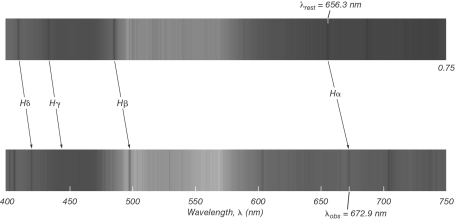
(Multiple Choice)
4.8/5 (82)
(82) The nearest big galaxy, Andromeda, is at an estimated distance of
(Multiple Choice)
4.8/5 (78)
(78) Would you expect life to be more likely (or common) in a spiral galaxy or in an elliptical galaxy? Justify your reasoning with relevant properties from each type of galaxy.
(Essay)
4.7/5 (82)
(82) In most cases it is impossible to observe the host galaxies of quasars because
(Multiple Choice)
4.9/5 (68)
(68) How do we know that the stellar disks in spiral galaxies are flat? How do we know that elliptical galaxies are not flat?
(Essay)
4.9/5 (88)
(88) How have astronomers searched for evidence of MACHOs in the halo of the Milky Way?
(Multiple Choice)
4.9/5 (71)
(71) In some radio galaxies, we see only one side of the jet because
(Multiple Choice)
4.9/5 (69)
(69) Why do the light gray bands (labeled Radar, Parallax, etc.) that cover certain ranges of distances in the figure shown below overlap with one another both at the beginning and at the end? 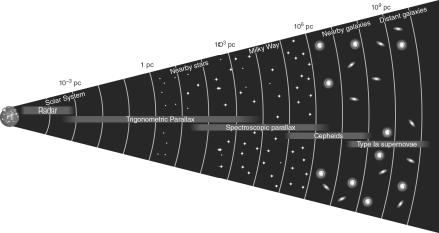
(Essay)
4.9/5 (75)
(75) In the Great Debate of 1920, Curtis and Shapley argued over whether or not
(Multiple Choice)
4.9/5 (87)
(87) What happens to active galaxies when their AGNs run out of fuel?
(Multiple Choice)
4.7/5 (78)
(78) The unified model of AGN suggests that quasars, Seyfert galaxies, and radio galaxies are
(Multiple Choice)
4.9/5 (86)
(86) Order the following objects by the maximum distance from which they can be detected: Cepheid variables, RR Lyrae stars, Type Ia supernovae, and low-mass main-sequence stars.Explain your reasoning.
(Essay)
4.8/5 (77)
(77) Quasars remain unresolved sources, even with the best telescopic observations, because they
(Multiple Choice)
4.8/5 (86)
(86) The rotation curve of a galaxy is a plot of the rotation speed as a function of the
(Multiple Choice)
4.9/5 (87)
(87) 
Filters
- Essay(0)
- Multiple Choice(0)
- Short Answer(0)
- True False(0)
- Matching(0)