



 Chat with AI
Exam 19: Galaxies

Exam 1: Thinking Like an Astronomer 97 Questions
Exam 2: Patterns in the Skymotions of Earth and the Moon101 Questions
Exam 3: Motion of Astronomical Bodies99 Questions
Exam 4: Gravity and Orbits100 Questions
Exam 5: Light100 Questions
Exam 6: The Tools of the Astronomer100 Questions
Exam 7: The Formation of Planetary Systems100 Questions
Exam 8: The Terrestrial Planets and Earths Moon100 Questions
Exam 9: Atmospheres of the Terrestrial Planets100 Questions
Exam 10: Worlds of Gas and Liquidthe Giant Planets100 Questions
Exam 11: Planetary Moons and Rings100 Questions
Exam 12: Dwarf Planets and Small Solar System Bodies100 Questions
Exam 13: Taking the Measure of Stars101 Questions
Exam 14: Our Starthe Sun100 Questions
Exam 15: The Interstellar Medium and Star Formation100 Questions
Exam 16: Evolution of Low-Mass Stars100 Questions
Exam 17: Evolution of High-Mass Stars100 Questions
Exam 18: Relativity and Black Holes97 Questions
Exam 19: Galaxies100 Questions
Exam 20: The Milky Waya Normal Spiral Galaxy100 Questions
Exam 21: The Expanding Universe98 Questions
Exam 22: Cosmology100 Questions
Exam 23: Large-Scale Structure in the Universe103 Questions
Exam 24: Life100 Questions
Select questions type


Why is a higher percentage of distant galaxies classified as AGNs compared with the percentage of galaxies around us locally?
(Essay)
4.9/5  (88)
(88) How do we know that many elliptical galaxies contain significant amounts of dark matter?
(Essay)
4.8/5 (81)
(81) What caused early astronomers to believe that our galaxy is only about 6,000 light-years across?
(Multiple Choice)
4.9/5 (71)
(71) Which of the galactic rotation curves in the figure below is closest to what is actually measured for galaxies? 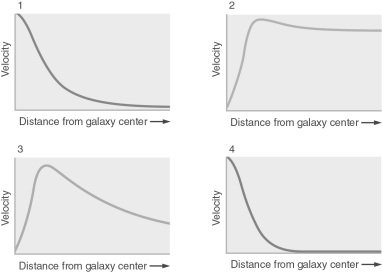
(Multiple Choice)
4.8/5 (76)
(76) If a galaxy has an apparent velocity of 700 km/s, what is its distance if the Hubble constant is assumed to be 70 km/s/Mpc?
(Multiple Choice)
4.7/5 (95)
(95) What makes up the majority of the mass of an individual spiral galaxy?
(Multiple Choice)
4.7/5 (76)
(76) For which galaxies would it be easiest to measure rotation curves?
(Multiple Choice)
4.8/5 (86)
(86) Astronomers can determine the maximum size of a distant, luminous object by
(Multiple Choice)
4.8/5 (81)
(81) The dark features in the HST image in the figure shown below indicate 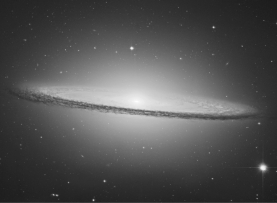
(Multiple Choice)
4.9/5 (75)
(75) What did Edwin Hubble study in the Andromeda Galaxy that proved it was an individual galaxy and not part of our own Milky Way?
(Multiple Choice)
4.7/5 (84)
(84) According to Hubble's law, as the distance of a galaxy ________, its ________ increases.
(Multiple Choice)
4.9/5 (63)
(63) Active star formation does not typically occur in elliptical galaxies because they
(Multiple Choice)
4.8/5 (83)
(83) What is plotted on a rotation curve, and what can it tell us about a galaxy?
(Essay)
4.7/5 (95)
(95) The spectrum of a galaxy is observed to have an H emission line at a wavelength of 856.3 nm.What is its distance if the Hubble constant is assumed to be 70 km/s/Mpc? (Note that the rest wavelength of the H emission line is 656.3 nm.)
(Essay)
4.8/5 (77)
(77) How did Edwin Hubble definitively prove that "spiral nebulae" were individual galaxies that were separate from the Milky Way?
(Essay)
4.8/5 (91)
(91) The formation of the Solar System and the existence of AGNs both demonstrate the
(Multiple Choice)
4.7/5 (77)
(77) What is the difference between a Seyfert galaxy and a normal spiral galaxy?
(Essay)
4.8/5 (76)
(76) 
Filters
- Essay(0)
- Multiple Choice(0)
- Short Answer(0)
- True False(0)
- Matching(0)