



 Chat with AI
Exam 19: Galaxies

Exam 1: Thinking Like an Astronomer 97 Questions
Exam 2: Patterns in the Skymotions of Earth and the Moon101 Questions
Exam 3: Motion of Astronomical Bodies99 Questions
Exam 4: Gravity and Orbits100 Questions
Exam 5: Light100 Questions
Exam 6: The Tools of the Astronomer100 Questions
Exam 7: The Formation of Planetary Systems100 Questions
Exam 8: The Terrestrial Planets and Earths Moon100 Questions
Exam 9: Atmospheres of the Terrestrial Planets100 Questions
Exam 10: Worlds of Gas and Liquidthe Giant Planets100 Questions
Exam 11: Planetary Moons and Rings100 Questions
Exam 12: Dwarf Planets and Small Solar System Bodies100 Questions
Exam 13: Taking the Measure of Stars101 Questions
Exam 14: Our Starthe Sun100 Questions
Exam 15: The Interstellar Medium and Star Formation100 Questions
Exam 16: Evolution of Low-Mass Stars100 Questions
Exam 17: Evolution of High-Mass Stars100 Questions
Exam 18: Relativity and Black Holes97 Questions
Exam 19: Galaxies100 Questions
Exam 20: The Milky Waya Normal Spiral Galaxy100 Questions
Exam 21: The Expanding Universe98 Questions
Exam 22: Cosmology100 Questions
Exam 23: Large-Scale Structure in the Universe103 Questions
Exam 24: Life100 Questions
Select questions type


Using the figure below, estimate for this galaxy the ratio of dark matter mass to total mass
contained within a radius of 100 kpc. 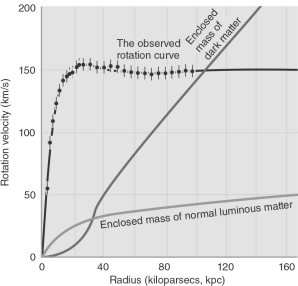
(Essay)
4.8/5  (76)
(76) Roughly what percentage of the total mass of a galaxy is made up of luminous, or normal, matter?
(Multiple Choice)
4.8/5 (80)
(80) Why can Type Ia supernovae be used to determine a galaxy's distance?
(Multiple Choice)
4.9/5 (74)
(74) If you found a galaxy with an H emission line that had a wavelength of 756.3 nm, what would be the galaxy's distance if the Hubble constant is 70 km/s/Mpc? (Note that the rest wavelength of the H emission line is 656.3 nm.)
(Multiple Choice)
4.8/5 (63)
(63) Astronomers have known that galaxies are separate entities outside of our own for roughly the last
(Multiple Choice)
4.8/5 (69)
(69) Which of the following images shows an edge-on spiral galaxy? 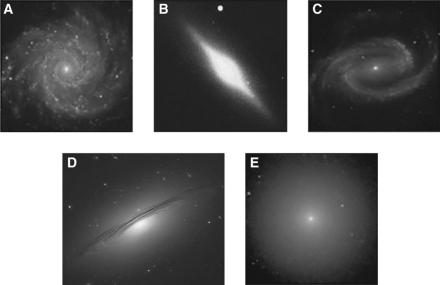
(Multiple Choice)
4.7/5 (79)
(79) The Hubble classification scheme for galaxies sorts them by their
(Multiple Choice)
4.7/5 (88)
(88) Assume that when a supermassive black hole accretes gas, approximately 20 percent of the accreted mass is converted directly into energy, which is radiated away.If a quasar has a luminosity of 1013 LSUN, then what must be its mass accretion rate? Note that the Sun has a luminosity of 4 x1026 W, and a mass of 2 x1030 kg.
(Multiple Choice)
4.9/5 (78)
(78) What do the broad emission lines in quasar spectra tell astronomers about these objects?
(Multiple Choice)
4.8/5 (69)
(69) Name three types of active galactic nuclei and give at least one reason why each is unique.
(Essay)
4.7/5 (78)
(78) A certain spectral line of rest wavelength lrest (i.e., laboratory value) is shifted by 100 nm in a quasar.A second line from the same quasar with a rest wavelength half the (rest) value of the first one would be shifted by
(Multiple Choice)
4.9/5 (71)
(71) How does the appearance of an AGN depend on the viewing angle to the nucleus?
(Essay)
5.0/5 (88)
(88) You observe a reddish galaxy with stars that orbit in random directions.This galaxy is most likely a(n)
(Multiple Choice)
4.9/5 (78)
(78) How do we explain that "billions of galaxies are closer to Earth than the nearest quasar"?
(Essay)
4.9/5 (75)
(75) If you measure the velocity of a cloud of gas that is rotating around the center of a galaxy in a circular orbit with radius R, you can determine the
(Multiple Choice)
4.7/5 (73)
(73) If a Seyfert galaxy's nucleus varies in brightness on the timescale of 10 hours, then what is the approximate upper limit for the size of the emitting region?
(Multiple Choice)
4.9/5 (72)
(72) Which of the following functions correctly illustrates the relation between mean density and black hole mass?
(Multiple Choice)
4.9/5 (83)
(83) If an AGN varies its brightness on a timescale of 4 hours, then what is the size limit of the AGN measured in AU?
(Essay)
4.8/5 (80)
(80) 
Filters
- Essay(0)
- Multiple Choice(0)
- Short Answer(0)
- True False(0)
- Matching(0)