



 Chat with AI
Exam 8: The Terrestrial Planets and Earths Moon

Exam 1: Thinking Like an Astronomer 97 Questions
Exam 2: Patterns in the Skymotions of Earth and the Moon101 Questions
Exam 3: Motion of Astronomical Bodies99 Questions
Exam 4: Gravity and Orbits100 Questions
Exam 5: Light100 Questions
Exam 6: The Tools of the Astronomer100 Questions
Exam 7: The Formation of Planetary Systems100 Questions
Exam 8: The Terrestrial Planets and Earths Moon100 Questions
Exam 9: Atmospheres of the Terrestrial Planets100 Questions
Exam 10: Worlds of Gas and Liquidthe Giant Planets100 Questions
Exam 11: Planetary Moons and Rings100 Questions
Exam 12: Dwarf Planets and Small Solar System Bodies100 Questions
Exam 13: Taking the Measure of Stars101 Questions
Exam 14: Our Starthe Sun100 Questions
Exam 15: The Interstellar Medium and Star Formation100 Questions
Exam 16: Evolution of Low-Mass Stars100 Questions
Exam 17: Evolution of High-Mass Stars100 Questions
Exam 18: Relativity and Black Holes97 Questions
Exam 19: Galaxies100 Questions
Exam 20: The Milky Waya Normal Spiral Galaxy100 Questions
Exam 21: The Expanding Universe98 Questions
Exam 22: Cosmology100 Questions
Exam 23: Large-Scale Structure in the Universe103 Questions
Exam 24: Life100 Questions
Select questions type


Studies of the amount of cratering at different locations on the Moon indicate that

Free
(Multiple Choice)
4.8/5  (79)
(79) Correct Answer: Verified
A
The feature on Mars shown in the image below is ________ named ________. 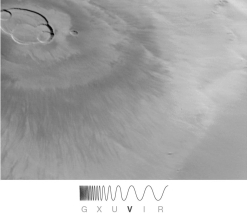
Free
(Multiple Choice)
4.8/5 (79)
(79) Correct Answer:Verified
VerifiedB
Based on the assumption that a liquid-conducting core and rapid rotation both are required for a magnetic dynamo to operate, which terrestrial planets would you expect to have magnetic fields?
(Multiple Choice)
4.8/5 (74)
(74) Which object would have the least effect on our planet if it were to strike Earth?
(Multiple Choice)
4.8/5 (77)
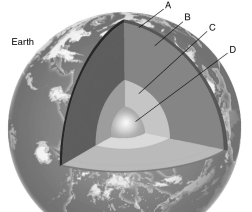
(77) List the names of the four layers of Earth's interior shown in the figure below, going from the outer layer to the innermost layer, and designate whether they are solid or liquid.
(Essay)
4.8/5 (77)
(77) Mars has a diameter that is approximately half that of Earth's.If the interiors of these planets are heated by radioactive decays, how does the heating rate of the interior of Mars compare to that of Earth?
(Multiple Choice)
4.7/5 (71)
(71) Suppose an earthquake occurs on a hypothetical planet.Scientists on the other side of the planet detect primary waves but not secondary waves after the quake occurs.This suggests that
(Multiple Choice)
4.8/5 (87)
(87) Describe the process of how an impact crater and secondary impact craters are formed.
(Essay)
4.8/5 (87)
(87) If there were water (in any phase) on Mars today, where would it likely be? Name two separate pieces of evidence we have that Mars once had flowing water on its surface and how this evidence was obtained.
(Essay)
4.9/5 (87)
(87) Which of the following will be a consequence of Earth's consumption of the bulk of its radioactive "fuel" in the future?
(Multiple Choice)
4.8/5 (86)
(86) Of the following methods, the age of the Solar System can be determined most accurately by
(Multiple Choice)
4.8/5 (65)
(65) A(n) ________ is a location on Earth that experiences frequent volcanic activity.
(Multiple Choice)
5.0/5 (83)
(83) Space rocks less than 100 m in diameter, when they hit the ground, are called
(Multiple Choice)
4.7/5 (81)
(81) To survive passage through Earth's atmosphere without burning or breaking up before it hits the ground, an asteroid must be
(Multiple Choice)
4.9/5 (81)
(81) Which object would have the largest impact if it were to strike Earth?
(Multiple Choice)
4.7/5 (82)
(82) 
Filters
- Essay(0)
- Multiple Choice(0)
- Short Answer(0)
- True False(0)
- Matching(0)