



 Chat with AI
Exam 8: The Terrestrial Planets and Earths Moon

Exam 1: Thinking Like an Astronomer 97 Questions
Exam 2: Patterns in the Skymotions of Earth and the Moon101 Questions
Exam 3: Motion of Astronomical Bodies99 Questions
Exam 4: Gravity and Orbits100 Questions
Exam 5: Light100 Questions
Exam 6: The Tools of the Astronomer100 Questions
Exam 7: The Formation of Planetary Systems100 Questions
Exam 8: The Terrestrial Planets and Earths Moon100 Questions
Exam 9: Atmospheres of the Terrestrial Planets100 Questions
Exam 10: Worlds of Gas and Liquidthe Giant Planets100 Questions
Exam 11: Planetary Moons and Rings100 Questions
Exam 12: Dwarf Planets and Small Solar System Bodies100 Questions
Exam 13: Taking the Measure of Stars101 Questions
Exam 14: Our Starthe Sun100 Questions
Exam 15: The Interstellar Medium and Star Formation100 Questions
Exam 16: Evolution of Low-Mass Stars100 Questions
Exam 17: Evolution of High-Mass Stars100 Questions
Exam 18: Relativity and Black Holes97 Questions
Exam 19: Galaxies100 Questions
Exam 20: The Milky Waya Normal Spiral Galaxy100 Questions
Exam 21: The Expanding Universe98 Questions
Exam 22: Cosmology100 Questions
Exam 23: Large-Scale Structure in the Universe103 Questions
Exam 24: Life100 Questions
Select questions type


Rounded pebbles have been found on Mars.What does this finding suggest?
(Essay)
4.8/5  (77)
(77) If you obtained a sample of a meteorite and determined the abundances of uranium (238U) and lead (207Pb) in it, and found that for every 1 uranium atom there were 15 lead atoms, what would be the age of this rock? Note that this form of uranium decays to this form of lead with a half-life of 700 million years.For simplicity, you can assume that there were no lead atoms of this specific isotope in the rock when it originally formed.
(Multiple Choice)
4.9/5 (82)
(82) Space rocks less than 100 m in diameter, when they burn up in the atmosphere, are called
(Multiple Choice)
4.8/5 (77)
(77) Which planet would you expect to have a larger molten core: a planet of Earth's size or a planet that had half the radius of Earth? Explain why.
(Essay)
4.8/5 (83)
(83) Explain and relate the terms radioisotope, parent element, daughter product, and half-life.
(Essay)
5.0/5 (79)
(79) Based on the age of the light- and dark-colored regions of the Moon and the number of craters observed in these regions, we know that impacts in the inner Solar System
(Multiple Choice)
4.8/5 (61)
(61) Describe one example of tectonic disruption on Mercury, Venus, and Mars, respectively, and explain how they formed.
(Essay)
4.8/5 (66)
(66) How has the radioactive heating of Earth varied from when it was first formed 4.6 billion years ago?
(Essay)
4.9/5 (71)
(71) What is one major difference between the volcanoes on Venus and Mars and the volcanoes on Earth? What might explain this difference?
(Essay)
4.9/5 (79)
(79) The smallest number of craters per square meter are found on the surface of
(Multiple Choice)
4.9/5 (67)
(67) Mars, Venus, and Earth are much less heavily cratered than Mercury and the Moon.This is explained by the fact that
(Multiple Choice)
4.8/5 (85)
(85) The large feature spanning the surface of Mars shown in the figure below is ________ and probably was created by ________. 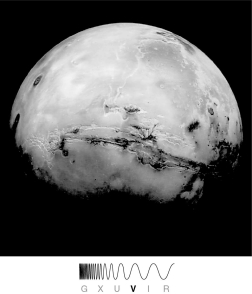
(Multiple Choice)
5.0/5 (77)
(77) 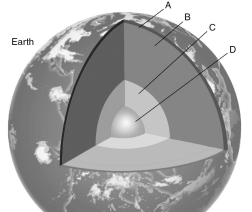
Venus' slow retrograde (backward) rotation is most likely due to
(Multiple Choice)
4.9/5 (88)
(88) Consider an external solar system in which there are three terrestrial planets.All are located far from other objects, so tidal forces aren't significant.If planet A has a radius of 1 Earth
Radius, planet B has a radius of 2 Earth radii, and planet C has a radius of 3 Earth radii, which
Planet has the highest chance of having at least a partially liquid core and a detectable
Magnetic field?
(Multiple Choice)
4.8/5 (74)
(74) The North American Plate and the Pacific Plate are sliding past one another at a rate of approximately 3 cm/yr.San Francisco, which is located on the edge of the North American Plate, is sliding southward toward Los Angeles, which is located on the Pacific Plate.If the cities are currently separated by a distance of 600 km, how many years will it take for the two cities to meet?
(Multiple Choice)
4.9/5 (70)
(70) What will eventually happen to Earth when radioactive decays in its interior cease?
(Multiple Choice)
4.9/5 (81)
(81) If you start with 16 atoms of a parent radioisotope, after how many half-lives will only one atom of the parent remain, on average?
(Multiple Choice)
4.7/5 (81)
(81) The feature shown in the image below is a(n) ________, the largest one of its kind in the Solar System, and is located on the planet ________. 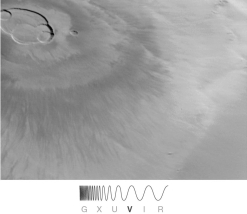
(Multiple Choice)
4.7/5 (84)
(84) The largest volcanic mountains in the Solar System are found on
(Multiple Choice)
4.9/5 (82)
(82) 
Filters
- Essay(0)
- Multiple Choice(0)
- Short Answer(0)
- True False(0)
- Matching(0)