



 Chat with AI
Exam 7: The Formation of Planetary Systems

Exam 1: Thinking Like an Astronomer 97 Questions
Exam 2: Patterns in the Skymotions of Earth and the Moon101 Questions
Exam 3: Motion of Astronomical Bodies99 Questions
Exam 4: Gravity and Orbits100 Questions
Exam 5: Light100 Questions
Exam 6: The Tools of the Astronomer100 Questions
Exam 7: The Formation of Planetary Systems100 Questions
Exam 8: The Terrestrial Planets and Earths Moon100 Questions
Exam 9: Atmospheres of the Terrestrial Planets100 Questions
Exam 10: Worlds of Gas and Liquidthe Giant Planets100 Questions
Exam 11: Planetary Moons and Rings100 Questions
Exam 12: Dwarf Planets and Small Solar System Bodies100 Questions
Exam 13: Taking the Measure of Stars101 Questions
Exam 14: Our Starthe Sun100 Questions
Exam 15: The Interstellar Medium and Star Formation100 Questions
Exam 16: Evolution of Low-Mass Stars100 Questions
Exam 17: Evolution of High-Mass Stars100 Questions
Exam 18: Relativity and Black Holes97 Questions
Exam 19: Galaxies100 Questions
Exam 20: The Milky Waya Normal Spiral Galaxy100 Questions
Exam 21: The Expanding Universe98 Questions
Exam 22: Cosmology100 Questions
Exam 23: Large-Scale Structure in the Universe103 Questions
Exam 24: Life100 Questions
Select questions type


If an astronomer on a planet orbiting a nearby star observed the Sun when Neptune was transiting in front of the Sun, how would the Sun's brightness change? Note that the radius of Neptune is 2.5 * 107 m.

Free
(Multiple Choice)
4.7/5  (77)
(77) Correct Answer: Verified
A
In order for two clumps of dust to stick together in an accretion disk, they must collide at roughly
Free
(Multiple Choice)
4.8/5 (86)
(86) Correct Answer:Verified
VerifiedE
A refractory material is a material that
Free
(Multiple Choice)
4.9/5 (68)
(68) Correct Answer:Verified
VerifiedA
Astronomers have used radial velocity monitoring to discover
(Multiple Choice)
4.8/5 (90)
(90) As the radius, r, of extrasolar planets increases, we expect the amount of light they block from their parent star to change by a factor of ________.
(Multiple Choice)
4.7/5 (87)
(87) What property of an extrasolar planet can be determined directly from the Doppler effect data shown in the figure below? What other properties of the planet can then be determined if the mass of the central star is known? 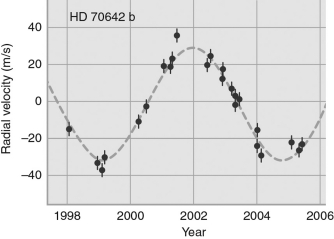
(Essay)
4.7/5 (80)
(80) What happens to the rotation speed of a slowly rotating cloud as it collapses to form a stellar system? Why does this occur?
(Essay)
4.8/5 (76)
(76) Approximately how massive are most of the extrasolar planets that have been discovered using the Doppler effect, and which planet in our Solar System is similar in mass? Why is the Doppler effect method more likely to find massive (rather than low-mass) planets and planets that are close to their stars?
(Essay)
4.8/5 (74)
(74) The atmosphere of which of these Solar System bodies is primary (as opposed to secondary) in origin?
(Multiple Choice)
4.9/5 (71)
(71) What have astronomers and geologists studied to arrive at the same conclusions about Earth's origins?
(Multiple Choice)
4.9/5 (75)
(75) If an interstellar cloud having a diameter of 1016 m and a rotation period of 1 million years were to collapse to form a sphere that had the diameter of our Solar System (approximately 40 AU), what would its rotation period be? Assume the cloud's total mass and angular momentum did not change.
(Multiple Choice)
4.9/5 (66)
(66) What evidence do we have that planetary systems are common in the universe?
(Essay)
5.0/5 (74)
(74) Why did the planetesimals in the asteroid belt never coalesce into a planet?
(Essay)
4.8/5 (89)
(89) What evidence do we have that the accretion disk that formed the Solar System was initially much denser near its center?
(Essay)
4.9/5 (75)
(75) How do astronomers explain the basic difference in composition between the inner planets and the outer planets?
(Essay)
4.9/5 (77)
(77) The object shown in the figure below is a ________ and the dark circles, or "lanes," are mostly likely due to ________. 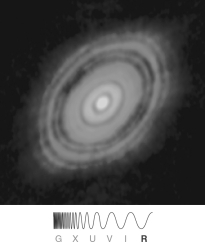
(Multiple Choice)
4.7/5 (87)
(87) 
Filters
- Essay(0)
- Multiple Choice(0)
- Short Answer(0)
- True False(0)
- Matching(0)