



 Chat with AI
Exam 7: The Formation of Planetary Systems

Exam 1: Thinking Like an Astronomer 97 Questions
Exam 2: Patterns in the Skymotions of Earth and the Moon101 Questions
Exam 3: Motion of Astronomical Bodies99 Questions
Exam 4: Gravity and Orbits100 Questions
Exam 5: Light100 Questions
Exam 6: The Tools of the Astronomer100 Questions
Exam 7: The Formation of Planetary Systems100 Questions
Exam 8: The Terrestrial Planets and Earths Moon100 Questions
Exam 9: Atmospheres of the Terrestrial Planets100 Questions
Exam 10: Worlds of Gas and Liquidthe Giant Planets100 Questions
Exam 11: Planetary Moons and Rings100 Questions
Exam 12: Dwarf Planets and Small Solar System Bodies100 Questions
Exam 13: Taking the Measure of Stars101 Questions
Exam 14: Our Starthe Sun100 Questions
Exam 15: The Interstellar Medium and Star Formation100 Questions
Exam 16: Evolution of Low-Mass Stars100 Questions
Exam 17: Evolution of High-Mass Stars100 Questions
Exam 18: Relativity and Black Holes97 Questions
Exam 19: Galaxies100 Questions
Exam 20: The Milky Waya Normal Spiral Galaxy100 Questions
Exam 21: The Expanding Universe98 Questions
Exam 22: Cosmology100 Questions
Exam 23: Large-Scale Structure in the Universe103 Questions
Exam 24: Life100 Questions
Select questions type


In the figure below, which of the dips in the brightness of the star is (are) caused by the transit of the planet with the largest orbital period? 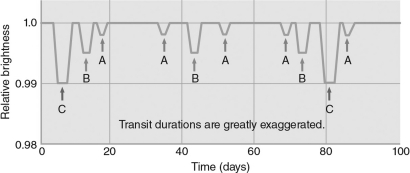
(Multiple Choice)
5.0/5  (79)
(79) Approximately how much mass was there in the protoplanetary disk out of which the planets formed, compared to the mass of the Sun?
(Multiple Choice)
4.9/5 (77)
(77) What are some limitations of the transit method of exoplanet detection?
(Essay)
4.8/5 (77)
(77) A planet is discovered orbiting a 2.0 Msolar star with a period of 0.2 (Earth) years.What is the semimajor axis of this planet?
(Essay)
4.8/5 (75)
(75) Explain why there are significant amounts of methane and ammonia in the atmospheres of Uranus and Neptune but not nearly as much in the atmospheres of Jupiter and Saturn.
(Essay)
4.7/5 (75)
(75) The solid form of a volatile material is generally referred to as a(n)
(Multiple Choice)
4.8/5 (81)
(81) What is the most accurate method to detect Earth-sized exoplanets with the telescopes and instrumentation that exist today?
(Multiple Choice)
4.8/5 (92)
(92) The difference in composition between the giant planets and the terrestrial planets is most likely caused by the fact that
(Multiple Choice)
4.7/5 (84)
(84) Explain the nebular hypothesis, and describe two observations that support it.
(Essay)
4.8/5 (61)
(61) Astronomers have discovered other stars with planets that are more massive than Earth, but less massive than Neptune, that are called
(Multiple Choice)
4.7/5 (73)
(73) Consider a small parcel of gas in the cloud out of which the Sun formed that initially was located in the accretion disk at a distance of 10 AU from the Sun and rotating around it with a speed of 10 km/s.If this parcel of gas eventually found its way to a distance of 1 AU from the Sun without changing its orbital angular momentum, what would be its new rotation speed?
(Multiple Choice)
4.9/5 (72)
(72) Jupiter's radius is contracting at a rate of 1 mm per year, which will result in
(Multiple Choice)
4.9/5 (80)
(80) Earth-sized planets have been found using the ________ method(s).
(Multiple Choice)
5.0/5 (73)
(73) That fact that all major Solar System objects orbit the Sun in the same direction, and mostly with the same direction of spin, is the original evidence for
(Multiple Choice)
4.8/5 (62)
(62) How much material in an accretion disk goes into forming the planets, moons, and smaller objects?
(Multiple Choice)
4.9/5 (65)
(65) How did the formation of our Moon differ from the formation of the Galilean moons of Jupiter?
(Essay)
4.8/5 (71)
(71) Hot Jupiters were the first exoplanets to be discovered, and have since been found to be
(Multiple Choice)
4.8/5 (70)
(70) Explain why most of the extrasolar planets that astronomers first detected were so-called hot Jupiters.
(Essay)
4.8/5 (86)
(86) 
Filters
- Essay(0)
- Multiple Choice(0)
- Short Answer(0)
- True False(0)
- Matching(0)