



 Chat with AI
Exam 12: Dwarf Planets and Small Solar System Bodies

Exam 1: Thinking Like an Astronomer 97 Questions
Exam 2: Patterns in the Skymotions of Earth and the Moon101 Questions
Exam 3: Motion of Astronomical Bodies99 Questions
Exam 4: Gravity and Orbits100 Questions
Exam 5: Light100 Questions
Exam 6: The Tools of the Astronomer100 Questions
Exam 7: The Formation of Planetary Systems100 Questions
Exam 8: The Terrestrial Planets and Earths Moon100 Questions
Exam 9: Atmospheres of the Terrestrial Planets100 Questions
Exam 10: Worlds of Gas and Liquidthe Giant Planets100 Questions
Exam 11: Planetary Moons and Rings100 Questions
Exam 12: Dwarf Planets and Small Solar System Bodies100 Questions
Exam 13: Taking the Measure of Stars101 Questions
Exam 14: Our Starthe Sun100 Questions
Exam 15: The Interstellar Medium and Star Formation100 Questions
Exam 16: Evolution of Low-Mass Stars100 Questions
Exam 17: Evolution of High-Mass Stars100 Questions
Exam 18: Relativity and Black Holes97 Questions
Exam 19: Galaxies100 Questions
Exam 20: The Milky Waya Normal Spiral Galaxy100 Questions
Exam 21: The Expanding Universe98 Questions
Exam 22: Cosmology100 Questions
Exam 23: Large-Scale Structure in the Universe103 Questions
Exam 24: Life100 Questions
Select questions type


The Kirkwood gaps are regularly spaced gaps in the asteroid distribution.What causes the gaps to appear?

Free
(Multiple Choice)
4.7/5  (81)
(81) Correct Answer: Verified
C
Why are asteroids considered to be excellent sources for studying conditions in the early Solar System, whereas planets themselves are not?
Free
(Essay)
4.8/5 (67)
(67) Correct Answer:Verified
VerifiedAsteroids are planetesimals that never accreted onto planets during planet formation,so they have not been subject to any of the weathering or processing that planets have undergone.As such,they maintain the chemical and physical signatures of conditions in the early Solar System and are invaluable for study.
If we know the semimajor axis and ________ of an object's orbit, then we can determine the object's closest and farthest points from the mass it is orbiting.
Free
(Multiple Choice)
4.9/5 (95)
(95) Correct Answer:Verified
VerifiedB
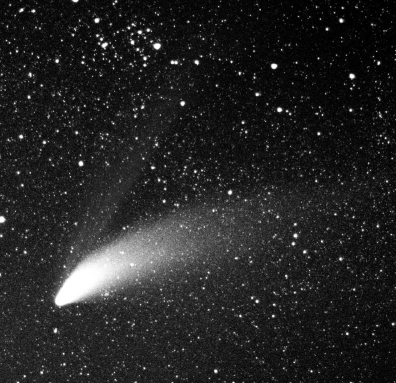
How does a comet's appearance change as it moves from the outer Solar System to the inner Solar System?
(Essay)
4.9/5 (100)
(100) 
In November 2005, the Japanese spacecraft Hayabusa brought back a sample from which type of object for the first time?
(Multiple Choice)
4.9/5 (79)
(79) Identify the meteorites in the figure below, and briefly describe each. 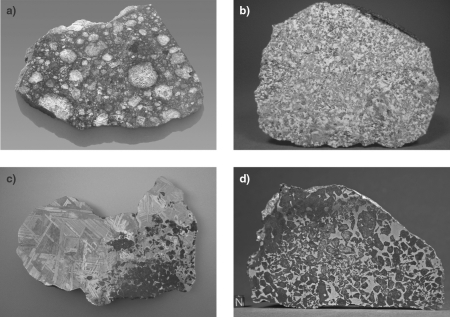
(Essay)
4.9/5 (79)
(79) The meteoroids in the Leonids meteor shower, which occurs every November, come from
(Multiple Choice)
4.8/5 (76)
(76) Approximately how often does a spectacularly active, visible comet appear in Earth's sky?
(Multiple Choice)
4.9/5 (77)
(77) Comets have highly eccentric orbits, with eccentricities of 0.95 to 0.99 being common.Suppose a certain comet has an eccentricity of 0.99.If the semimajor axis of its orbit is 2,500 AU, what will be its distance at perihelion and at aphelion? Is this most likely a Kuiper Belt object or an Oort Cloud comet? (Note: For an ellipse, a(1+ e) is the distance from one focus to the farther edge of the long axis and a(1 -e) is the distance from the same focus to the closer edge of the long axis.)
(Essay)
4.9/5 (81)
(81) The most straightforward way to determine the mass of an asteroid is if it has
(Multiple Choice)
4.7/5 (73)
(73) Which of the following likely helps replenish the zodiacal dust in the vicinity of Earth the most?
(Multiple Choice)
4.8/5 (65)
(65) How is it possible for the tail of a comet to actually move ahead of the comet itself?
(Essay)
4.8/5 (85)
(85) Name three properties of the dwarf planets Pluto and Eris that are similar.
(Essay)
4.9/5 (78)
(78) Suppose we discover a comet whose orbit was very highly eccentric, retrograde, had a very large tilt with respect to the ecliptic plane, and had a period of 30,000 years.Where is the most likely place of origin for this comet?
(Multiple Choice)
4.8/5 (70)
(70) 
Filters
- Essay(0)
- Multiple Choice(0)
- Short Answer(0)
- True False(0)
- Matching(0)