



 Chat with AI
Exam 12: Dwarf Planets and Small Solar System Bodies

Exam 1: Thinking Like an Astronomer 97 Questions
Exam 2: Patterns in the Skymotions of Earth and the Moon101 Questions
Exam 3: Motion of Astronomical Bodies99 Questions
Exam 4: Gravity and Orbits100 Questions
Exam 5: Light100 Questions
Exam 6: The Tools of the Astronomer100 Questions
Exam 7: The Formation of Planetary Systems100 Questions
Exam 8: The Terrestrial Planets and Earths Moon100 Questions
Exam 9: Atmospheres of the Terrestrial Planets100 Questions
Exam 10: Worlds of Gas and Liquidthe Giant Planets100 Questions
Exam 11: Planetary Moons and Rings100 Questions
Exam 12: Dwarf Planets and Small Solar System Bodies100 Questions
Exam 13: Taking the Measure of Stars101 Questions
Exam 14: Our Starthe Sun100 Questions
Exam 15: The Interstellar Medium and Star Formation100 Questions
Exam 16: Evolution of Low-Mass Stars100 Questions
Exam 17: Evolution of High-Mass Stars100 Questions
Exam 18: Relativity and Black Holes97 Questions
Exam 19: Galaxies100 Questions
Exam 20: The Milky Waya Normal Spiral Galaxy100 Questions
Exam 21: The Expanding Universe98 Questions
Exam 22: Cosmology100 Questions
Exam 23: Large-Scale Structure in the Universe103 Questions
Exam 24: Life100 Questions
Select questions type


You find a blackened rock lying on top of the snow.You find that it is fairly dense and suspect it might be a meteorite.You take it to a lab, where it is cut open to reveal many small spherical, glassy particles set into the surrounding rock.Is this a meteorite? Why or why not?
(Essay)
4.7/5  (87)
(87) The nucleus of the typical comet is approximately ________ in size.
(Multiple Choice)
4.7/5 (78)
(78) Why do some short-period comets have orbits within the orbit of Jupiter?
(Multiple Choice)
4.8/5 (85)
(85) Consider three comets that have orbital periods of 100, 1,000, and 100,000 years.Where would each of these comets likely originate, in the Oort Cloud or the Kuiper Belt? If you wanted to study material that was the best example of pristine Solar System material, which would you study?
(Essay)
4.9/5 (88)
(88) The depth at which meteorites are found in Antarctica tells scientists
(Multiple Choice)
4.7/5 (79)
(79) Earth was impacted by a massive asteroid roughly 65 million years ago.Summarize this impact's effects on various forms of life: plants, reptiles, mammals, aquatic life.
(Essay)
4.9/5 (71)
(71) The major property that differentiates a dwarf planet from a major planet is that dwarf planets
(Multiple Choice)
4.9/5 (65)
(65) In its 1986 trip around the Sun, it was estimated that Comet Halley lost approximately 100 billion kg of material.The total mass of the nucleus was estimated to be 3 *1014 kg.Assuming the mass loss rate is constant with each passage, and assuming the nucleus remains intact until there is nothing left, how many more times will we see Comet Halley? Explain why your answer is an upper limit.
(Essay)
4.9/5 (59)
(59) How might impacts have helped increase Earth's water supply in the early history of the Solar System?
(Essay)
4.8/5 (87)
(87) Describe two challenges faced by astronomers in identifying potential collisions between Earth and Earth-crossing asteroids and meteorites.
(Essay)
4.9/5 (68)
(68) The image of asteroid Vesta, shown in the figure below, must have been taken by 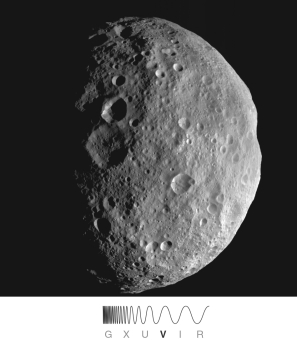
(Multiple Choice)
4.8/5 (69)
(69) Remnants of volcanic activity on the asteroid Vesta indicate that members of the asteroid belt
(Multiple Choice)
5.0/5 (80)
(80) Carbonaceous chondrite meteorites are fragments of which type of asteroid?
(Multiple Choice)
4.8/5 (72)
(72) 
Filters
- Essay(0)
- Multiple Choice(0)
- Short Answer(0)
- True False(0)
- Matching(0)