



 Chat with AI
Exam 16: Evolution of Low-Mass Stars

Exam 1: Thinking Like an Astronomer 97 Questions
Exam 2: Patterns in the Skymotions of Earth and the Moon101 Questions
Exam 3: Motion of Astronomical Bodies99 Questions
Exam 4: Gravity and Orbits100 Questions
Exam 5: Light100 Questions
Exam 6: The Tools of the Astronomer100 Questions
Exam 7: The Formation of Planetary Systems100 Questions
Exam 8: The Terrestrial Planets and Earths Moon100 Questions
Exam 9: Atmospheres of the Terrestrial Planets100 Questions
Exam 10: Worlds of Gas and Liquidthe Giant Planets100 Questions
Exam 11: Planetary Moons and Rings100 Questions
Exam 12: Dwarf Planets and Small Solar System Bodies100 Questions
Exam 13: Taking the Measure of Stars101 Questions
Exam 14: Our Starthe Sun100 Questions
Exam 15: The Interstellar Medium and Star Formation100 Questions
Exam 16: Evolution of Low-Mass Stars100 Questions
Exam 17: Evolution of High-Mass Stars100 Questions
Exam 18: Relativity and Black Holes97 Questions
Exam 19: Galaxies100 Questions
Exam 20: The Milky Waya Normal Spiral Galaxy100 Questions
Exam 21: The Expanding Universe98 Questions
Exam 22: Cosmology100 Questions
Exam 23: Large-Scale Structure in the Universe103 Questions
Exam 24: Life100 Questions
Select questions type


The main-sequence lifetime of a star is given by which equation?

Free
(Multiple Choice)
4.9/5  (85)
(85) Correct Answer: Verified
A
Place the evolutionary stages shown in the figure below in order from earliest to latest. 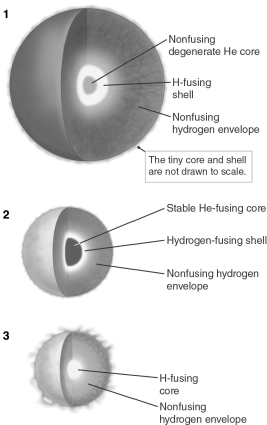
Free
(Multiple Choice)
4.9/5 (83)
(83) Correct Answer:Verified
VerifiedD
A star's surface temperature during the horizontal branch phase is determined primarily by its
Free
(Multiple Choice)
4.8/5 (78)
(78) Correct Answer:Verified
VerifiedB
During evolutionary phase A in the figure shown below, the star is ________.In evolutionary phase B, it is ________. 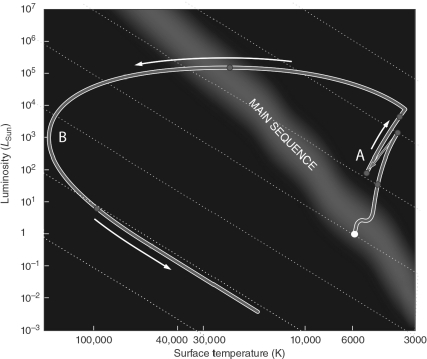
(Multiple Choice)
4.8/5 (80)
(80) How can the core of a star be degenerate with respect to the electrons but nondegenerate with respect to the nuclei?
(Essay)
4.8/5 (87)
(87) When the Sun becomes an AGB star, its radius will be approximately 100 RSUN.If its mass at this point will be approximately the same as it is now, how will its surface gravity as an AGB star compare to its present surface gravity as a main-sequence star? (Note that g =GM/R2.)
(Essay)
4.8/5 (93)
(93) Considering their lifetimes, which types of main-sequence stars would be more likely to have planets with complex life?
(Essay)
4.8/5 (69)
(69) What is a white dwarf star, and what are the major properties of such a star?
(Essay)
4.9/5 (84)
(84) What types of chemical elements can low-mass stars contribute to the enrichment of the interstellar medium and how are they produced?
(Essay)
4.9/5 (85)
(85) What is a planetary nebula, and why are many planetary nebulae not symmetrical?
(Essay)
4.8/5 (84)
(84) As a low-mass main-sequence star runs out of fuel in its core, it grows more luminous. How is this possible?
(Multiple Choice)
5.0/5 (89)
(89) A 1-MSUN star in a binary system could eventually create which chemical element and eject it into the interstellar medium?
(Multiple Choice)
5.0/5 (74)
(74) Describe the similarities and differences between the helium flash in the core of a red giant star and the explosive hydrogen burning on the surface of a white dwarf star.
(Essay)
4.8/5 (91)
(91) When matter is packed so tightly together that quantum physics will not allow the electrons to get any closer, it is called
(Multiple Choice)
4.8/5 (66)
(66) When helium fusion begins in the core of a red giant star, the situation quickly gets out of control because electron-degeneracy pressure does not respond to changes in
(Multiple Choice)
4.7/5 (80)
(80) 
Filters
- Essay(0)
- Multiple Choice(0)
- Short Answer(0)
- True False(0)
- Matching(0)