



 Chat with AI
Exam 16: Evolution of Low-Mass Stars

Exam 1: Thinking Like an Astronomer 97 Questions
Exam 2: Patterns in the Skymotions of Earth and the Moon101 Questions
Exam 3: Motion of Astronomical Bodies99 Questions
Exam 4: Gravity and Orbits100 Questions
Exam 5: Light100 Questions
Exam 6: The Tools of the Astronomer100 Questions
Exam 7: The Formation of Planetary Systems100 Questions
Exam 8: The Terrestrial Planets and Earths Moon100 Questions
Exam 9: Atmospheres of the Terrestrial Planets100 Questions
Exam 10: Worlds of Gas and Liquidthe Giant Planets100 Questions
Exam 11: Planetary Moons and Rings100 Questions
Exam 12: Dwarf Planets and Small Solar System Bodies100 Questions
Exam 13: Taking the Measure of Stars101 Questions
Exam 14: Our Starthe Sun100 Questions
Exam 15: The Interstellar Medium and Star Formation100 Questions
Exam 16: Evolution of Low-Mass Stars100 Questions
Exam 17: Evolution of High-Mass Stars100 Questions
Exam 18: Relativity and Black Holes97 Questions
Exam 19: Galaxies100 Questions
Exam 20: The Milky Waya Normal Spiral Galaxy100 Questions
Exam 21: The Expanding Universe98 Questions
Exam 22: Cosmology100 Questions
Exam 23: Large-Scale Structure in the Universe103 Questions
Exam 24: Life100 Questions
Select questions type


One star in a binary will almost always become a red giant before the other because
(Multiple Choice)
4.9/5  (81)
(81) Using the data in the figure shown below, identify the spectral type of a star that has a main-sequence lifetime of about 500 billion years. 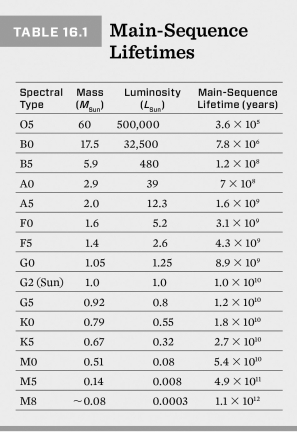
(Multiple Choice)
4.8/5 (74)
(74) As a white dwarf star gradually cools, its radius stays approximately constant.What is happening to the white dwarf's luminosity?
(Multiple Choice)
4.8/5 (79)
(79) What would you need to measure in a planetary nebula to determine how long ago its parent star died?
(Multiple Choice)
4.9/5 (79)
(79) ________ keeps the core of a red giant star from collapsing.
(Multiple Choice)
5.0/5 (83)
(83) What is the escape velocity from the surface of a 1 MSUN AGB star that has a radius of 100 RSUN?
(Multiple Choice)
4.9/5 (73)
(73) Why is a star's time as a horizontal branch star so much shorter than its time as a main-sequence star?
(Essay)
4.9/5 (76)
(76) When a star depletes its core supply of hydrogen, the core will
(Multiple Choice)
4.9/5 (86)
(86) When a spectral-type G2 star like the Sun leaves the main sequence, its
(Multiple Choice)
4.9/5 (67)
(67) If a main-sequence star's core temperature increased, fusion reaction rates would ________ because the protons would be moving ________.
(Multiple Choice)
5.0/5 (70)
(70) Explain what the triple-alpha process is and when it takes place in evolving stars.
(Essay)
4.8/5 (85)
(85) The largest low-mass stars have masses that are approximately
(Multiple Choice)
4.8/5 (72)
(72) You observe a 0.8 MSUN white dwarf in a binary orbit around a main-sequence star of mass 1.4 MSUN.Which of the following is most likely the original mass of the star that became the white dwarf?
(Multiple Choice)
4.8/5 (84)
(84) Calculate the main-sequence lifetimes of the following stars of different spectral types: B0 (18 MSUN), B5 (6 MSUN), A5 (2 MSUN), F5 (1.3 MSUN), and M0 (0.5 MSUN).What trend do you notice in your results?
(Essay)
4.7/5 (82)
(82) When a star is stably fusing helium in its core, it is a ________ star.
(Multiple Choice)
4.8/5 (78)
(78) 
Filters
- Essay(0)
- Multiple Choice(0)
- Short Answer(0)
- True False(0)
- Matching(0)