



 Chat with AI
Exam 16: Evolution of Low-Mass Stars

Exam 1: Thinking Like an Astronomer 97 Questions
Exam 2: Patterns in the Skymotions of Earth and the Moon101 Questions
Exam 3: Motion of Astronomical Bodies99 Questions
Exam 4: Gravity and Orbits100 Questions
Exam 5: Light100 Questions
Exam 6: The Tools of the Astronomer100 Questions
Exam 7: The Formation of Planetary Systems100 Questions
Exam 8: The Terrestrial Planets and Earths Moon100 Questions
Exam 9: Atmospheres of the Terrestrial Planets100 Questions
Exam 10: Worlds of Gas and Liquidthe Giant Planets100 Questions
Exam 11: Planetary Moons and Rings100 Questions
Exam 12: Dwarf Planets and Small Solar System Bodies100 Questions
Exam 13: Taking the Measure of Stars101 Questions
Exam 14: Our Starthe Sun100 Questions
Exam 15: The Interstellar Medium and Star Formation100 Questions
Exam 16: Evolution of Low-Mass Stars100 Questions
Exam 17: Evolution of High-Mass Stars100 Questions
Exam 18: Relativity and Black Holes97 Questions
Exam 19: Galaxies100 Questions
Exam 20: The Milky Waya Normal Spiral Galaxy100 Questions
Exam 21: The Expanding Universe98 Questions
Exam 22: Cosmology100 Questions
Exam 23: Large-Scale Structure in the Universe103 Questions
Exam 24: Life100 Questions
Select questions type


The 8Be nucleus is highly unstable, and would break apart after only 10-12 seconds if left alone.Explain why it is nevertheless able to participate in the triple-alpha process.
(Essay)
4.9/5  (74)
(74) If there were mixing processes in a main-sequence star with a radiative zone (there aren't) that churned up all the material in the interior, we would expect that the main-sequence lifetime would be ________ because ________.
(Multiple Choice)
4.8/5 (81)
(81) If an 0.8 MSUN white dwarf could accrete matter from a binary companion at a rate of 10-9 MSUN/yr, how long would it take before it exploded as a Type Ia supernova?
(Multiple Choice)
4.7/5 (66)
(66) Use the figure shown below and the relationship t M/L to estimate the main-sequence lifetime of a star with a mass equal to 10 times that of the Sun.(Note that the Sun's main-sequence lifetime is about 1010 years.) 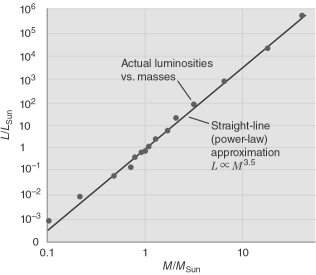
(Multiple Choice)
4.9/5 (86)
(86) An asymptotic giant branch star loses mass to the interstellar medium because
(Multiple Choice)
4.9/5 (90)
(90) Even while the Sun is still on the main sequence, it may eventually threaten life on Earth due to its
(Multiple Choice)
4.8/5 (74)
(74) Given the figure below, explain the three different ways that a Type Ia supernova can be produced.What do all three have in common? 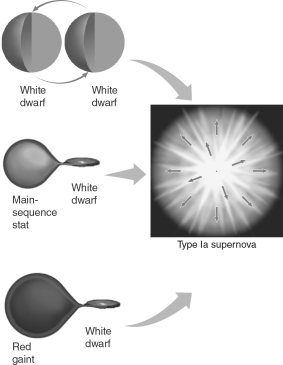
(Essay)
4.8/5 (68)
(68) If a main-sequence star were gaining mass by being in an interacting binary system, what would happen to that star's luminosity and why?
(Multiple Choice)
4.8/5 (69)
(69) Describe the structure of a red giant star just before the helium flash takes place.How does this compare with the structure of a horizontal branch star?
(Essay)
4.9/5 (86)
(86) When a star leaves the main sequence, which of the following is a possible outcome for a planet orbiting that star?
(Multiple Choice)
4.7/5 (76)
(76) A low-mass star that burns helium in its core and hydrogen in a shell surrounding the core is ________ than a similar star that burns hydrogen only ________.
(Multiple Choice)
4.8/5 (75)
(75) If the Milky Way formed stars at approximately a constant rate over the last 14 billion years, what fraction of the M-type stars that ever formed in it can still be found as main-sequence stars today? (Note that M-type stars have a mass of approximately 0.5 MSUN.)
(Multiple Choice)
4.9/5 (73)
(73) Asymptotic giant branch stars have high mass-loss rates because they
(Multiple Choice)
4.8/5 (75)
(75) As a main-sequence star burns its core supply of hydrogen, what happens?
(Multiple Choice)
4.8/5 (61)
(61) Given the figure below, identify the type of star that would be found at each label. 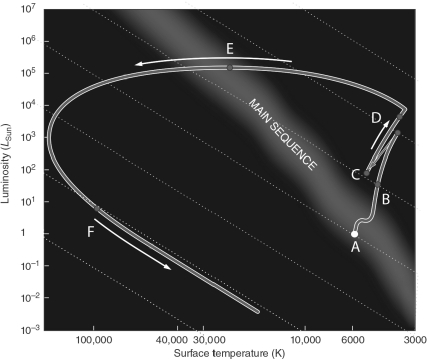
(Essay)
4.8/5 (76)
(76) The percentage of hydrogen in the Sun's core today is roughly ________ of what it was originally.
(Multiple Choice)
4.8/5 (83)
(83) 
Filters
- Essay(0)
- Multiple Choice(0)
- Short Answer(0)
- True False(0)
- Matching(0)