



 Chat with AI
Exam 16: Evolution of Low-Mass Stars

Exam 1: Thinking Like an Astronomer 97 Questions
Exam 2: Patterns in the Skymotions of Earth and the Moon101 Questions
Exam 3: Motion of Astronomical Bodies99 Questions
Exam 4: Gravity and Orbits100 Questions
Exam 5: Light100 Questions
Exam 6: The Tools of the Astronomer100 Questions
Exam 7: The Formation of Planetary Systems100 Questions
Exam 8: The Terrestrial Planets and Earths Moon100 Questions
Exam 9: Atmospheres of the Terrestrial Planets100 Questions
Exam 10: Worlds of Gas and Liquidthe Giant Planets100 Questions
Exam 11: Planetary Moons and Rings100 Questions
Exam 12: Dwarf Planets and Small Solar System Bodies100 Questions
Exam 13: Taking the Measure of Stars101 Questions
Exam 14: Our Starthe Sun100 Questions
Exam 15: The Interstellar Medium and Star Formation100 Questions
Exam 16: Evolution of Low-Mass Stars100 Questions
Exam 17: Evolution of High-Mass Stars100 Questions
Exam 18: Relativity and Black Holes97 Questions
Exam 19: Galaxies100 Questions
Exam 20: The Milky Waya Normal Spiral Galaxy100 Questions
Exam 21: The Expanding Universe98 Questions
Exam 22: Cosmology100 Questions
Exam 23: Large-Scale Structure in the Universe103 Questions
Exam 24: Life100 Questions
Select questions type


The figure below depicts the evolution in chemical composition of the Sun's interior at three different times during its life.How do the relative percentages of hydrogen and helium change at a fractional radius of 0.1 solar radii, from the time the Sun formed until it exhausts its core supply of hydrogen in 5 billion years? 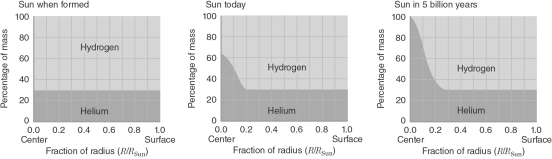
(Essay)
4.8/5  (74)
(74) As a star evolves through its post-main-sequence phases, what effect might be had on planets orbiting this star?
(Essay)
4.8/5 (86)
(86) Why does the core of a main-sequence star have to be hotter to burn helium into carbon than hydrogen into helium?
(Essay)
4.9/5 (74)
(74) What ionizes the gas in a planetary nebula and makes it visible?
(Multiple Choice)
4.8/5 (81)
(81) Novae and Type Ia supernovae can occur in binary star systems because ________ can mean large differences in their ________.
(Multiple Choice)
4.8/5 (79)
(79) The ________ a main-sequence star is, the more hydrogen it has to burn, and the ________ its main-sequence lifetime.
(Multiple Choice)
4.8/5 (76)
(76) Considering how long it took for life to arise on Earth, which of the stellar spectral types shown below would be the LEAST likely to have planets with life?
(Multiple Choice)
4.8/5 (77)
(77) In a white dwarf, what is the source of pressure that halts its contraction as it cools?
(Multiple Choice)
4.8/5 (87)
(87) As a red giant star evolves, hydrogen shell burning proceeds increasingly faster due to
(Multiple Choice)
4.9/5 (76)
(76) Consider a 1 MSUN star's journey up the red giant branch.Its luminosity will change from 10 LSUN to nearly 1,000 LSUN.How will its temperature and radius change as the star ascends? (Recall that
L  R2T4.)
 (Essay)
4.9/5 (74)
(74) What causes a star to leave the red giant phase and settle on the horizontal branch?
(Essay)
4.8/5 (78)
(78) Explain the two different forms of pressure that support the core of a low-mass main-sequence star and the core of a low-mass red giant star.
(Essay)
5.0/5 (79)
(79) The figure below depicts helium fusion in a late-stage star with certain elements labeled A, B, and C.What are these elements, in the order A, B, C? 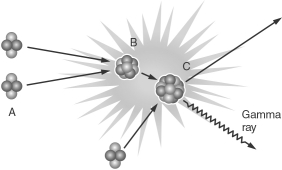
(Multiple Choice)
4.7/5 (96)
(96) Using the figure shown below, identify the star with the smallest radius. 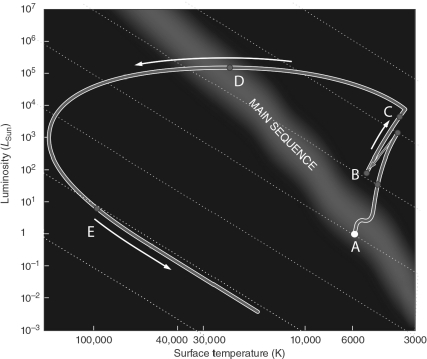
(Multiple Choice)
4.8/5 (84)
(84) What types of stars cause Type Ia supernovae, and what makes them explode?
(Essay)
4.9/5 (80)
(80) A star like the Sun will eventually become a(n) ________ star.
(Multiple Choice)
5.0/5 (71)
(71) How many times longer does a 2 MSUN main-sequence star live compared to a 10 MSUN main-sequence star?
(Essay)
4.8/5 (78)
(78) 
Filters
- Essay(0)
- Multiple Choice(0)
- Short Answer(0)
- True False(0)
- Matching(0)