



 Chat with AI
Exam 6: The Tools of the Astronomer

Exam 1: Thinking Like an Astronomer 97 Questions
Exam 2: Patterns in the Skymotions of Earth and the Moon101 Questions
Exam 3: Motion of Astronomical Bodies99 Questions
Exam 4: Gravity and Orbits100 Questions
Exam 5: Light100 Questions
Exam 6: The Tools of the Astronomer100 Questions
Exam 7: The Formation of Planetary Systems100 Questions
Exam 8: The Terrestrial Planets and Earths Moon100 Questions
Exam 9: Atmospheres of the Terrestrial Planets100 Questions
Exam 10: Worlds of Gas and Liquidthe Giant Planets100 Questions
Exam 11: Planetary Moons and Rings100 Questions
Exam 12: Dwarf Planets and Small Solar System Bodies100 Questions
Exam 13: Taking the Measure of Stars101 Questions
Exam 14: Our Starthe Sun100 Questions
Exam 15: The Interstellar Medium and Star Formation100 Questions
Exam 16: Evolution of Low-Mass Stars100 Questions
Exam 17: Evolution of High-Mass Stars100 Questions
Exam 18: Relativity and Black Holes97 Questions
Exam 19: Galaxies100 Questions
Exam 20: The Milky Waya Normal Spiral Galaxy100 Questions
Exam 21: The Expanding Universe98 Questions
Exam 22: Cosmology100 Questions
Exam 23: Large-Scale Structure in the Universe103 Questions
Exam 24: Life100 Questions
Select questions type


LIGO and VIRGO are facilities that detect

Free
(Multiple Choice)
4.9/5  (85)
(85) Correct Answer: Verified
B
Which of the following is the biggest disadvantage of putting a telescope in space?
Free
(Multiple Choice)
4.7/5 (75)
(75) Correct Answer:Verified
VerifiedE
Landers, rovers, and/or atmospheric probes have visited which object(s) listed below in an effort to gain new information about our Solar System?
(Multiple Choice)
4.9/5 (78)
(78) A large region of ________ wavelengths are not affected in any way by Earth's atmosphere, and so astronomers can effectively observe at these wavelengths even at sea level.
(Multiple Choice)
4.9/5 (85)
(85) The diffraction limit of a 4-m telescope is ________ than that of a 2-m telescope.
(Multiple Choice)
4.8/5 (78)
(78) Which property of light is responsible for chromatic aberration?
(Multiple Choice)
4.7/5 (86)
(86) An object sits infinitely far away from a parabolic mirror.At what distance from the mirror will its image be created?
(Multiple Choice)
4.8/5 (82)
(82) Discuss two tools that modern astronomers use to explore the cosmos that are different from traditional optical telescopes and give an example of how and why each is used.
(Essay)
4.9/5 (73)
(73) What geographic properties should be considered when choosing a location on Earth for a ground-based research telescope, in order to get the best possible resolution and view of the sky? Name and discuss the reasoning behind at least two such properties.
(Essay)
4.8/5 (72)
(72) Label the eyepiece, primary mirror, secondary mirror, focus, and focal length of the telescope shown in the figure below. 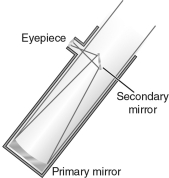
(Essay)
4.9/5 (79)
(79) Why does combining the light from smaller telescopes give observation results comparable to those of a single large telescope with a diameter equal to the separation of the two smaller telescopes?
(Essay)
4.9/5 (70)
(70) When you look at the side of a CD where the data are stored, why do you observe a rainbow?
(Essay)
4.9/5 (73)
(73) The two Keck 10-m telescopes, separated by a distance of 85 m, can operate as an optical interferometer.What is its resolution when it observes in the infrared at a wavelength of 2 microns?
(Multiple Choice)
4.9/5 (82)
(82) Which of the following cannot be directly detected using a telescope?
(Multiple Choice)
4.9/5 (69)
(69) What are some advantages and disadvantages of using landers to explore the solar system?
(Essay)
4.8/5 (74)
(74) Which of the following is the best location for an infrared telescope on the on Earth's surface?
(Multiple Choice)
4.7/5 (67)
(67) A small backyard refracting telescope might have an aperture of 50 mm, a focal length of
600 mm, and three eyepieces with a focal lengths of 20 mm, 12 mm, and 4 mm, respectively.
What magnification(s) is (or are) possible with this equipment?
(Essay)
4.9/5 (94)
(94) 
Filters
- Essay(0)
- Multiple Choice(0)
- Short Answer(0)
- True False(0)
- Matching(0)