



 Chat with AI
Exam 17: Evolution of High-Mass Stars

Exam 1: Thinking Like an Astronomer 97 Questions
Exam 2: Patterns in the Skymotions of Earth and the Moon101 Questions
Exam 3: Motion of Astronomical Bodies99 Questions
Exam 4: Gravity and Orbits100 Questions
Exam 5: Light100 Questions
Exam 6: The Tools of the Astronomer100 Questions
Exam 7: The Formation of Planetary Systems100 Questions
Exam 8: The Terrestrial Planets and Earths Moon100 Questions
Exam 9: Atmospheres of the Terrestrial Planets100 Questions
Exam 10: Worlds of Gas and Liquidthe Giant Planets100 Questions
Exam 11: Planetary Moons and Rings100 Questions
Exam 12: Dwarf Planets and Small Solar System Bodies100 Questions
Exam 13: Taking the Measure of Stars101 Questions
Exam 14: Our Starthe Sun100 Questions
Exam 15: The Interstellar Medium and Star Formation100 Questions
Exam 16: Evolution of Low-Mass Stars100 Questions
Exam 17: Evolution of High-Mass Stars100 Questions
Exam 18: Relativity and Black Holes97 Questions
Exam 19: Galaxies100 Questions
Exam 20: The Milky Waya Normal Spiral Galaxy100 Questions
Exam 21: The Expanding Universe98 Questions
Exam 22: Cosmology100 Questions
Exam 23: Large-Scale Structure in the Universe103 Questions
Exam 24: Life100 Questions
Select questions type


What causes massive stars to lose mass at a high rate through stellar winds?

Free
(Multiple Choice)
4.7/5  (89)
(89) Correct Answer: Verified
A
The Crab Nebula is about 10 light-years across and its glow is energized by the pulsar at its center, about 10 km in size.The shell of this nebula is expanding at almost 1,500 km/s.Estimate the age of the Crab Nebula.How does it reconcile with the documented records of a "guest star" from Chinese astronomers dating to 1054 CE?
Free
(Essay)
4.9/5 (74)
(74) Correct Answer:Verified
VerifiedIf the "radius" of about 5 ly (recall that 1 ly =9.46 * 1012 km)has been covered at a rate of about 1,500 km/s in about (5 * 9.46 *1012 km)/(1,500 km/s)= 3.15 * 1010 s,that would translate to about 1,000 years of expansion,in agreement with the time elapsed since 1054.(A caveat should be pointed out,however.Considering that at the moment of the stellar explosion the ejected layers could have started at 30,000 km/s and scientists presently measure about 1,500 km/s,the average speed could be quite uncertain-it may be significantly larger than 1,500 km/s-and hence our rough estimate is a nice coincidence.)
Massive stars explode soon after fusion to iron begins because
Free
(Multiple Choice)
4.8/5 (79)
(79) Correct Answer:Verified
VerifiedC
Recent research revealed that stars like our Sun slow their rotation as they age while on the main sequence.Assuming that you find a nearby Sun-like star with a measured rotational period of only 4-5 days, it is likely that, compared with our Sun, the star will have
(Multiple Choice)
4.8/5 (89)
(89) What provides us the best clues as to the age of a galaxy like ours?
(Multiple Choice)
4.9/5 (77)
(77) Each kilogram of hydrogen that fuses into helium releases about 6 * 1014 joules of energy.How many tons of hydrogen are fused each second to power a massive main-sequence star with a luminosity of 100 LSUN? (Note that 1 LSUN = 4 *1026 joule/second and 1 ton= 103 kg.)
(Multiple Choice)
4.8/5 (74)
(74) The Crab Nebula is an important test of our ideas about supernova explosions because
(Multiple Choice)
4.9/5 (89)
(89) The energy released during the process of nuclear fusion comes from
(Multiple Choice)
4.8/5 (87)
(87) Suppose you observe a distant galaxy (effectively a "cluster" of several hundred billion stars) that used up the last of its star-forming gas 10 billion years ago.What types of stars do you expect to find in this galaxy?
(Essay)
4.9/5 (76)
(76) Explain why the pulsars we see might be only a fraction of the neutron stars in the Milky Way.
(Essay)
4.9/5 (86)
(86) You observe three different star clusters and find that the main-sequence turnoff stars in Cluster 1 have spectral type F, the main-sequence turnoff stars in Cluster 2 have spectral type A, and the main-sequence turnoff stars in Cluster 3 have spectral type G.Which star cluster is the youngest and which one is the oldest?
(Multiple Choice)
4.9/5 (83)
(83) Which of the clusters in the figure shown below are open clusters? 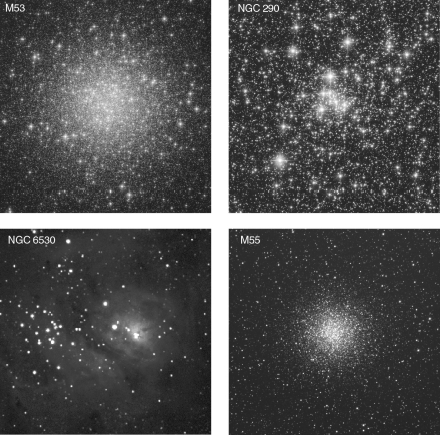
(Multiple Choice)
4.8/5 (76)
(76) The fundamental stellar property that determines the major evolutionary differences in the life history of stars is
(Multiple Choice)
4.8/5 (93)
(93) Which of the following is a common characteristic of a neutron star?
(Multiple Choice)
4.9/5 (77)
(77) What characteristic of a star cluster is used to determine its age?
(Multiple Choice)
5.0/5 (82)
(82) Describe how free neutrons released in supernovae create new heavy elements.
(Essay)
4.7/5 (82)
(82) Why do main-sequence high-mass stars lose so much mass compared with low-mass stars?
(Essay)
4.9/5 (85)
(85) How does convection in the core of a high-mass star affect the star's main-sequence lifespan?
(Essay)
4.7/5 (84)
(84) 
Filters
- Essay(0)
- Multiple Choice(0)
- Short Answer(0)
- True False(0)
- Matching(0)