



 Chat with AI
Exam 17: Evolution of High-Mass Stars

Exam 1: Thinking Like an Astronomer 97 Questions
Exam 2: Patterns in the Skymotions of Earth and the Moon101 Questions
Exam 3: Motion of Astronomical Bodies99 Questions
Exam 4: Gravity and Orbits100 Questions
Exam 5: Light100 Questions
Exam 6: The Tools of the Astronomer100 Questions
Exam 7: The Formation of Planetary Systems100 Questions
Exam 8: The Terrestrial Planets and Earths Moon100 Questions
Exam 9: Atmospheres of the Terrestrial Planets100 Questions
Exam 10: Worlds of Gas and Liquidthe Giant Planets100 Questions
Exam 11: Planetary Moons and Rings100 Questions
Exam 12: Dwarf Planets and Small Solar System Bodies100 Questions
Exam 13: Taking the Measure of Stars101 Questions
Exam 14: Our Starthe Sun100 Questions
Exam 15: The Interstellar Medium and Star Formation100 Questions
Exam 16: Evolution of Low-Mass Stars100 Questions
Exam 17: Evolution of High-Mass Stars100 Questions
Exam 18: Relativity and Black Holes97 Questions
Exam 19: Galaxies100 Questions
Exam 20: The Milky Waya Normal Spiral Galaxy100 Questions
Exam 21: The Expanding Universe98 Questions
Exam 22: Cosmology100 Questions
Exam 23: Large-Scale Structure in the Universe103 Questions
Exam 24: Life100 Questions
Select questions type


Using the formula g =GMNS/R2NS, calculate the acceleration of gravity on a 2 MSUN neutron with a radius of 10 km, and express this in terms of the acceleration of gravity on the surface
Of Earth (g = 9.8 m/s2).
(Multiple Choice)
4.8/5  (70)
(70) You observe three star clusters and construct their respective H-R diagrams.Cluster 1 has a main-sequence turnoff point at spectral type G, Cluster 2 has a turnoff point at spectral type A, and Cluster 3 has a turnoff point at spectral type B.Which cluster is the youngest and which is the oldest? Explain why.What is the approximate age of the oldest cluster?
(Essay)
4.9/5 (82)
(82) Which of the following is the correct order for elements fused (as fuel) in the core of late-stage high-mass stars?
(Multiple Choice)
4.7/5 (73)
(73) The nuclear fusion reactions involved in the CNO cycle require much higher temperatures than the reactions within the proton-proton chain because
(Multiple Choice)
4.9/5 (75)
(75) Why is the CNO cycle the primary fusion cycle in only high-mass stars?
(Essay)
4.7/5 (66)
(66) If a 25 MSUN main-sequence star loses mass at an average rate of 10-6 MSUN/yr while on the main sequence, then how much mass will it lose in its lifetime of about 7 million years?
(Multiple Choice)
4.7/5 (76)
(76) We can identify only a fraction of all the radio pulsars that exist in our galaxy because
(Multiple Choice)
4.7/5 (87)
(87) As a high-mass main-sequence star evolves off the main sequence, it follows a ________ on the H-R diagram.
(Multiple Choice)
4.8/5 (63)
(63) Type Ia and Type II supernovae are respectively caused by what types of stars?
(Multiple Choice)
4.8/5 (74)
(74) Iron has 26 protons in its nucleus, and gold has 79 protons.Where did all the gold on Earth come from?
(Multiple Choice)
4.7/5 (73)
(73) The figure below shows the H-R diagram for the very young cluster NGC 6530.Notice that the main sequence is missing the low-luminosity red tail.At the same time, there are several reddish and yellowish objects to the right of the main sequence (clearly marked).What could these objects represent? 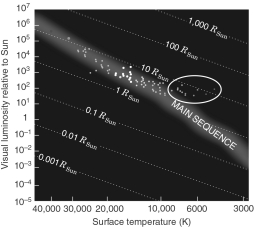
(Multiple Choice)
4.8/5 (78)
(78) Type I and Type II supernovae can be distinguished by what combination of observations?
(Multiple Choice)
4.8/5 (75)
(75) Explain why neutron stars are fast-spinning objects and why they have very strong magnetic fields.
(Essay)
4.9/5 (70)
(70) The main difference between classical Cepheids and RR Lyrae stars is
(Multiple Choice)
4.8/5 (87)
(87) Supernovae are very energetic events.Of the following events, which is the brightest that a supernova can outshine at their maximum?
(Multiple Choice)
4.9/5 (52)
(52) One reason why we think neutron stars were formed in supernova explosions is that
(Multiple Choice)
4.9/5 (84)
(84) 
Filters
- Essay(0)
- Multiple Choice(0)
- Short Answer(0)
- True False(0)
- Matching(0)