



 Chat with AI
Exam 17: Evolution of High-Mass Stars

Exam 1: Thinking Like an Astronomer 97 Questions
Exam 2: Patterns in the Skymotions of Earth and the Moon101 Questions
Exam 3: Motion of Astronomical Bodies99 Questions
Exam 4: Gravity and Orbits100 Questions
Exam 5: Light100 Questions
Exam 6: The Tools of the Astronomer100 Questions
Exam 7: The Formation of Planetary Systems100 Questions
Exam 8: The Terrestrial Planets and Earths Moon100 Questions
Exam 9: Atmospheres of the Terrestrial Planets100 Questions
Exam 10: Worlds of Gas and Liquidthe Giant Planets100 Questions
Exam 11: Planetary Moons and Rings100 Questions
Exam 12: Dwarf Planets and Small Solar System Bodies100 Questions
Exam 13: Taking the Measure of Stars101 Questions
Exam 14: Our Starthe Sun100 Questions
Exam 15: The Interstellar Medium and Star Formation100 Questions
Exam 16: Evolution of Low-Mass Stars100 Questions
Exam 17: Evolution of High-Mass Stars100 Questions
Exam 18: Relativity and Black Holes97 Questions
Exam 19: Galaxies100 Questions
Exam 20: The Milky Waya Normal Spiral Galaxy100 Questions
Exam 21: The Expanding Universe98 Questions
Exam 22: Cosmology100 Questions
Exam 23: Large-Scale Structure in the Universe103 Questions
Exam 24: Life100 Questions
Select questions type


The particles that circle the magnetic-field lines of neutron stars producing radiation are
(Multiple Choice)
4.7/5  (71)
(71) The collapse of the core of a high-mass star at the end of its life lasts approximately
(Multiple Choice)
5.0/5 (66)
(66) At what rate would a 25 MSUN star lose mass via stellar winds (in MSUN/yr) in order to reduce its mass by 20 percent in its lifetime? The main-sequence lifespan is about 7 million years.
(Essay)
4.8/5 (84)
(84) About 2 percent of the mass of the Sun is in elements heavier than helium.Where did these elements come from?
(Essay)
4.9/5 (88)
(88) In the universe, as a general trend, more massive atoms are less prevalent than lighter ones.There is, however, an exception to this pattern in the domain of low-mass elements.Using the figure below, identify the low-mass nuclei related to the aforementioned "exception," and briefly indicate how nuclear physicists explain this apparent oddity. 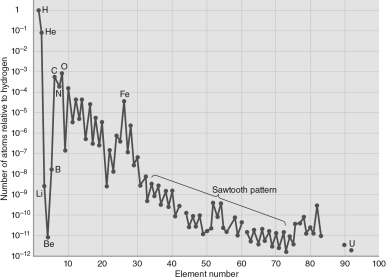
(Essay)
4.9/5 (86)
(86) A main-sequence star of 25 solar masses has about 25 times the luminosity of a 10-solar-mass star (recall the mass-luminosity relation presented in the previous chapter).This is because the more massive star
(Multiple Choice)
4.7/5 (69)
(69) A neutron star contains a mass of up to 2 MSUN in a sphere with a diameter approximately the size of
(Multiple Choice)
4.8/5 (67)
(67) During the main-sequence evolution of a massive star, progressively more massive elements are fused in the core until the core is filled with
(Multiple Choice)
4.8/5 (82)
(82) Explain the likelihood of Type Ia and Type II supernovae occurrence in open and globular clusters of stars.
(Essay)
4.8/5 (65)
(65) Name three processes that speed the collapse of the core of a dying high-mass star.
(Essay)
4.8/5 (95)
(95) Briefly explain why planets like ours could not have formed at about the same time as the very first generations of stars in the universe.
(Essay)
4.9/5 (73)
(73) With the Hubble Space Telescope, you discover a Cepheid variable star in a nearby galaxy that has a period of 30 days.If nearby Cepheids follow a period-luminosity that relates the absolute magnitude to the period of pulsation via  , where P(days) is the star's period in days, then what is this Cepheid's luminosity? Recall that the Sun's absolute magnitude is M = 4.83.If the apparent magnitude of the Cepheid is 25, what is this galaxy's distance in parsecs?
 (Essay)
5.0/5 (72)
(72) A typical neutron star has a diameter of 15 km and a mass of 2 MSUN (One solar mass is
MSUN =2* 1030 kg).What is the density of this neutron star? How much mass would be in one
teaspoon (about 5.0 cubic cm, or cm3) of neutron star material?
(Essay)
4.9/5 (71)
(71) In the CNO cycle, carbon is used as a catalyst for the fusion of hydrogen into helium. This means that
(Multiple Choice)
5.0/5 (75)
(75) The figure below shows three distinct types of pulsating stars: Type I (Classical) Cepheids, type II Cepheids and RR Lyrae.Assume that you find a variable star whose period of pulsation is several days.You accurately measure its apparent brightness, but you misidentify its type, labeling it "Classical" instead of Type II, which would in fact be its correct type.What would be the effect in the determination of distance? 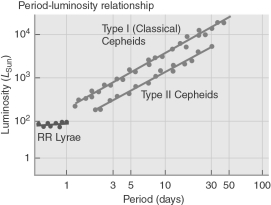
(Essay)
4.9/5 (86)
(86) If the core of a high-mass star remains at the center of a Type II supernova remnant, that core will be classified as a(n)
(Multiple Choice)
5.0/5 (89)
(89) The weight of an average human of 70 kg on a typical 1.5 MSUN, 10-km-wide neutron star would be about ________ times greater than here on Earth.
(Multiple Choice)
4.8/5 (86)
(86) The first step in the CNO cycle diagram below shows the fusion of one proton and one nucleus of 12C.What are the frequency and wavelength of a photon emitted in the process? Note that the mass of a 12C atom is 12.0000 amu (atomic mass units; 1 amu = 1.66 x1027 kg), 1H is 1.0073 amu, and 13N = 13.0057 amu. 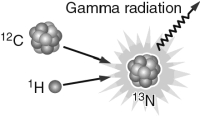
(Essay)
4.8/5 (89)
(89) It is known that pulsars tend to slow their rotation as they age, albeit at a very, very slow rate (they are considered by far the most accurate clocks in the universe, in fact).Some extreme pulsars, however, rotate hundreds of times per second (they are hence called millisecond pulsars) and were discovered in globular clusters.They spin faster than most blenders, mixers, and other kitchen gadgets with rotating parts.What would be a reasonable explanation that you could infer from the figure shown below? 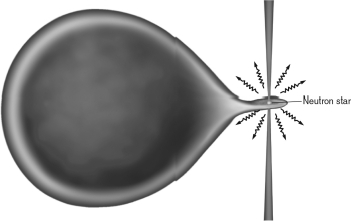
(Essay)
5.0/5 (83)
(83) List the H-R diagrams in the figure shown below from oldest to youngest. 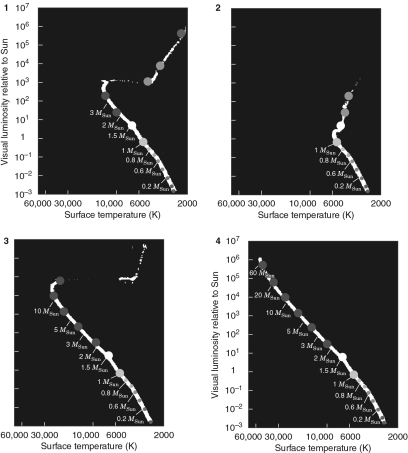
(Multiple Choice)
4.9/5 (66)
(66) 
Filters
- Essay(0)
- Multiple Choice(0)
- Short Answer(0)
- True False(0)
- Matching(0)