



 Chat with AI
Exam 17: Evolution of High-Mass Stars

Exam 1: Thinking Like an Astronomer 97 Questions
Exam 2: Patterns in the Skymotions of Earth and the Moon101 Questions
Exam 3: Motion of Astronomical Bodies99 Questions
Exam 4: Gravity and Orbits100 Questions
Exam 5: Light100 Questions
Exam 6: The Tools of the Astronomer100 Questions
Exam 7: The Formation of Planetary Systems100 Questions
Exam 8: The Terrestrial Planets and Earths Moon100 Questions
Exam 9: Atmospheres of the Terrestrial Planets100 Questions
Exam 10: Worlds of Gas and Liquidthe Giant Planets100 Questions
Exam 11: Planetary Moons and Rings100 Questions
Exam 12: Dwarf Planets and Small Solar System Bodies100 Questions
Exam 13: Taking the Measure of Stars101 Questions
Exam 14: Our Starthe Sun100 Questions
Exam 15: The Interstellar Medium and Star Formation100 Questions
Exam 16: Evolution of Low-Mass Stars100 Questions
Exam 17: Evolution of High-Mass Stars100 Questions
Exam 18: Relativity and Black Holes97 Questions
Exam 19: Galaxies100 Questions
Exam 20: The Milky Waya Normal Spiral Galaxy100 Questions
Exam 21: The Expanding Universe98 Questions
Exam 22: Cosmology100 Questions
Exam 23: Large-Scale Structure in the Universe103 Questions
Exam 24: Life100 Questions
Select questions type


What is the reason for the very fast rotation of neutron stars?
(Multiple Choice)
4.8/5  (86)
(86) In a rescaled model in which the Crab Nebula (10 light-years across in reality) would only be about 10 km across, how big would the central neutron star (about 10 km in reality) be?
(Multiple Choice)
4.8/5 (72)
(72) An iron core cannot support a massive main-sequence star because iron
(Multiple Choice)
4.8/5 (76)
(76) Which of these fusion reactions begins first in the core of a massive star?
(Multiple Choice)
4.9/5 (69)
(69) Betelgeuse is a star whose luminosity exceeds 1.2 * 105 LSUN, but its measured surface temperature is quite low for a star, about 3500K.What would be its estimated size and where would it fall in the H-R diagram shown in the figure below? What would be the final fate of Betelgeuse? 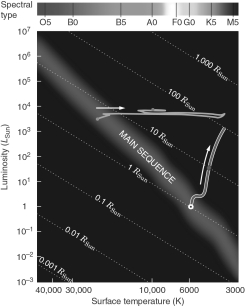
(Essay)
4.9/5 (82)
(82) Why does the luminosity of a high-mass star remain nearly constant as the star burns elements heavier than helium in its core, even though it is producing millions of times more
Energy per second than it did on the main sequence?
(Multiple Choice)
4.9/5 (75)
(75) The main-sequence lifetime of a star can be estimated using the formula:  What is the lowest-mass star that can have left the main sequence, assuming this star was created as soon as the universe formed? (The universe is about 13.8 billion years old.)
 (Essay)
4.9/5 (88)
(88) The dominant mechanism by which high-mass stars generate energy on the main sequence is called
(Multiple Choice)
4.8/5 (72)
(72) What should be true about the oldest stars in the Milky Way?
(Multiple Choice)
4.8/5 (74)
(74) A H-R diagram is made for two star clusters, Cluster A and Cluster B.Cluster A has stars of spectral type A, while Cluster B has no such stars.What can we conclude about these two clusters from this information?
(Multiple Choice)
4.8/5 (80)
(80) Give two major arguments for the scarcity of stars in the high-mass, high-luminosity, main-sequence blue region of the H-R diagram.
(Essay)
4.8/5 (84)
(84) What mechanism provides the internal pressure inside a neutron star?
(Multiple Choice)
4.9/5 (85)
(85) Why are star clusters helpful for testing our ideas about star formation and stellar evolution?
(Essay)
4.9/5 (82)
(82) Once silicon burning initiates in the core of a high-mass star, the star has only a few ________ left to live.
(Multiple Choice)
4.8/5 (75)
(75) How do astronomers know that the Sun (and our Solar System) formed from the remnants of other stars?
(Multiple Choice)
4.8/5 (90)
(90) A few hours before a high-mass star will blast its outer layers in a colossal explosion, specialized detectors on Earth would recognize a spike in the number of
(Multiple Choice)
4.9/5 (85)
(85) The CNO cycle is the more efficient mechanism for hydrogen fusion only in stars more massive than 1.3-1.5 MSUN because of the greater ________ their cores.
(Multiple Choice)
4.8/5 (81)
(81) In their post-main-sequence stages of evolution high-mass stars spend progressively shorter periods in each stage, in part because
(Multiple Choice)
4.9/5 (68)
(68) 
Filters
- Essay(0)
- Multiple Choice(0)
- Short Answer(0)
- True False(0)
- Matching(0)