



 Chat with AI
Exam 16: Evolution of Low-Mass Stars

Exam 1: Thinking Like an Astronomer 97 Questions
Exam 2: Patterns in the Skymotions of Earth and the Moon101 Questions
Exam 3: Motion of Astronomical Bodies99 Questions
Exam 4: Gravity and Orbits100 Questions
Exam 5: Light100 Questions
Exam 6: The Tools of the Astronomer100 Questions
Exam 7: The Formation of Planetary Systems100 Questions
Exam 8: The Terrestrial Planets and Earths Moon100 Questions
Exam 9: Atmospheres of the Terrestrial Planets100 Questions
Exam 10: Worlds of Gas and Liquidthe Giant Planets100 Questions
Exam 11: Planetary Moons and Rings100 Questions
Exam 12: Dwarf Planets and Small Solar System Bodies100 Questions
Exam 13: Taking the Measure of Stars101 Questions
Exam 14: Our Starthe Sun100 Questions
Exam 15: The Interstellar Medium and Star Formation100 Questions
Exam 16: Evolution of Low-Mass Stars100 Questions
Exam 17: Evolution of High-Mass Stars100 Questions
Exam 18: Relativity and Black Holes97 Questions
Exam 19: Galaxies100 Questions
Exam 20: The Milky Waya Normal Spiral Galaxy100 Questions
Exam 21: The Expanding Universe98 Questions
Exam 22: Cosmology100 Questions
Exam 23: Large-Scale Structure in the Universe103 Questions
Exam 24: Life100 Questions
Select questions type


During which phase of the evolution of a low-mass star does it have two separate regions of nuclear burning occurring in its interior?
(Multiple Choice)
4.9/5  (92)
(92) Explain why stars are able to lose mass as they expand to red giant size.
(Essay)
4.8/5 (81)
(81) What types of fusion are occurring in an asymptotic giant branch (AGB) star, where is each type located, and what are the products of each type?
(Essay)
4.8/5 (70)
(70) When a star burns hydrogen in a shell, how does the energy released compare with when the star burned hydrogen in the core?
(Multiple Choice)
4.9/5 (87)
(87) A low-mass main-sequence star's climb up the red giant branch is halted by
(Multiple Choice)
4.8/5 (85)
(85) Which star spends the longest time as a main-sequence star?
(Multiple Choice)
4.7/5 (80)
(80) A star like the Sun will lose ________ of its mass before it evolves to become a white dwarf.
(Multiple Choice)
4.9/5 (75)
(75) A particular asymptotic giant branch star has approximately the same mass as the Sun but 100 times its radius.Compared with the Sun, what is the escape velocity from that star?
(Multiple Choice)
4.7/5 (70)
(70) A Type Ia supernova occurs when a white dwarf exceeds a mass of
(Multiple Choice)
4.8/5 (82)
(82) Asymptotic giant branch stars have ________ luminosities, ________ radii, and ________ escape velocities.
(Multiple Choice)
4.9/5 (75)
(75) Helium burns in the core of a horizontal branch star via the ________ and produces ________.
(Multiple Choice)
4.8/5 (75)
(75) Describe the helium flash that occurs when helium fusion ignites in the core of a red giant star.
(Essay)
4.8/5 (81)
(81) What is the shortest phase of evolution for a one solar mass star that we can visibly see?
(Essay)
4.8/5 (77)
(77) What factor is most important in determining a star's position on the main sequence and its subsequent evolution?
(Multiple Choice)
4.8/5 (89)
(89) As a subgiant star becomes a red giant, its luminosity increases while its temperature remains approximately constant.What does this mean?
(Multiple Choice)
4.8/5 (81)
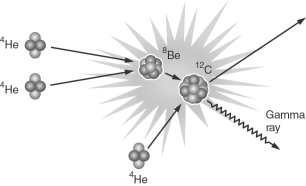
(81) 

Filters
- Essay(0)
- Multiple Choice(0)
- Short Answer(0)
- True False(0)
- Matching(0)