



 Chat with AI
Exam 7: The Formation of Planetary Systems

Exam 1: Thinking Like an Astronomer 97 Questions
Exam 2: Patterns in the Skymotions of Earth and the Moon101 Questions
Exam 3: Motion of Astronomical Bodies99 Questions
Exam 4: Gravity and Orbits100 Questions
Exam 5: Light100 Questions
Exam 6: The Tools of the Astronomer100 Questions
Exam 7: The Formation of Planetary Systems100 Questions
Exam 8: The Terrestrial Planets and Earths Moon100 Questions
Exam 9: Atmospheres of the Terrestrial Planets100 Questions
Exam 10: Worlds of Gas and Liquidthe Giant Planets100 Questions
Exam 11: Planetary Moons and Rings100 Questions
Exam 12: Dwarf Planets and Small Solar System Bodies100 Questions
Exam 13: Taking the Measure of Stars101 Questions
Exam 14: Our Starthe Sun100 Questions
Exam 15: The Interstellar Medium and Star Formation100 Questions
Exam 16: Evolution of Low-Mass Stars100 Questions
Exam 17: Evolution of High-Mass Stars100 Questions
Exam 18: Relativity and Black Holes97 Questions
Exam 19: Galaxies100 Questions
Exam 20: The Milky Waya Normal Spiral Galaxy100 Questions
Exam 21: The Expanding Universe98 Questions
Exam 22: Cosmology100 Questions
Exam 23: Large-Scale Structure in the Universe103 Questions
Exam 24: Life100 Questions
Select questions type


The figure below shows data from the transit study of a star in which three different planets (A, B, and C) repeatedly transit in front of the star.Which dip is (are) caused by the transit of the planet with the smallest radius? 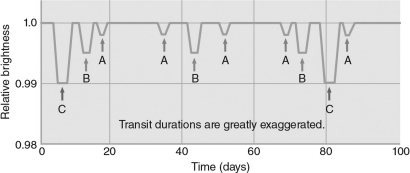
(Multiple Choice)
5.0/5  (89)
(89) Based on the figure shown below, which planet(s) is (are) most likely to have the largest fraction of its (their) mass made of highly volatile materials such as methane and ammonia? 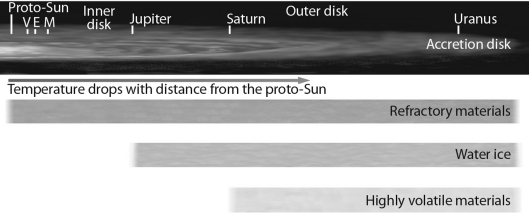
(Multiple Choice)
4.8/5 (87)
(87) When you push your palms together and rub them back and forth, you are demonstrating one way of converting ________ energy into ________ energy.
(Multiple Choice)
4.8/5 (80)
(80) Using the Doppler effect data for a particular star shown in the figure below, and assuming the star is about the same mass as our Sun, what is the approximate orbital distance of its exoplanet? 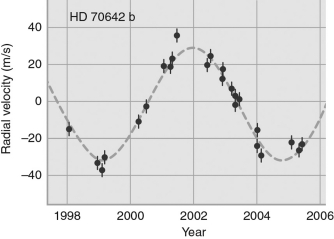
(Multiple Choice)
4.8/5 (78)
(78) If the entirety of a collapsing interstellar cloud went into forming a single protostar,
(Multiple Choice)
4.7/5 (90)
(90) The figure shown below illustrates the changing brightness of a star due to a planet transiting in front of it.Which of the following can be directly measured from the information provided? 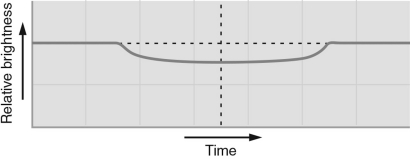
(Multiple Choice)
4.8/5 (87)
(87) According to the conservation of angular momentum, if an ice-skater who is spinning with her arms out wide slowly pulls them close to her body, she will
(Multiple Choice)
4.8/5 (85)
(85) In the figure shown below, the direction of the disk's rotation is indicated.What is the direction of the protostellar Sun's rotation? 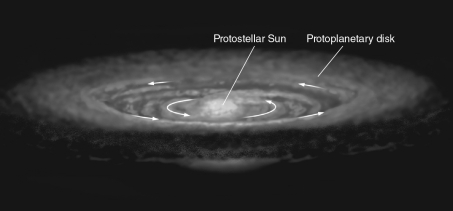
(Multiple Choice)
4.8/5 (74)
(74) The borderline between the most massive planet and the least massive brown dwarf is thought to occur at around
(Multiple Choice)
4.9/5 (74)
(74) What are some limitations of the radial velocity method of exoplanet detection?
(Essay)
4.9/5 (90)
(90) The primary atmosphere of Earth consisted of what type of chemical elements and from where did it originate? What chemical elements did the secondary atmosphere of Earth consist of and from where did it originate?
(Essay)
5.0/5 (88)
(88) What is the ratio of the orbital angular momentum of Jupiter to its spin angular momentum? Jupiter's orbit has a semimajor axis of 5 AU and period of 12 years, and Jupiter has a rotation period of 0.4 days and a radius of 70,000 km.
(Multiple Choice)
4.7/5 (79)
(79) Explain the primary reasons why the inner solar nebula was hotter than the outer solar nebula.
(Essay)
4.7/5 (66)
(66) Consider the figure shown below.At which point in time does the collapsing cloud have the greatest angular momentum? 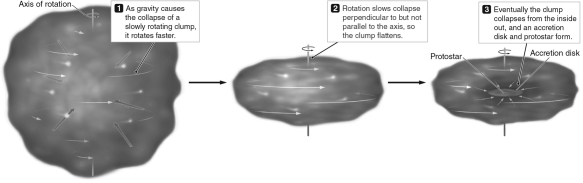
(Multiple Choice)
4.9/5 (84)
(84) Why have astronomers using the radial velocity method found more Jupiter-sized planets at a distance of 1 AU around other stars than Earth-sized planets?
(Multiple Choice)
4.9/5 (86)
(86) Was it ever possible (or is it currently possible) for Jupiter to become a star?
(Multiple Choice)
4.9/5 (76)
(76) 
Filters
- Essay(0)
- Multiple Choice(0)
- Short Answer(0)
- True False(0)
- Matching(0)