



 Chat with AI
Exam 7: The Formation of Planetary Systems

Exam 1: Thinking Like an Astronomer 97 Questions
Exam 2: Patterns in the Skymotions of Earth and the Moon101 Questions
Exam 3: Motion of Astronomical Bodies99 Questions
Exam 4: Gravity and Orbits100 Questions
Exam 5: Light100 Questions
Exam 6: The Tools of the Astronomer100 Questions
Exam 7: The Formation of Planetary Systems100 Questions
Exam 8: The Terrestrial Planets and Earths Moon100 Questions
Exam 9: Atmospheres of the Terrestrial Planets100 Questions
Exam 10: Worlds of Gas and Liquidthe Giant Planets100 Questions
Exam 11: Planetary Moons and Rings100 Questions
Exam 12: Dwarf Planets and Small Solar System Bodies100 Questions
Exam 13: Taking the Measure of Stars101 Questions
Exam 14: Our Starthe Sun100 Questions
Exam 15: The Interstellar Medium and Star Formation100 Questions
Exam 16: Evolution of Low-Mass Stars100 Questions
Exam 17: Evolution of High-Mass Stars100 Questions
Exam 18: Relativity and Black Holes97 Questions
Exam 19: Galaxies100 Questions
Exam 20: The Milky Waya Normal Spiral Galaxy100 Questions
Exam 21: The Expanding Universe98 Questions
Exam 22: Cosmology100 Questions
Exam 23: Large-Scale Structure in the Universe103 Questions
Exam 24: Life100 Questions
Select questions type


Using the Doppler effect data shown in the figure below, what is the approximate orbital period of the extrasolar planet? 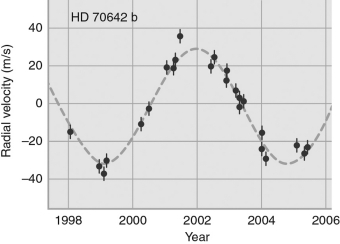
(Multiple Choice)
5.0/5  (82)
(82) Compare the orbital angular momentum of Earth and Jupiter.Which is larger and by how much? (Note that Jupiter's mass is 318 times that of Earth, the semimajor axis of Jupiter's orbit is 5.2 AU, and Jupiter's orbital period is 12 years.)
(Essay)
4.8/5 (72)
(72) In addition to the percentage reduction in light, is anything else needed to determine the size of a transiting planet?
(Essay)
4.8/5 (80)
(80) The icy planetesimals that remain in the Solar System today are called
(Multiple Choice)
4.9/5 (77)
(77) Explain why an accretion disk forms around a protostar when an interstellar cloud collapses.
(Essay)
4.8/5 (91)
(91) Explain how astronomers use the Doppler effect to detect the presence of extrasolar planets.
(Essay)
4.8/5 (85)
(85) An observer located outside our Solar System, who monitors the velocity of our Sun over time, will find that the Sun's velocity varies by 12 m/s over a period of 12 years, due mainly to
(Multiple Choice)
4.7/5 (85)
(85) From the data shown in the figure below, which property of an extrasolar planet can be determined? 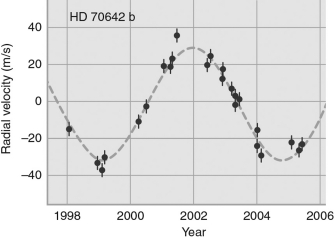
(Multiple Choice)
4.9/5 (72)
(72) Which of the following would be considered to have a secondary atmosphere?
(Multiple Choice)
4.9/5 (84)
(84) If you detect an exoplanet that is orbiting a star that is 8 times as massive as the Sun with an orbital period of 1 (Earth) year, you would expect the semimajor axis of its orbit to be
(Multiple Choice)
5.0/5 (85)
(85) Detecting a planet around another star using the transit method is difficult because the
(Multiple Choice)
4.8/5 (80)
(80) If you want to find naturally occurring volatile materials that formed with the Solar System, you should look
(Multiple Choice)
4.8/5 (83)
(83) Two competing models of the formation of giant gaseous planets suggest they form either from gas accreting onto a rocky core or from
(Multiple Choice)
4.9/5 (69)
(69) What is the most important factor in determining whether or not a planet will be rocky like terrestrial planets or gaseous like giant planets?
(Multiple Choice)
4.8/5 (100)
(100) Briefly explain the five different observational methods we use to detect extrasolar planets.How many extrasolar planets have been discovered to date?
(Essay)
4.9/5 (88)
(88) When astronomers began searching for extrasolar planets, they were surprised to discover Jupiter-sized planets much closer than 1 AU from their parent stars.Why is this surprising?
(Multiple Choice)
4.8/5 (85)
(85) 
Filters
- Essay(0)
- Multiple Choice(0)
- Short Answer(0)
- True False(0)
- Matching(0)