



 Chat with AI
Exam 8: The Terrestrial Planets and Earths Moon

Exam 1: Thinking Like an Astronomer 97 Questions
Exam 2: Patterns in the Skymotions of Earth and the Moon101 Questions
Exam 3: Motion of Astronomical Bodies99 Questions
Exam 4: Gravity and Orbits100 Questions
Exam 5: Light100 Questions
Exam 6: The Tools of the Astronomer100 Questions
Exam 7: The Formation of Planetary Systems100 Questions
Exam 8: The Terrestrial Planets and Earths Moon100 Questions
Exam 9: Atmospheres of the Terrestrial Planets100 Questions
Exam 10: Worlds of Gas and Liquidthe Giant Planets100 Questions
Exam 11: Planetary Moons and Rings100 Questions
Exam 12: Dwarf Planets and Small Solar System Bodies100 Questions
Exam 13: Taking the Measure of Stars101 Questions
Exam 14: Our Starthe Sun100 Questions
Exam 15: The Interstellar Medium and Star Formation100 Questions
Exam 16: Evolution of Low-Mass Stars100 Questions
Exam 17: Evolution of High-Mass Stars100 Questions
Exam 18: Relativity and Black Holes97 Questions
Exam 19: Galaxies100 Questions
Exam 20: The Milky Waya Normal Spiral Galaxy100 Questions
Exam 21: The Expanding Universe98 Questions
Exam 22: Cosmology100 Questions
Exam 23: Large-Scale Structure in the Universe103 Questions
Exam 24: Life100 Questions
Select questions type


By orbiting a planet with a probe and using Kepler's third law, scientists can learn a planet's
(Multiple Choice)
4.8/5  (76)
(76) Which terrestrial object shows the least evidence of recent volcanic activity?
(Multiple Choice)
5.0/5 (92)
(92) Compared to the dark-colored regions of the surface of the Moon, the light-colored regions are approximately
(Multiple Choice)
4.9/5 (86)
(86) If you obtained a sample of rock from Venus and determined the abundances of uranium (238U) and lead (207Pb) in it, and found that for every one uranium atom there were three lead atoms, what would be the age of this rock? Note that this form of uranium decays to this form of lead with a half-life of 700 million years.For simplicity, you can assume that there were no lead atoms of this specific isotope in the rock when it originally formed.
(Multiple Choice)
4.9/5 (75)
(75) Along which type of plate boundary are mountain chains commonly found?
(Essay)
4.7/5 (65)
(65) Which of the following statements is an example of comparative planetology?
(Multiple Choice)
4.9/5 (87)
(87) 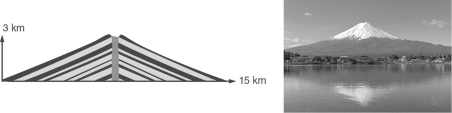
What are the four main processes that shape the surfaces of the terrestrial planets?
(Essay)
4.8/5 (86)
(86) The American and African/European continents are now separated by the Atlantic Ocean, which is approximately 4,000 km wide.Assuming a continental drift rate of 2 cm/yr, how long has it been since they were one land mass?
(Essay)
4.8/5 (82)
(82) If the Himalayan mountain range is presently 8,000 m in height and is rising at a rate of 0.5 m per century because of the convergence of two continental plates, how long did it take to create this mountain range?
(Multiple Choice)
4.8/5 (83)
(83) The dynamo theory says that a planet will have a strong magnetic field if it has
(Multiple Choice)
4.9/5 (71)
(71) Name the terrestrial planets in order of increasing distance from the Sun.What are the terrestrial planets in order of increasing geological age of their surface?
(Essay)
4.8/5 (71)
(71) How do we know that Earth's magnetic field has flipped its polarity many times in the past?
(Essay)
4.9/5 (80)
(80) What would you study in order to determine the timescale on which Earth's magnetic field reverses direction?
(Multiple Choice)
4.9/5 (84)
(84) Based on the number of impact craters observed per square meter on their surface, place these terrestrial planets in order from youngest to oldest surface.
(Multiple Choice)
4.9/5 (71)
(71) Which layer in the figure below represents Earth's liquid core? 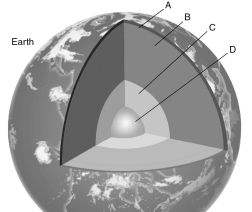
(Multiple Choice)
4.8/5 (72)
(72) What is the evidence for a large asteroid impact and an associated mass extinction event occurring approximately 65 million years ago?
(Essay)
4.7/5 (66)
(66) The observation that the Moon's average density is similar to the density of Earth's ________ supports the collision theory of the Moon's origin.
(Multiple Choice)
4.7/5 (72)
(72) Rocks less than 100 meters (m) in diameter are called ________ when they are in space.
(Multiple Choice)
4.9/5 (69)
(69) 
Filters
- Essay(0)
- Multiple Choice(0)
- Short Answer(0)
- True False(0)
- Matching(0)