



 Chat with AI
Exam 19: Galaxies

Exam 1: Thinking Like an Astronomer 97 Questions
Exam 2: Patterns in the Skymotions of Earth and the Moon101 Questions
Exam 3: Motion of Astronomical Bodies99 Questions
Exam 4: Gravity and Orbits100 Questions
Exam 5: Light100 Questions
Exam 6: The Tools of the Astronomer100 Questions
Exam 7: The Formation of Planetary Systems100 Questions
Exam 8: The Terrestrial Planets and Earths Moon100 Questions
Exam 9: Atmospheres of the Terrestrial Planets100 Questions
Exam 10: Worlds of Gas and Liquidthe Giant Planets100 Questions
Exam 11: Planetary Moons and Rings100 Questions
Exam 12: Dwarf Planets and Small Solar System Bodies100 Questions
Exam 13: Taking the Measure of Stars101 Questions
Exam 14: Our Starthe Sun100 Questions
Exam 15: The Interstellar Medium and Star Formation100 Questions
Exam 16: Evolution of Low-Mass Stars100 Questions
Exam 17: Evolution of High-Mass Stars100 Questions
Exam 18: Relativity and Black Holes97 Questions
Exam 19: Galaxies100 Questions
Exam 20: The Milky Waya Normal Spiral Galaxy100 Questions
Exam 21: The Expanding Universe98 Questions
Exam 22: Cosmology100 Questions
Exam 23: Large-Scale Structure in the Universe103 Questions
Exam 24: Life100 Questions
Select questions type


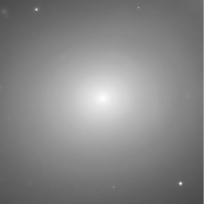

What is the most likely candidate for what composes the dark matter in galaxies?
(Essay)
4.9/5  (80)
(80) How did Hubble classify galaxies? Is there any significance to this organization?
(Essay)
4.7/5 (88)
(88) Which distance indicator can be used to measure the most distant objects?
(Multiple Choice)
4.9/5 (73)
(73) How do we know that AGNs have sizes on the order of our Solar System?
(Multiple Choice)
4.9/5 (98)
(98) The spectrum of a galaxy is observed to have an H emission line at a wavelength of 928.7 nm.What is its redshift? (Note that the rest wavelength of the H emission line is 656.3 nm.)
(Essay)
4.9/5 (81)
(81) As of the writing of your textbook, what types of galaxies (not including our own Milky Way Galaxy) have been observed to have planets orbiting stars within them?
(Multiple Choice)
4.9/5 (76)
(76) If the spectrum of a distant galaxy is observed to have a calcium K absorption line that occurs at a wavelength of 500.4 nm, what is this galaxy's distance if the rest wavelength of this absorption line is 393.4 nm? Assume the Hubble constant is 70 km/s/Mpc.
(Multiple Choice)
4.8/5 (82)
(82) The technique of using a star's spectrum to find its location on the H-R diagram, which provides an estimate of its luminosity, and thereby its distance, is called
(Multiple Choice)
4.9/5 (76)
(76) The term "dark" in "dark matter" refers to the fact that dark matter
(Multiple Choice)
4.9/5 (78)
(78) Even though each item on the distance ladder is only effective within a certain distance range, the concept is still effective because
(Multiple Choice)
4.8/5 (81)
(81) Name two "rungs" in the distance ladder, and how distances within of these two "rungs" are measured or estimated.
(Essay)
4.7/5 (72)
(72) The recession speed of spiral galaxies may also render their colors ________ due to ________.
(Multiple Choice)
4.7/5 (85)
(85) You read about the discovery of quasars with redshift z larger than 1.This means that
(Multiple Choice)
4.7/5 (85)
(85) Which of the following lists distance indicators from nearest to farthest?
(Multiple Choice)
4.7/5 (81)
(81) Use the figure below to estimate the value of Hubble's constant.Be sure to include the appropriate units. 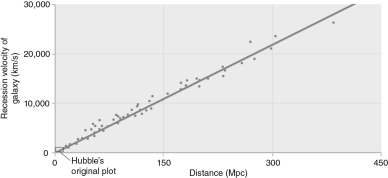
(Essay)
4.9/5 (79)
(79) Explain why Hubble's law, which is linear, has no intercept (recall the standard equation for a line
is y = mx + b).
(Essay)
4.9/5 (84)
(84) Using the figure below, describe what each observer (labeled 1 through 3) would see in terms of the type of event and special features visible to that observer. 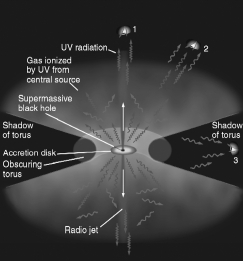
(Essay)
5.0/5 (81)
(81) 
Filters
- Essay(0)
- Multiple Choice(0)
- Short Answer(0)
- True False(0)
- Matching(0)