



 Chat with AI
Exam 15: The Interstellar Medium and Star Formation

Exam 1: Thinking Like an Astronomer 97 Questions
Exam 2: Patterns in the Skymotions of Earth and the Moon101 Questions
Exam 3: Motion of Astronomical Bodies99 Questions
Exam 4: Gravity and Orbits100 Questions
Exam 5: Light100 Questions
Exam 6: The Tools of the Astronomer100 Questions
Exam 7: The Formation of Planetary Systems100 Questions
Exam 8: The Terrestrial Planets and Earths Moon100 Questions
Exam 9: Atmospheres of the Terrestrial Planets100 Questions
Exam 10: Worlds of Gas and Liquidthe Giant Planets100 Questions
Exam 11: Planetary Moons and Rings100 Questions
Exam 12: Dwarf Planets and Small Solar System Bodies100 Questions
Exam 13: Taking the Measure of Stars101 Questions
Exam 14: Our Starthe Sun100 Questions
Exam 15: The Interstellar Medium and Star Formation100 Questions
Exam 16: Evolution of Low-Mass Stars100 Questions
Exam 17: Evolution of High-Mass Stars100 Questions
Exam 18: Relativity and Black Holes97 Questions
Exam 19: Galaxies100 Questions
Exam 20: The Milky Waya Normal Spiral Galaxy100 Questions
Exam 21: The Expanding Universe98 Questions
Exam 22: Cosmology100 Questions
Exam 23: Large-Scale Structure in the Universe103 Questions
Exam 24: Life100 Questions
Select questions type


As a protostar evolves towards becoming a main-sequence star, its core temperature will
(Multiple Choice)
4.8/5  (75)
(75) What primarily makes it difficult to observe the process of star formation?
(Multiple Choice)
4.8/5 (87)
(87) Because angular momentum must be conserved, as a gas cloud contracts due to gravity it will also
(Multiple Choice)
4.7/5 (82)
(82) A protostar may evolve into either a main-sequence star or a
(Multiple Choice)
4.8/5 (84)
(84) In the figure shown below, the portion of the H-R diagram corresponding to the Hayashi track
of a 1 MSUN star is shown.Temperature increases toward the left, and luminosity increases toward the top of the diagram.Even though the temperature of the protostar is hardly changing as it approaches the main sequence, its luminosity is decreasing.Why? 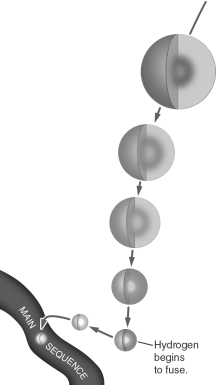
(Essay)
4.8/5 (79)
(79) A surprising fact about a 1 MSUN protostar is that, even though nuclear reactions have not yet started in their cores, they are ________ than the Sun
(Multiple Choice)
4.8/5 (77)
(77) Suppose a protostar shrinks in size from 100 RSUN down to 20 RSUN while maintaining a constant temperature.By what factor does its luminosity decrease?
(Essay)
4.9/5 (93)
(93) At what wavelength(s) are H II regions most clearly visible, and why do H II regions mark the regions where new stars are currently being formed?
(Essay)
5.0/5 (89)
(89) If you could watch stars forming out of a gas cloud, which stars would form first?
(Multiple Choice)
4.8/5 (84)
(84) When winds blow the gas away from a forming protostar, the protostar
(Multiple Choice)
4.9/5 (86)
(86) Warm ionized gas in the interstellar medium appears ________ when imaged in the optical region of the electromagnetic spectrum.
(Multiple Choice)
5.0/5 (92)
(92) The interstellar medium is divided into three different kinds of gas clouds.These are
(Multiple Choice)
4.8/5 (78)
(78) Objects with masses from 0.01 MSUN to 0.08 MSUN are very different from the Sun because they
(Multiple Choice)
4.8/5 (80)
(80) If the surface of a star cools, the number of H - ions ________ and the atmosphere becomes more ________.
(Multiple Choice)
4.9/5 (83)
(83) The red emission (bright region at the top) in the figure shown below is due to 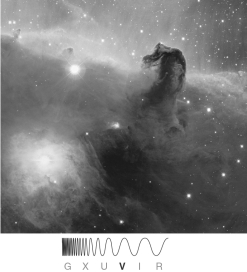
(Multiple Choice)
4.7/5 (87)
(87) 
Filters
- Essay(0)
- Multiple Choice(0)
- Short Answer(0)
- True False(0)
- Matching(0)