



 Chat with AI
Exam 24: Life

Exam 1: Thinking Like an Astronomer 97 Questions
Exam 2: Patterns in the Skymotions of Earth and the Moon101 Questions
Exam 3: Motion of Astronomical Bodies99 Questions
Exam 4: Gravity and Orbits100 Questions
Exam 5: Light100 Questions
Exam 6: The Tools of the Astronomer100 Questions
Exam 7: The Formation of Planetary Systems100 Questions
Exam 8: The Terrestrial Planets and Earths Moon100 Questions
Exam 9: Atmospheres of the Terrestrial Planets100 Questions
Exam 10: Worlds of Gas and Liquidthe Giant Planets100 Questions
Exam 11: Planetary Moons and Rings100 Questions
Exam 12: Dwarf Planets and Small Solar System Bodies100 Questions
Exam 13: Taking the Measure of Stars101 Questions
Exam 14: Our Starthe Sun100 Questions
Exam 15: The Interstellar Medium and Star Formation100 Questions
Exam 16: Evolution of Low-Mass Stars100 Questions
Exam 17: Evolution of High-Mass Stars100 Questions
Exam 18: Relativity and Black Holes97 Questions
Exam 19: Galaxies100 Questions
Exam 20: The Milky Waya Normal Spiral Galaxy100 Questions
Exam 21: The Expanding Universe98 Questions
Exam 22: Cosmology100 Questions
Exam 23: Large-Scale Structure in the Universe103 Questions
Exam 24: Life100 Questions
Select questions type


The ability of a celestial body to retain an atmosphere would depend mainly on which of the following properties?
(Multiple Choice)
4.8/5  (72)
(72) The evolution of terrestrial life involves which of the following?
(Multiple Choice)
4.8/5 (79)
(79) How did the presence of cyanobacteria on Earth in the past enable the later appearance of more advanced life-forms, such as humans?
(Multiple Choice)
4.8/5 (87)
(87) Briefly explain the various factors that differentiate life from other natural, physical processes.
(Essay)
4.9/5 (74)
(74) Why are high-mass stars not expected to have planets with advanced/intelligent life-forms?
(Multiple Choice)
4.8/5 (65)
(65) Using the figure below, explain which types of events necessarily preceded the formation of our Solar System in order for the four main chemical elements of life to be present. 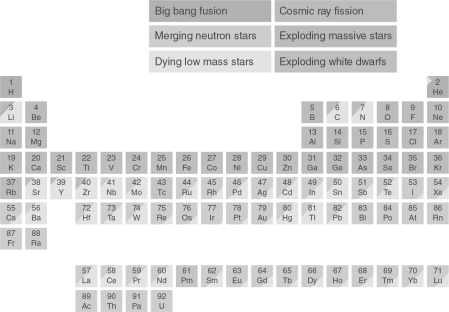
(Essay)
4.8/5 (78)
(78) Which of the following bodies of the Solar System has not yet been landed upon by spacecraft?
(Multiple Choice)
4.9/5 (68)
(68) The Solar System body to which humans have dedicated the largest number of landing missions so far is
(Multiple Choice)
5.0/5 (79)
(79) Animals are most closely related to which of the following evolutionary branches?
(Multiple Choice)
4.9/5 (82)
(82) Which factors in the Drake equation can be better understood by studying large numbers of exoplanets?
(Essay)
4.9/5 (83)
(83) Which of the following is expected to be a strong requirement for supporting life?
(Multiple Choice)
4.9/5 (64)
(64) What is SETI, what is its main objective, and how does it plan to achieve it?
(Essay)
4.7/5 (84)
(84) The main goal of the Allen Telescope Array is to search for
(Multiple Choice)
4.7/5 (81)
(81) What does the word "intelligent" mean, with respect to life in the universe?
(Essay)
4.9/5 (73)
(73) In the context of self-replication of molecules, if each of them is successfully copying itself every 2 minutes, how long does it take to have a population growth factor of the order of a billion?
(Multiple Choice)
4.9/5 (73)
(73) What would be the main factors determining whether water can exist in a liquid state on the surface of a planet?
(Multiple Choice)
4.9/5 (85)
(85) In 1974, astronomers sent a message toward globular cluster M13.If life exists there, and it returns our signal, we won't receive it for at least another 50,000 years.Why?
(Multiple Choice)
4.9/5 (67)
(67) The chemical element that forms the "backbone" of DNA molecules is
(Multiple Choice)
5.0/5 (73)
(73) 
Filters
- Essay(0)
- Multiple Choice(0)
- Short Answer(0)
- True False(0)
- Matching(0)