



 Chat with AI
Exam 24: Life

Exam 1: Thinking Like an Astronomer 97 Questions
Exam 2: Patterns in the Skymotions of Earth and the Moon101 Questions
Exam 3: Motion of Astronomical Bodies99 Questions
Exam 4: Gravity and Orbits100 Questions
Exam 5: Light100 Questions
Exam 6: The Tools of the Astronomer100 Questions
Exam 7: The Formation of Planetary Systems100 Questions
Exam 8: The Terrestrial Planets and Earths Moon100 Questions
Exam 9: Atmospheres of the Terrestrial Planets100 Questions
Exam 10: Worlds of Gas and Liquidthe Giant Planets100 Questions
Exam 11: Planetary Moons and Rings100 Questions
Exam 12: Dwarf Planets and Small Solar System Bodies100 Questions
Exam 13: Taking the Measure of Stars101 Questions
Exam 14: Our Starthe Sun100 Questions
Exam 15: The Interstellar Medium and Star Formation100 Questions
Exam 16: Evolution of Low-Mass Stars100 Questions
Exam 17: Evolution of High-Mass Stars100 Questions
Exam 18: Relativity and Black Holes97 Questions
Exam 19: Galaxies100 Questions
Exam 20: The Milky Waya Normal Spiral Galaxy100 Questions
Exam 21: The Expanding Universe98 Questions
Exam 22: Cosmology100 Questions
Exam 23: Large-Scale Structure in the Universe103 Questions
Exam 24: Life100 Questions
Select questions type


The ability for one generation to pass on its characteristics to future generations is known as
(Multiple Choice)
4.9/5  (66)
(66) In which of the following locations has life been found on Earth?
(Multiple Choice)
4.8/5 (67)
(67) In 1952, chemists Harold Urey and Stanley Miller mixed ammonia, methane, and hydrogen in a closed container, zapped it with electrical sparks, and found that
(Multiple Choice)
5.0/5 (71)
(71) Explain why scientists think we are specifically made of star stuff, or, more poetically, that humans are the "children of stars."
(Essay)
4.9/5 (89)
(89) If a certain population of bacteria doubles itself every 10 minutes, how many times bigger will the population be after 1 hour?
(Multiple Choice)
4.8/5 (73)
(73) What are the four main elements that make up all living organisms on the Earth?
(Short Answer)
4.8/5 (85)
(85) If you wanted to find intelligent life in the universe, what spectral types of stars would you prioritize for study and why?
(Essay)
4.8/5 (73)
(73) We search for intelligent life in the universe most effectively by
(Multiple Choice)
4.7/5 (83)
(83) Planets that are close to their stars may lack the day/night cycle due to
(Multiple Choice)
4.9/5 (78)
(78) Explain why, in a self-replicating system (e.g., bacterial populations) in which a member would copy itself every minute, even mutations that have only a slim rate of occurrence could still significantly improve the survival chance of the system.
(Essay)
4.9/5 (94)
(94) As our Sun ages, it slowly gets brighter.For example, the Sun is about 30 percent brighter than it was in its infancy (4.5 billion years ago), and it will become about 30 percent brighter in the next 3 billion years or so.Explain how this would affect the definition of a habitable zone in our Solar System.
(Essay)
4.8/5 (84)
(84) In order to survive, humans require a minimum of one-third of the oxygen content at sea level.Using the figure below, what was the most recent point in Earth's history at which a human could (barely) survive unaided on the surface? 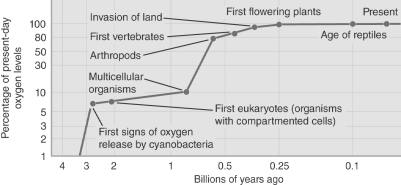
(Multiple Choice)
4.7/5 (84)
(84) How old is Earth? What was the age of Earth when each of the following occurred: microorganisms first formed; oxygen became a significant component of the atmosphere; and humans split from their genetic ancestors?
(Essay)
4.9/5 (86)
(86) What is the major difference between prokaryotes and eukaryotes?
(Multiple Choice)
4.9/5 (82)
(82) Planet Kepler 438-b orbits within its central star's habitable zone, at an average distance of 0.166 AU.Based on the figure below, what would be the temperature and spectral type of the central star? 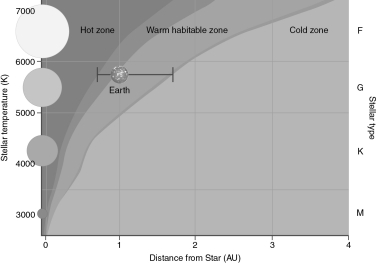
(Essay)
4.7/5 (75)
(75) It is hypothesized that both carbon and silicon could form the "backbone" of DNA.Using the figure below, which of the following scenarios might lead to a star system that has more silicon than carbon? 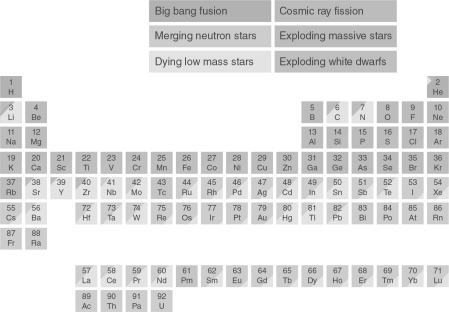
(Multiple Choice)
4.8/5 (86)
(86) Name at least three main dangers (one human and two astronomical) that could threaten the
continued existence of human life on Earth.
(Essay)
4.8/5 (89)
(89) Why do scientists consider it unlikely that microbes exist on the surface of Mars?
(Essay)
4.9/5 (80)
(80) 
Filters
- Essay(0)
- Multiple Choice(0)
- Short Answer(0)
- True False(0)
- Matching(0)