



 Chat with AI
Exam 4: Gravity and Orbits

Exam 1: Thinking Like an Astronomer 97 Questions
Exam 2: Patterns in the Skymotions of Earth and the Moon101 Questions
Exam 3: Motion of Astronomical Bodies99 Questions
Exam 4: Gravity and Orbits100 Questions
Exam 5: Light100 Questions
Exam 6: The Tools of the Astronomer100 Questions
Exam 7: The Formation of Planetary Systems100 Questions
Exam 8: The Terrestrial Planets and Earths Moon100 Questions
Exam 9: Atmospheres of the Terrestrial Planets100 Questions
Exam 10: Worlds of Gas and Liquidthe Giant Planets100 Questions
Exam 11: Planetary Moons and Rings100 Questions
Exam 12: Dwarf Planets and Small Solar System Bodies100 Questions
Exam 13: Taking the Measure of Stars101 Questions
Exam 14: Our Starthe Sun100 Questions
Exam 15: The Interstellar Medium and Star Formation100 Questions
Exam 16: Evolution of Low-Mass Stars100 Questions
Exam 17: Evolution of High-Mass Stars100 Questions
Exam 18: Relativity and Black Holes97 Questions
Exam 19: Galaxies100 Questions
Exam 20: The Milky Waya Normal Spiral Galaxy100 Questions
Exam 21: The Expanding Universe98 Questions
Exam 22: Cosmology100 Questions
Exam 23: Large-Scale Structure in the Universe103 Questions
Exam 24: Life100 Questions
Select questions type


If Earth did not have a moon, would we still have tides because of the Sun? If so, explain how they might be different, or why they might remain unchanged.
(Essay)
4.9/5  (85)
(85) Earth is held together in the shape of a sphere.This is due to
(Multiple Choice)
5.0/5 (88)
(88) Two rocks (call them S and T) are released at the same time from the same height and start from rest.Rock S has 20 times the mass of rock T.Which rock will fall faster if the only forces involved are each rock's mutual gravitational attraction with Earth?
(Multiple Choice)
4.9/5 (78)
(78) Suppose you are suddenly transported to a planet that had 1/4 the radius of Earth but the same mass as Earth.Your weight would ________ by a factor of ________.
(Multiple Choice)
4.9/5 (90)
(90) What is the escape velocity from Mars if its mass is 6 *1023 kg and its radius is 3,400 km?
(Multiple Choice)
4.9/5 (87)
(87) Why are there high and low tides each day instead of having the same tide all day during a given phase of the Moon?
(Essay)
4.9/5 (79)
(79) If you doubled the distance the Moon is from Earth, by what fraction does the strength of the tidal force change?
(Multiple Choice)
4.8/5 (78)
(78) According to the figure below, when the Moon is in between Earth and the Sun, ________ tides occur. 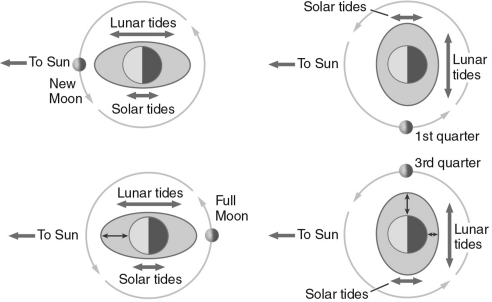
(Multiple Choice)
4.9/5 (92)
(92) Which of the following is true considering Newton's laws of motion and Newton's law of gravitation?
(Multiple Choice)
4.7/5 (73)
(73) Astronauts orbiting Earth in the space shuttle experience so-called weightlessness in space because
(Multiple Choice)
4.8/5 (77)
(77) Explain why the Moon rotates in the same amount of time as it takes to orbit once around Earth.
(Essay)
4.9/5 (72)
(72) If an object is in orbit with an orbital speed less than the escape speed but greater than the circular orbit speed, what type of orbit is it?
(Multiple Choice)
4.7/5 (76)
(76) Mars has about one-tenth the mass of Earth and half Earth's radius.By what numerical factor does the acceleration of gravity on Mars compare to that on Earth?
(Essay)
4.8/5 (73)
(73) What is the escape velocity from Ceres if its mass is 9 * 1020 kg and its radius is 470 km?
(Multiple Choice)
4.8/5 (73)
(73) When the Sun and Moon are separated by 90 degrees in the sky, ________ tides occur on Earth when the strength of the tides are ________ than normal.
(Multiple Choice)
4.8/5 (74)
(74) The definition of the term satellite in astronomy refers to
(Multiple Choice)
4.8/5 (74)
(74) The force of gravity between Saturn and the Sun is ________ the force of gravity between Earth and the Sun.For reference, Saturn is approximately 100 times more massive than Earth, and the semimajor axis of Saturn's orbit is 10 AU.
(Multiple Choice)
4.9/5 (70)
(70) 
Filters
- Essay(0)
- Multiple Choice(0)
- Short Answer(0)
- True False(0)
- Matching(0)