



 Chat with AI
Exam 4: Gravity and Orbits

Exam 1: Thinking Like an Astronomer 97 Questions
Exam 2: Patterns in the Skymotions of Earth and the Moon101 Questions
Exam 3: Motion of Astronomical Bodies99 Questions
Exam 4: Gravity and Orbits100 Questions
Exam 5: Light100 Questions
Exam 6: The Tools of the Astronomer100 Questions
Exam 7: The Formation of Planetary Systems100 Questions
Exam 8: The Terrestrial Planets and Earths Moon100 Questions
Exam 9: Atmospheres of the Terrestrial Planets100 Questions
Exam 10: Worlds of Gas and Liquidthe Giant Planets100 Questions
Exam 11: Planetary Moons and Rings100 Questions
Exam 12: Dwarf Planets and Small Solar System Bodies100 Questions
Exam 13: Taking the Measure of Stars101 Questions
Exam 14: Our Starthe Sun100 Questions
Exam 15: The Interstellar Medium and Star Formation100 Questions
Exam 16: Evolution of Low-Mass Stars100 Questions
Exam 17: Evolution of High-Mass Stars100 Questions
Exam 18: Relativity and Black Holes97 Questions
Exam 19: Galaxies100 Questions
Exam 20: The Milky Waya Normal Spiral Galaxy100 Questions
Exam 21: The Expanding Universe98 Questions
Exam 22: Cosmology100 Questions
Exam 23: Large-Scale Structure in the Universe103 Questions
Exam 24: Life100 Questions
Select questions type


How fast is the Moon moving as it orbits Earth? For reference, the Moon's orbit is approximately circular with a radius equal to 400,000 km, and the Moon's orbital period is 27 days.
(Multiple Choice)
4.9/5  (75)
(75) Newton's law of gravitation says that gravity is a mutually attractive force.Explain the following observation: A small object is dropped on Earth and we see it fall toward Earth.However, we do not observe Earth moving toward the object.
(Essay)
4.9/5 (77)
(77) How might tidal forces affect the ability of a planet to sustain life? Provide at least two examples and justify each.
(Essay)
5.0/5 (77)
(77) Earth's tidal bulge "leads" the Moon in its orbit.Does this have any effect on the Moon?
(Essay)
4.8/5 (67)
(67) According to the scales shown in the figure below, about how many times stronger is gravity on Earth than on the Moon? 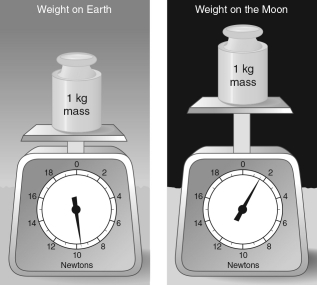
(Multiple Choice)
4.9/5 (69)
(69) Uniform circular motion applies to which of the following orbits?
(Multiple Choice)
4.8/5 (71)
(71) Mercury orbits the Sun with an average distance of 0.4 AU, and its mass is 0.06 times that of Earth.The gravitational force that the Sun exerts on Mercury is approximately ________ times the force of gravity that the Sun exerts on Earth.
(Multiple Choice)
4.9/5 (79)
(79) You discover a moon orbiting a planet.The moon has an orbital period of three weeks, and the average distance between the moon and planet is 1.2 *106 km.What is the planet's mass? Compare its mass to that of Jupiter, which is 1.9 * 1027 kg.
(Essay)
4.9/5 (76)
(76) The force of gravity that an object has is directly proportional to its
(Multiple Choice)
4.8/5 (83)
(83) If you weighed 150 lb on Earth, what would you weigh on Mars? For reference, Mars has a mass that is 0.1 times Earth's mass and Mars has a radius that is 0.5 times Earth's radius.
(Multiple Choice)
4.7/5 (89)
(89) Explain the difference between being weightless and being in free fall.
(Essay)
4.7/5 (84)
(84) If a person having mass, M, is standing on the ground and experiencing an acceleration due to gravity of g, what is the correct formula for the person's weight, F?
(Multiple Choice)
4.9/5 (75)
(75) Which of the following properties of an astronaut changes when he or she is standing on the Moon, relative to when the astronaut is standing on Earth?
(Multiple Choice)
4.8/5 (86)
(86) In the absence of air friction, a 0.001-kg piece of paper and a 0.1-kg notebook are dropped from the same height and allowed to fall to the ground.How do their accelerations compare?
(Multiple Choice)
4.9/5 (79)
(79) Consider the figure below, which illustrates the tidal bulge on Earth's oceans due to the Moon and four people at different longitudes on Earth from the point of view of an observer looking down on the North Pole of Earth.If you were to arrive at the beach and find that the Moon was visible in the western half of the sky, then is the tide most likely to be coming in and the water level rising; or is the tide going out and the water level going down? Explain the rationale for your answer. 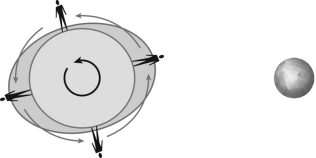
(Essay)
4.8/5 (83)
(83) According to the figure below, when Earth is in between the Moon and the Sun, ________ tides occur. 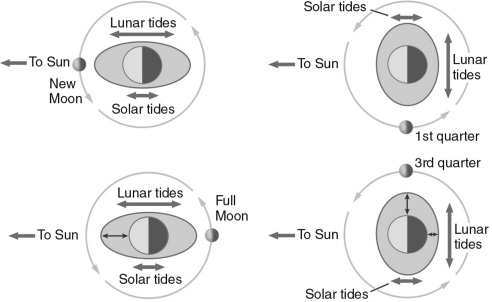
(Multiple Choice)
4.9/5 (86)
(86) Consider the figure below, which illustrates the tidal bulge on Earth's oceans due to the Moon and Sun from an observer looking down on the North Pole of Earth.At what phase of the Moon will the mildest tides of the month occur? Explain the rationale for your answer either in words or with a sketch. 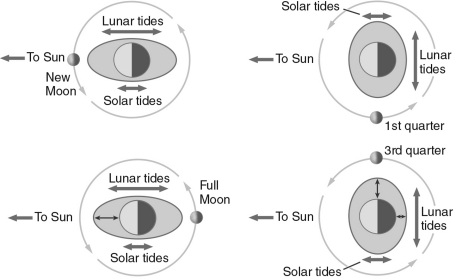
(Essay)
4.8/5 (81)
(81) Imagine a planet in a very eccentric elliptical orbit around a star.This planet has no moons, but it has oceans.This planet's orbit is not tidally locked.Are there tides? If so, explain how they would behave.
(Essay)
4.9/5 (91)
(91) 
Filters
- Essay(0)
- Multiple Choice(0)
- Short Answer(0)
- True False(0)
- Matching(0)