



 Chat with AI
Exam 4: Gravity and Orbits

Exam 1: Thinking Like an Astronomer 97 Questions
Exam 2: Patterns in the Skymotions of Earth and the Moon101 Questions
Exam 3: Motion of Astronomical Bodies99 Questions
Exam 4: Gravity and Orbits100 Questions
Exam 5: Light100 Questions
Exam 6: The Tools of the Astronomer100 Questions
Exam 7: The Formation of Planetary Systems100 Questions
Exam 8: The Terrestrial Planets and Earths Moon100 Questions
Exam 9: Atmospheres of the Terrestrial Planets100 Questions
Exam 10: Worlds of Gas and Liquidthe Giant Planets100 Questions
Exam 11: Planetary Moons and Rings100 Questions
Exam 12: Dwarf Planets and Small Solar System Bodies100 Questions
Exam 13: Taking the Measure of Stars101 Questions
Exam 14: Our Starthe Sun100 Questions
Exam 15: The Interstellar Medium and Star Formation100 Questions
Exam 16: Evolution of Low-Mass Stars100 Questions
Exam 17: Evolution of High-Mass Stars100 Questions
Exam 18: Relativity and Black Holes97 Questions
Exam 19: Galaxies100 Questions
Exam 20: The Milky Waya Normal Spiral Galaxy100 Questions
Exam 21: The Expanding Universe98 Questions
Exam 22: Cosmology100 Questions
Exam 23: Large-Scale Structure in the Universe103 Questions
Exam 24: Life100 Questions
Select questions type


The International Space Station orbits at an altitude of 400 km above Earth's surface.Assuming it is in a stable circular orbit, what is its velocity? For reference, Earth's radius is 6,400 km, and Earth's mass is 6 *1024 kg and G = 6.7 * 10?2-11 N m2/kg2.
(Essay)
4.8/5  (90)
(90) Suppose you are suddenly transported to a planet with 1/4 the mass of Earth but the same radius as Earth.Your weight would ________ by a factor of ________.
(Multiple Choice)
4.9/5 (93)
(93) Assume that a planet just like Earth orbits the bright star named Sirius.If this Earth-like planet orbits with a semimajor axis of 1 AU and an orbital period of 7 months, what is the mass of Sirius?
(Multiple Choice)
4.7/5 (79)
(79) How would the acceleration due to gravity on a planet that is 16 times as massive as Earth and 4 times its radius compare to the acceleration of gravity on Earth?
(Essay)
4.7/5 (80)
(80) Is there a difference in your weight when measured on top of a mountain 1,000 meters above sea level and when measured in a classroom 10 meters above sea level?
(Essay)
4.8/5 (82)
(82) The force of gravity between Earth and the Sun is approximately ________ the force of gravity between Earth and the Moon.For reference, the average distance between Earth and the Moon is 0.003 astronomical unit (AU), the mass of the Moon is 7 * 1022 kg, and the mass of the Sun is 2 * 1030 kg.
(Multiple Choice)
4.9/5 (78)
(78) According to the figure below, spring tides occur at which phases of the Moon? 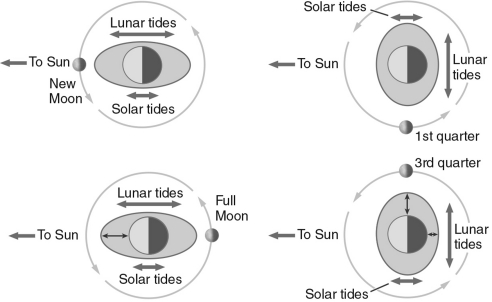
(Multiple Choice)
4.7/5 (66)
(66) If you found an exoplanet whose mass was the same as Jupiter's, but the planet orbited its star with a period of 2 years and a semimajor axis of 1 AU, what would be the mass of its star? For reference, Jupiter has a semimajor axis of 5.4 AU and an orbital period of 12 years.
(Multiple Choice)
4.8/5 (78)
(78) If the distance between Earth and the Sun were cut in half, the gravitational force between these two objects would
(Multiple Choice)
5.0/5 (73)
(73) You find a moon orbiting a planet.The moon has a period of 10 days, and the average distance between the moon and planet is 106 km.What is the planet's mass? Note that the mass of Jupiter is 1.9 * 1027 kg.
(Multiple Choice)
4.8/5 (77)
(77) How much stronger is the gravitational force of the Sun on Earth compared to the gravitational force of the Sun on Pluto? Note that Pluto's semimajor axis is 40 AU, and Pluto's mass is 0.002 times the mass of Earth.
(Essay)
4.9/5 (91)
(91) What two pieces of information would you need to obtain about one of the moons of the planet Jupiter in order to measure the mass of Jupiter? What formulae would you use to determine the mass?
(Essay)
4.9/5 (76)
(76) When two galaxies collide long streams of stars can be observed.These "tails" are caused by
(Multiple Choice)
4.8/5 (86)
(86) ________ may have been instrumental in shaping daily interactions between Earth's land and oceans, where the chemistry needed to develop life may have occurred.
(Multiple Choice)
4.8/5 (76)
(76) Show that the tidal force on Earth from the Moon is approximately two times the tidal force on Earth from the Sun.For reference, the Moon's mass is 7.3 *1022 kg, the Sun's mass is 2 * 1030 kg, the Earth-Moon distance is 3.8 * 105 km, and the Earth-Sun distance is 1.5*108 km.
(Essay)
4.7/5 (77)
(77) 
Filters
- Essay(0)
- Multiple Choice(0)
- Short Answer(0)
- True False(0)
- Matching(0)