



 Chat with AI
Exam 4: Gravity and Orbits

Exam 1: Thinking Like an Astronomer 97 Questions
Exam 2: Patterns in the Skymotions of Earth and the Moon101 Questions
Exam 3: Motion of Astronomical Bodies99 Questions
Exam 4: Gravity and Orbits100 Questions
Exam 5: Light100 Questions
Exam 6: The Tools of the Astronomer100 Questions
Exam 7: The Formation of Planetary Systems100 Questions
Exam 8: The Terrestrial Planets and Earths Moon100 Questions
Exam 9: Atmospheres of the Terrestrial Planets100 Questions
Exam 10: Worlds of Gas and Liquidthe Giant Planets100 Questions
Exam 11: Planetary Moons and Rings100 Questions
Exam 12: Dwarf Planets and Small Solar System Bodies100 Questions
Exam 13: Taking the Measure of Stars101 Questions
Exam 14: Our Starthe Sun100 Questions
Exam 15: The Interstellar Medium and Star Formation100 Questions
Exam 16: Evolution of Low-Mass Stars100 Questions
Exam 17: Evolution of High-Mass Stars100 Questions
Exam 18: Relativity and Black Holes97 Questions
Exam 19: Galaxies100 Questions
Exam 20: The Milky Waya Normal Spiral Galaxy100 Questions
Exam 21: The Expanding Universe98 Questions
Exam 22: Cosmology100 Questions
Exam 23: Large-Scale Structure in the Universe103 Questions
Exam 24: Life100 Questions
Select questions type


Explain why the gravitational force an object experiences from Earth can be considered to come from the center of Earth.
(Essay)
5.0/5  (83)
(83) According to the figure below, neap tides occur when the lunar and solar tides ________, resulting in ________ tides. 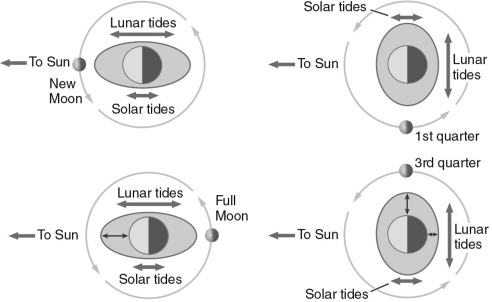
(Multiple Choice)
4.9/5 (74)
(74) According to the figure below, spring tides occur when the lunar and solar tides ________, resulting in ________ tides. 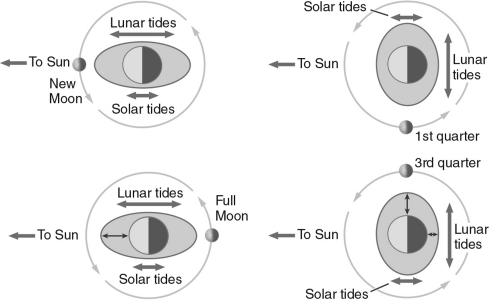
(Multiple Choice)
4.8/5 (82)
(82) When one object is tidally locked to the larger object it is orbiting, it
(Multiple Choice)
4.7/5 (82)
(82) Explain what the Roche limit is and how it is related to rings around giant planets.
(Essay)
4.8/5 (73)
(73) If you have two moons that have the same radius, but Moon A is denser and has 2 times the mass of Moon B, how do their escape velocities from their respective surfaces compare?
(Multiple Choice)
5.0/5 (77)
(77) Titan, the largest moon of Saturn, has an orbital period of 16 days and a semimajor axis of 1.2 *109 m.Based on this information, what is Saturn's mass? For reference, Earth's mass is
6 * 1024 kg.
(Multiple Choice)
4.7/5 (75)
(75) According to the figure below, the approximate amount of time between two high tides at a given location is about 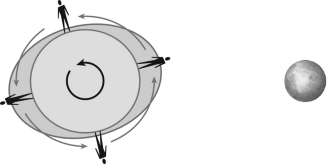
(Multiple Choice)
4.9/5 (78)
(78) Which of the statements below is true about the Roche limit of a giant planet?
(Multiple Choice)
4.9/5 (77)
(77) According to the figure below, the approximate amount of time between a high tide and a low tide at a given location is about 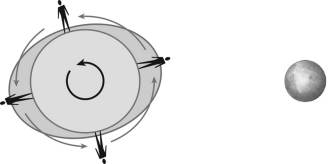
(Multiple Choice)
4.7/5 (88)
(88) Between any two objects with mass, the force of gravity is always
(Multiple Choice)
4.8/5 (85)
(85) Because of tidal forces, for every ________ time(s) it rotates on its axis, Mercury revolves around the Sun ________ time(s).
(Multiple Choice)
4.9/5 (82)
(82) For which of the following orbital velocities, V, is the orbit unbound?
(Multiple Choice)
4.7/5 (95)
(95) Two rocks (call them S and T) are a distance of 50 km from one another in empty space.Rock S has 20 times the mass of rock T.Considering only their mutual gravitational force, which rock will accelerate faster in response to gravity?
(Multiple Choice)
4.8/5 (65)
(65) Because of tidal forces, which type of eclipse will become impossible first?
(Multiple Choice)
4.9/5 (76)
(76) If we wanted to increase the Hubble Space Telescope's altitude above Earth and keep it in a stable orbit, we also would need to
(Multiple Choice)
4.8/5 (86)
(86) The Hubble Space Telescope orbits at an altitude of 600 km above Earth's surface.Assuming it is in a stable circular orbit, what is its velocity? For reference, Earth's radius is 6,400 km and Earth's mass is 6* 1024 kg.
(Multiple Choice)
4.9/5 (76)
(76) The distance between Earth and the Moon is increasing because of
(Multiple Choice)
4.8/5 (76)
(76) 
Filters
- Essay(0)
- Multiple Choice(0)
- Short Answer(0)
- True False(0)
- Matching(0)