



 Chat with AI
Exam 7: Releasing Chemical Energy

Exam 1: The Science of Biology68 Questions
Exam 2: Lifes Chemical Basis79 Questions
Exam 3: Molecules of Life56 Questions
Exam 4: Cell Structure64 Questions
Exam 5: Ground Rules of Metabolism58 Questions
Exam 6: Where It Starts-Photosynthesis87 Questions
Exam 7: Releasing Chemical Energy80 Questions
Exam 8: DNA Structure and Function75 Questions
Exam 9: From DNA to Protein65 Questions
Exam 10: Control of Gene Expression61 Questions
Exam 11: How Cells Reproduce75 Questions
Exam 12: Meiosis and Sexual Reproduction68 Questions
Exam 13: Patterns in Inherited Traits54 Questions
Exam 14: Human Inheritance41 Questions
Exam 15: Biotechnology71 Questions
Exam 16: Evidence of Evolution69 Questions
Exam 17: Processes of Evolution83 Questions
Exam 18: Lifes Origin and Early Evolution49 Questions
Exam 19: Viruses, Bacteria, and Archaea42 Questions
Exam 20: The Protists56 Questions
Exam 21: Plant Evolution55 Questions
Exam 22: Fungi50 Questions
Exam 23: Animals I: Major Invertebrate Groups72 Questions
Exam 24: Animals Ii: the Chordates76 Questions
Exam 25: Plant Tissues67 Questions
Exam 26: Plant Nutrition and Transport67 Questions
Exam 27: Plant Reproduction and Development71 Questions
Exam 28: Animal Tissues and Organ Systems78 Questions
Exam 29: Neural Control80 Questions
Exam 30: Sensory Perception62 Questions
Exam 31: Endocrine Control65 Questions
Exam 32: Structural Support and Movement52 Questions
Exam 33: Circulation66 Questions
Exam 34: Immunity57 Questions
Exam 35: Respiration63 Questions
Exam 36: Digestion and Human Nutrition57 Questions
Exam 37: Maintaining the Internal Environment63 Questions
Exam 38: Reproduction and Development88 Questions
Exam 39: Animal Behavior73 Questions
Exam 40: Population Ecology55 Questions
Exam 41: Community Ecology73 Questions
Exam 42: Ecosystems52 Questions
Exam 43: The Biosphere74 Questions
Exam 44: Human Effects on the Biosphere73 Questions
Select questions type


Which product(s) are generated during glycolysis and the citric acid cycle that is/are needed for electron transfer phosphorylation?
(Essay)
4.8/5  (75)
(75) The final steps of both alcoholic and lactate fermentation regenerate ____.
(Multiple Choice)
4.8/5 (76)
(76) Match the cellular respiration process with the correct description. Some choices may be used more than once.
-starts and ends in the cytoplasm
(Multiple Choice)
4.8/5 (69)
(69) During which phase(s) of aerobic respiration is ATP produced directly by substrate-level phosphorylation?
(Multiple Choice)
4.8/5 (86)
(86) Match the cellular respiration process with the correct description. Some choices may be used more than once.
-starts in the cytoplasm and ends in the mitochondrion
(Multiple Choice)
4.9/5 (76)
(76) Match the cellular respiration process to the correct description. Some answers may be used more than once.
-anaerobic respiration
(Multiple Choice)
4.8/5 (79)
(79) How are mitochondria passed on from parents to offspring? Describe the process of mitochondrial donation, which is used to prevent children from inheriting mitochondrial disorders.
(Essay)
4.9/5 (88)
(88) During alcoholic fermentation, electrons and hydrogen ions are transferred from NADH to acetaldehyde, forming ____.
(Multiple Choice)
4.7/5 (65)
(65) 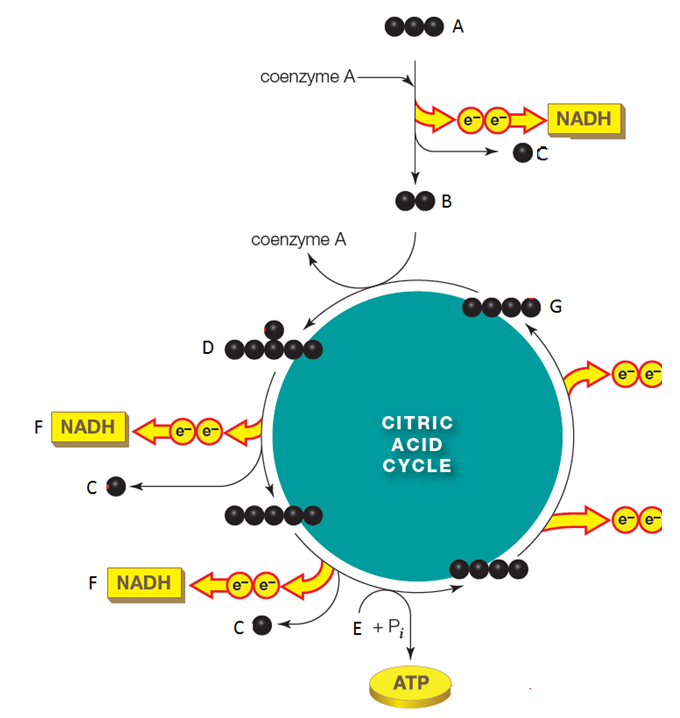 Match the process/substance in the citric acid cycle with the correct description.
-citrate is formed by the addition of two carbon atoms to oxaloacetate
Match the process/substance in the citric acid cycle with the correct description.
-citrate is formed by the addition of two carbon atoms to oxaloacetate (Multiple Choice)
4.7/5 (86)
(86) Of the six carbons in a molecule of glucose, how many are converted to CO2 during aerobic respiration?
(Multiple Choice)
4.9/5 (96)
(96) During aerobic respiration, ____ is/are formed and detoxified by antioxidant molecules in the cell's cytoplasm.
(Multiple Choice)
4.9/5 (84)
(84) Match the cellular respiration process to the correct description. Some answers may be used more than once.
-uses pyruvate as a substrate
(Multiple Choice)
4.9/5 (73)
(73) When protein molecules are used as energy sources, the amino groups of the amino acids are ____ and the carbon backbones enter ____.
(Multiple Choice)
4.9/5 (83)
(83)
Match the process/substance in the citric acid cycle with the correct description.
-pyruvate, produced by glycolysis
Match the process/substance in the citric acid cycle with the correct description.
-pyruvate, produced by glycolysis (Multiple Choice)
4.9/5 (90)
(90) During aerobic respiration, glucose becomes ____ and coenzymes become ____.
(Multiple Choice)
4.9/5 (87)
(87) When blood glucose levels decrease (for example, between meals), which energy reserves are tapped first?
(Multiple Choice)
4.9/5 (81)
(81) 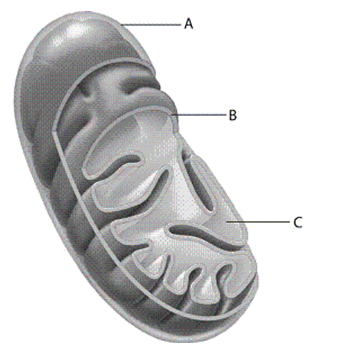 -In the accompanying figure, which letter(s) corresponds to the location where the citric acid cycle takes place?
 (Multiple Choice)
5.0/5 (80)
(80) Match the cellular respiration process to the correct description. Some answers may be used more than once.
-aerobic respiration
(Multiple Choice)
4.9/5 (72)
(72) 
Filters
- Essay(0)
- Multiple Choice(0)
- Short Answer(0)
- True False(0)
- Matching(0)