



 Chat with AI
Exam 16: Evidence of Evolution

Exam 1: The Science of Biology68 Questions
Exam 2: Lifes Chemical Basis79 Questions
Exam 3: Molecules of Life56 Questions
Exam 4: Cell Structure64 Questions
Exam 5: Ground Rules of Metabolism58 Questions
Exam 6: Where It Starts-Photosynthesis87 Questions
Exam 7: Releasing Chemical Energy80 Questions
Exam 8: DNA Structure and Function75 Questions
Exam 9: From DNA to Protein65 Questions
Exam 10: Control of Gene Expression61 Questions
Exam 11: How Cells Reproduce75 Questions
Exam 12: Meiosis and Sexual Reproduction68 Questions
Exam 13: Patterns in Inherited Traits54 Questions
Exam 14: Human Inheritance41 Questions
Exam 15: Biotechnology71 Questions
Exam 16: Evidence of Evolution69 Questions
Exam 17: Processes of Evolution83 Questions
Exam 18: Lifes Origin and Early Evolution49 Questions
Exam 19: Viruses, Bacteria, and Archaea42 Questions
Exam 20: The Protists56 Questions
Exam 21: Plant Evolution55 Questions
Exam 22: Fungi50 Questions
Exam 23: Animals I: Major Invertebrate Groups72 Questions
Exam 24: Animals Ii: the Chordates76 Questions
Exam 25: Plant Tissues67 Questions
Exam 26: Plant Nutrition and Transport67 Questions
Exam 27: Plant Reproduction and Development71 Questions
Exam 28: Animal Tissues and Organ Systems78 Questions
Exam 29: Neural Control80 Questions
Exam 30: Sensory Perception62 Questions
Exam 31: Endocrine Control65 Questions
Exam 32: Structural Support and Movement52 Questions
Exam 33: Circulation66 Questions
Exam 34: Immunity57 Questions
Exam 35: Respiration63 Questions
Exam 36: Digestion and Human Nutrition57 Questions
Exam 37: Maintaining the Internal Environment63 Questions
Exam 38: Reproduction and Development88 Questions
Exam 39: Animal Behavior73 Questions
Exam 40: Population Ecology55 Questions
Exam 41: Community Ecology73 Questions
Exam 42: Ecosystems52 Questions
Exam 43: The Biosphere74 Questions
Exam 44: Human Effects on the Biosphere73 Questions
Select questions type


Which organism is most likely to be preserved as a fossil?

Free
(Multiple Choice)
4.9/5  (71)
(71) Correct Answer: Verified
B
While related species do share similar genomes, it is the diversity in genes that makes them phenotypically different. How do most genes change and lead to species diversity?
Free
(Multiple Choice)
4.8/5 (91)
(91) Correct Answer:Verified
VerifiedD
The age of fossils can be determined by radiometric dating. Match the following terms with the best descriptions. Note that all options may not be used.
-A decaying carbon isotope becomes this form of carbon.
Free
(Multiple Choice)
4.8/5 (71)
(71) Correct Answer:Verified
VerifiedA
The age of fossils can be determined by radiometric dating. Match the following terms with the best descriptions. Note that all options may not be used.
-This is the time it takes for half of a quantity of any radioisotope to decay.
(Multiple Choice)
4.8/5 (69)
(69) Suppose that a dinosaur's footprints were preserved, but that its body was not fossilized upon its death. Evidence of the existence of this organism is provided by which type of fossil?
(Multiple Choice)
4.8/5 (83)
(83) Through ____, a body part of an ancestor is modified differently in different lines of descent.
(Multiple Choice)
4.8/5 (81)
(81) When nineteenth century scientists compared desert plants, differences in their ____ indicated that these plants could not be as closely related as might otherwise be thought.
(Multiple Choice)
4.7/5 (66)
(66) Most scientists believe that the dinosaurs went extinct due to ____.
(Multiple Choice)
5.0/5 (88)
(88) Certain species have weaker fossil records because they ____.
(Multiple Choice)
4.8/5 (79)
(79) Individuals that are better suited to their environment are likely to have more offspring and pass their genetic material onto future generations. This is referred to as ____.
(Multiple Choice)
4.9/5 (86)
(86) The wings of a bird and the wings of a butterfly are ____ and show morphological ____.
(Multiple Choice)
4.8/5 (70)
(70) Match the statements with one of the geologic times listed below.
-mammals first appear
(Multiple Choice)
4.9/5 (78)
(78) Match the description with the correct term.
-ruptures in Earth's crust where plates meet
(Multiple Choice)
4.9/5 (92)
(92) Match the description with the correct term.
-theory that Earth's outer layer of rock is cracked into plates that slowly move over time
(Multiple Choice)
4.8/5 (80)
(80) 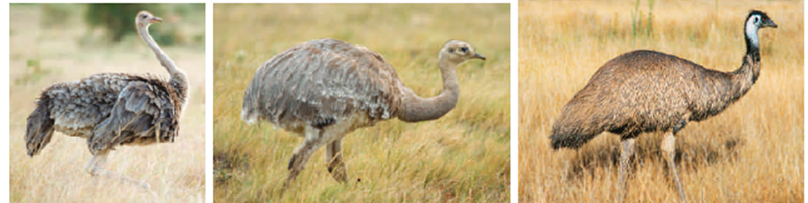 -Similarities between flightless birds such as the emu, rhea, and ostrich provide ____ support for evolution.?
 (Multiple Choice)
4.7/5 (64)
(64) Locations where molten rock ruptures a tectonic plate are called ____.
(Multiple Choice)
4.9/5 (79)
(79) 
Filters
- Essay(0)
- Multiple Choice(0)
- Short Answer(0)
- True False(0)
- Matching(0)