



 Chat with AI
Exam 12: Meiosis and Sexual Reproduction

Exam 1: The Science of Biology68 Questions
Exam 2: Lifes Chemical Basis79 Questions
Exam 3: Molecules of Life56 Questions
Exam 4: Cell Structure64 Questions
Exam 5: Ground Rules of Metabolism58 Questions
Exam 6: Where It Starts-Photosynthesis87 Questions
Exam 7: Releasing Chemical Energy80 Questions
Exam 8: DNA Structure and Function75 Questions
Exam 9: From DNA to Protein65 Questions
Exam 10: Control of Gene Expression61 Questions
Exam 11: How Cells Reproduce75 Questions
Exam 12: Meiosis and Sexual Reproduction68 Questions
Exam 13: Patterns in Inherited Traits54 Questions
Exam 14: Human Inheritance41 Questions
Exam 15: Biotechnology71 Questions
Exam 16: Evidence of Evolution69 Questions
Exam 17: Processes of Evolution83 Questions
Exam 18: Lifes Origin and Early Evolution49 Questions
Exam 19: Viruses, Bacteria, and Archaea42 Questions
Exam 20: The Protists56 Questions
Exam 21: Plant Evolution55 Questions
Exam 22: Fungi50 Questions
Exam 23: Animals I: Major Invertebrate Groups72 Questions
Exam 24: Animals Ii: the Chordates76 Questions
Exam 25: Plant Tissues67 Questions
Exam 26: Plant Nutrition and Transport67 Questions
Exam 27: Plant Reproduction and Development71 Questions
Exam 28: Animal Tissues and Organ Systems78 Questions
Exam 29: Neural Control80 Questions
Exam 30: Sensory Perception62 Questions
Exam 31: Endocrine Control65 Questions
Exam 32: Structural Support and Movement52 Questions
Exam 33: Circulation66 Questions
Exam 34: Immunity57 Questions
Exam 35: Respiration63 Questions
Exam 36: Digestion and Human Nutrition57 Questions
Exam 37: Maintaining the Internal Environment63 Questions
Exam 38: Reproduction and Development88 Questions
Exam 39: Animal Behavior73 Questions
Exam 40: Population Ecology55 Questions
Exam 41: Community Ecology73 Questions
Exam 42: Ecosystems52 Questions
Exam 43: The Biosphere74 Questions
Exam 44: Human Effects on the Biosphere73 Questions
Select questions type


Each of the cells formed after meiosis I are ____.

Free
(Multiple Choice)
4.8/5  (75)
(75) Correct Answer: Verified
E
Asexual reproduction is/was evolutionarily advantageous ____.
Free
(Multiple Choice)
4.8/5 (82)
(82) Correct Answer:Verified
VerifiedC
Which statement correctly describes chromosome segregation during meiosis?
Free
(Multiple Choice)
4.8/5 (85)
(85) Correct Answer:Verified
VerifiedC
If a diploid organism has a genome consisting of 4 chromosomes, it can produce ____ different combinations of chromosomes through meiosis (disregarding crossing over).
(Multiple Choice)
4.9/5 (93)
(93) Genes for specific traits (e.g., hair color) are located at specific spots on a chromosome. Is it possible for a maternal allele for blonde hair to be switched to the paternal chromosome of the homologous pair during meiosis?
(Essay)
4.8/5 (72)
(72) If a parent cell of a certain organism has 16 chromosomes and undergoes meiosis, the resulting cells will have ____ chromosomes.
(Multiple Choice)
4.9/5 (87)
(87) Match the following stages with the corresponding chromosome number in human cells.
-gamete
(Multiple Choice)
4.9/5 (79)
(79) 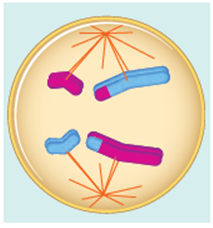 -The cell in the diagram below is in anaphase I, not anaphase II. How do we know this?
 (Essay)
4.8/5 (80)
(80) 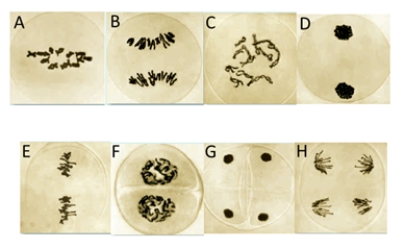 Use the accompanying figure to match the cells in the figure to the correct phase in meiosis. The top figure panel is phases of meiosis I; the bottom panel is phases of meiosis II.
-anaphase II?
Use the accompanying figure to match the cells in the figure to the correct phase in meiosis. The top figure panel is phases of meiosis I; the bottom panel is phases of meiosis II.
-anaphase II? (Multiple Choice)
4.7/5 (79)
(79) Which situation is most probable at a metaphase I alignment?
(Multiple Choice)
4.8/5 (86)
(86)
Use the accompanying figure to match the cells in the figure to the correct phase in meiosis. The top figure panel is phases of meiosis I; the bottom panel is phases of meiosis II.
-metaphase II?
Use the accompanying figure to match the cells in the figure to the correct phase in meiosis. The top figure panel is phases of meiosis I; the bottom panel is phases of meiosis II.
-metaphase II? (Multiple Choice)
4.7/5 (68)
(68) What is one of the very important differences between mitosis and meiosis?
(Multiple Choice)
4.8/5 (83)
(83) Explain the relationship between germ cells and gametes for both plants and animals.
(Essay)
4.9/5 (74)
(74) Match each term with the correct description.
-metaphase II
(Multiple Choice)
4.8/5 (81)
(81) 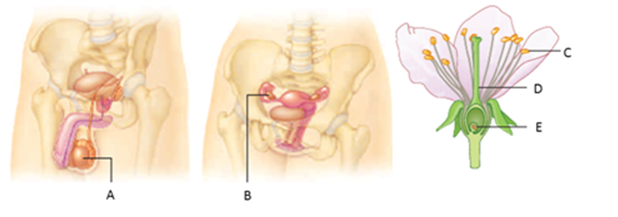 -Identify the locations in the accompanying figure where sperm are produced.
 (Multiple Choice)
4.8/5 (82)
(82) The main evolutionary advantage of sexual over asexual reproduction is that sexual reproduction produces _____.
(Multiple Choice)
4.8/5 (80)
(80) 
Filters
- Essay(0)
- Multiple Choice(0)
- Short Answer(0)
- True False(0)
- Matching(0)